Lungfish are easy to recruit into the wrong story. Because living lungfish breathe air and genomic work places them as the closest living relatives of tetrapods, they can start to look like a living rehearsal for land vertebrates.[2] That is too neat. A modern lungfish is not a stranded ancestor waiting to become an amphibian. A Devonian lungfish was not a failed walker. The group is more useful when it is read as a sister lineage that kept solving fish problems while preserving clues to the body plan from which tetrapods eventually emerged.
The best starting point is not the lung itself. It is the mouth. Early lungfish history is full of tooth plates, palatal bites, short jaws, and hard-prey processing. A 2022 Nature Communications study argues that lungfish were among the earliest and longest-ranging vertebrate lineages to specialize in durophagy, the processing of hard food, and that major feeding innovations may have assembled rapidly near the start of the lineage.[3] In other words, the lungfish contribution to deep-time history begins less like a heroic crawl onto land and more like a skull being rebuilt for crushing.
The closest living relative is not an ancestor
The phrase "closest living relative" does important work, but it has a trap inside it. Nature's 2021 Australian lungfish genome paper confirmed lungfish as the closest living relatives of land vertebrates, but that is a statement about branching relationships among surviving lineages.[2] It does not mean today's African, South American, or Australian lungfish are direct models of the first tetrapod. They have their own hundreds of millions of years of history.
That distinction keeps the fossil record honest. Lungfish and tetrapods share ancestry deep in the sarcopterygian, or lobe-finned, part of vertebrate history. After that split, the lungfish branch did not pause. It diversified, changed habitats, simplified some structures, preserved others, and carried forward a set of traits that are useful for comparison precisely because they are close to, but not identical with, the tetrapod line.[2][6]
The Australian lungfish genome is especially helpful because it connects living biology to deep history without turning the animal into a time capsule. The study found genetic signatures relevant to air breathing and lobed fins, including lung surfactant genes and limb-like expression patterns in developmental genes.[2] Those details are powerful because they show that pieces of the later land-vertebrate toolkit were present in aquatic sarcopterygians. But they are not a license to make lungfish walk on behalf of tetrapods.
The mouth changed before the myth did
Early lungfish were not defined only by lungs or fins. They were also defined by a peculiar feeding machine. Cui, Friedman, Qiao, Yu, and Zhu's study of early lungfish durophagy places forms such as Youngolepis and Diabolepis near a rapid reorganization of the lungfish skull and bite.[3] The important pieces include palatal biting surfaces, non-shedding tooth plates arranged in radial rows, short jaws, and a mandibular symphysis built for force transmission.[3]
That is an ecological claim as much as an anatomical one. A fish that can crush hard prey has access to a different menu from a fish built mainly for piercing or suction. The study argues that this feeding apparatus opened major opportunities during the early radiation of sarcopterygians, with key changes in jaws and teeth concentrated in a short evolutionary interval.[3] If the water-to-land story starts with limb ingredients, the lungfish story reminds us that the head may be moving just as fast as the appendages.
This is why tooth plates matter so much. They are not just dental curiosities. In lungfish, tooth plates are durable surfaces that can grow, wear, and preserve a record of use. Anne Kemp's review of lungfish fossil and living populations emphasizes that tooth plates grow through microscopic remodeling and added dental tissues while preserving functional surfaces that can record grinding, crushing, pathology, and environmental stress.[5] In many fossil lungfish, especially later forms, isolated tooth plates are often the most common evidence left behind. The mouth becomes the archive.
Dipterus keeps the body aquatic
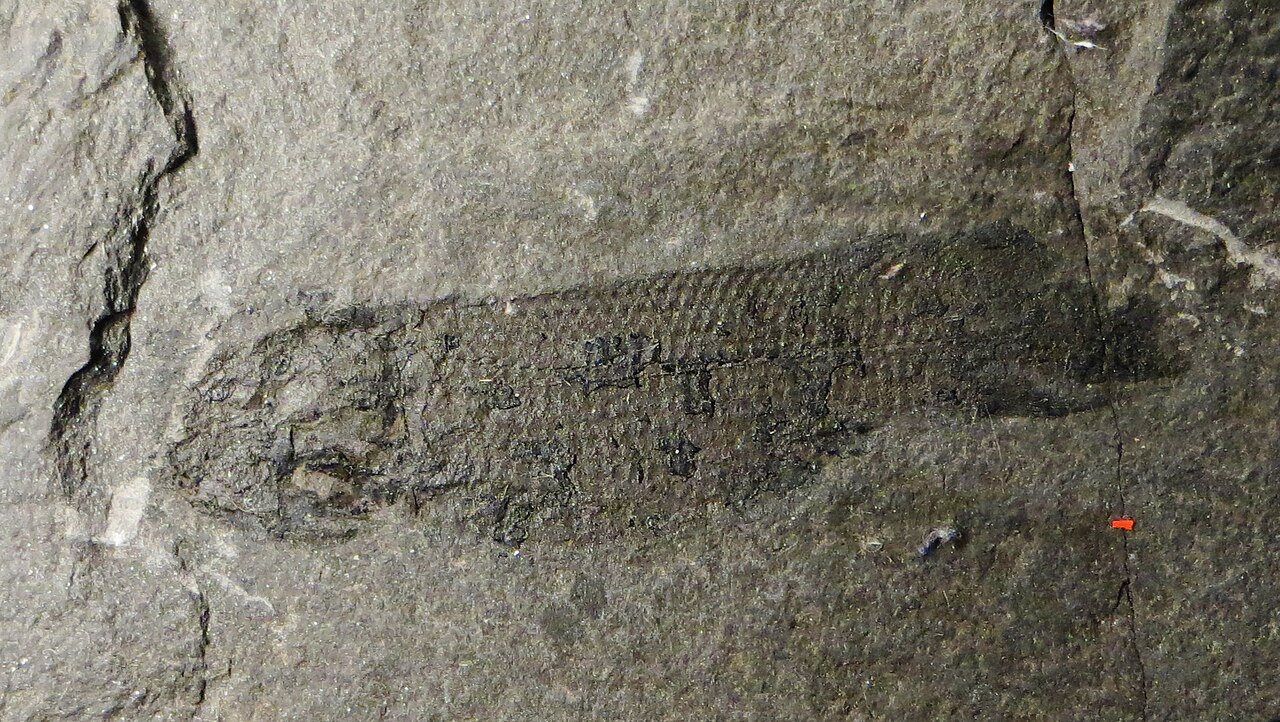
The photographed fossil in this post shows Dipterus valenciennesi, a Devonian lungfish from the Old Red Sandstone world of Scotland. The Landscapes of Orkney account of Dipterus emphasizes how common the fish is in Devonian Orkney rocks, how often articulated specimens preserve the fins and cranial shield, and how tooth plates and the unusual lower jaw made the animal scientifically attractive early on.[4] That point matters because Dipterus is not a bridge animal in a postcard sense. It is a lungfish with its own body, its own feeding apparatus, and its own aquatic commitments.
The slab photograph makes that restraint visible. The body is long and fish-shaped. The fossil does not ask to be posed on mud, propped on elbows, or given a narrative of escape. It asks to be read as a preserved aquatic animal whose skull and dental system help explain why lungfish became a successful Devonian lineage.
That is a better evolutionary object than a mascot. A mascot has one job: point toward us. A fossil animal has several. Dipterus can help illuminate lungfish feeding, Old Red Sandstone lake and river systems, Devonian sarcopterygian diversity, and the difference between a lineage close to tetrapods and the lineage that actually became tetrapods.[4][6] It belongs near the land-vertebrate origin story, but it should not be forced to perform the whole transition.
Lungs were a water solution first
Air breathing also becomes clearer when kept in water. Lungfish lungs are not theatrical props for a single move onto land. Adult lungfish are air breathers, and the Australian lungfish genome paper notes expansions in pulmonary surfactant genes and lung-development expression patterns that illuminate the respiratory side of sarcopterygian evolution.[2] Those findings matter because they show that air-breathing biology was already meaningful before a true terrestrial vertebrate life had stabilized.
In seasonal or low-oxygen waters, air breathing can be an aquatic survival tool. It lets an animal persist where dissolved oxygen falls, where pools shrink, or where environmental stress comes and goes. Later tetrapods would inherit and transform parts of this respiratory architecture, but the first utility did not have to be land conquest. It could be staying alive in water that was no longer easy to breathe.
This reframing also protects the living lungfish from a misleading burden. African and South American lungfish can survive difficult seasonal conditions in ways that fascinate biologists, while the Australian lungfish preserves a more robust fin-and-scale body form.[2][5] These are living specializations, not museum labels. Their value is comparative: they help researchers ask which features are ancient, which are later simplifications, and which evolved independently in lineages that kept adapting after the Devonian.
The afterlife was freshwater, not frozen
Lungfish did not vanish after the classic Devonian scenes. A phylogenetic study of post-Devonian lungfishes argues that the group experienced two broad diversification phases: a Devonian marine phase and a later freshwater phase, with important shifts in body size and classification across the post-Devonian record.[6] That matters because the common "living fossil" label can make lungfish sound motionless. The record says otherwise.
Kemp's review is useful here because it treats later Australian fossil lungfish not as decorative survivors but as populations with tooth wear, disease, size structure, and environmental signals.[5] In some deposits, tooth plates suggest harsh food, crowding, acidic water, poor recruitment, or long-lived adults under ecological stress.[5] That is not evolutionary stasis. It is a long freshwater history recorded through mouths.
The irony is that the most famous lungfish trait, air breathing, can make the group seem simple, while the fossil record makes it complicated again. Some lineages persisted. Some grew large. Some were mostly known from dental remains. Some environments preserved enough material to talk about population health rather than merely presence. The group becomes less like a relic and more like a set of experiments in how lobe-finned fishes can remain fishes for a very long time.
What lungfish clarify
Lungfish clarify the water-to-land transition by refusing to be the transition. They show that a close living relative is not a direct ancestor. They show that air-breathing machinery can be useful in aquatic settings before land becomes the main stage. They show that skull and tooth innovation can be as important as fins when a lineage diversifies. They show that a fossil record dominated by tooth plates is not a poor record if the question is diet, wear, growth, and ecology.
Most of all, they make the story less theatrical and more evolutionary. The move from water to land was not a single animal crawling out because its lungs and fins were ready. It was a long reassembly of bodies, habitats, developmental programs, respiratory systems, feeding systems, and ecological opportunities. Lungfish sit beside that story, close enough to illuminate it and separate enough to correct it.
Read that way, a photographed Dipterus slab is not a primitive sketch of a future amphibian. It is a lungfish: an aquatic Devonian vertebrate with a hard-working mouth, a lobe-finned body, and a branch of history that kept breathing long after the land story moved elsewhere.
Sources
- Ghedoghedo, "Dipterus valenciennesi Naturalis.JPG," Wikimedia Commons file page for the fossil photograph used in this article.
- Axel Meyer, Siegfried Schloissnig, Paolo Franchini, et al., "Giant lungfish genome elucidates the conquest of land by vertebrates," Nature 590 (2021), open-access article.
- Xindong Cui, Matt Friedman, Tuo Qiao, Yilun Yu, and Min Zhu, "The rapid evolution of lungfish durophagy," Nature Communications 13 (2022), open-access article.
- Landscapes of Orkney, "Dipterus valenciennesi," field-and-specimen page on Devonian Orkney lungfish fossils.
- Anne Kemp, "Lungfish and the Long Defeat," Diversity 15, no. 1 (2023), open-access review mirrored at PubMed Central.
- Lionel Cavin, Anne Kemp, Samuel Guinot, and Jürgen Kriwet, "Evolutionary history of lungfishes with a new phylogeny of post-Devonian genera," Griffith Research Repository record for Palaeogeography, Palaeoclimatology, Palaeoecology 471 (2017).