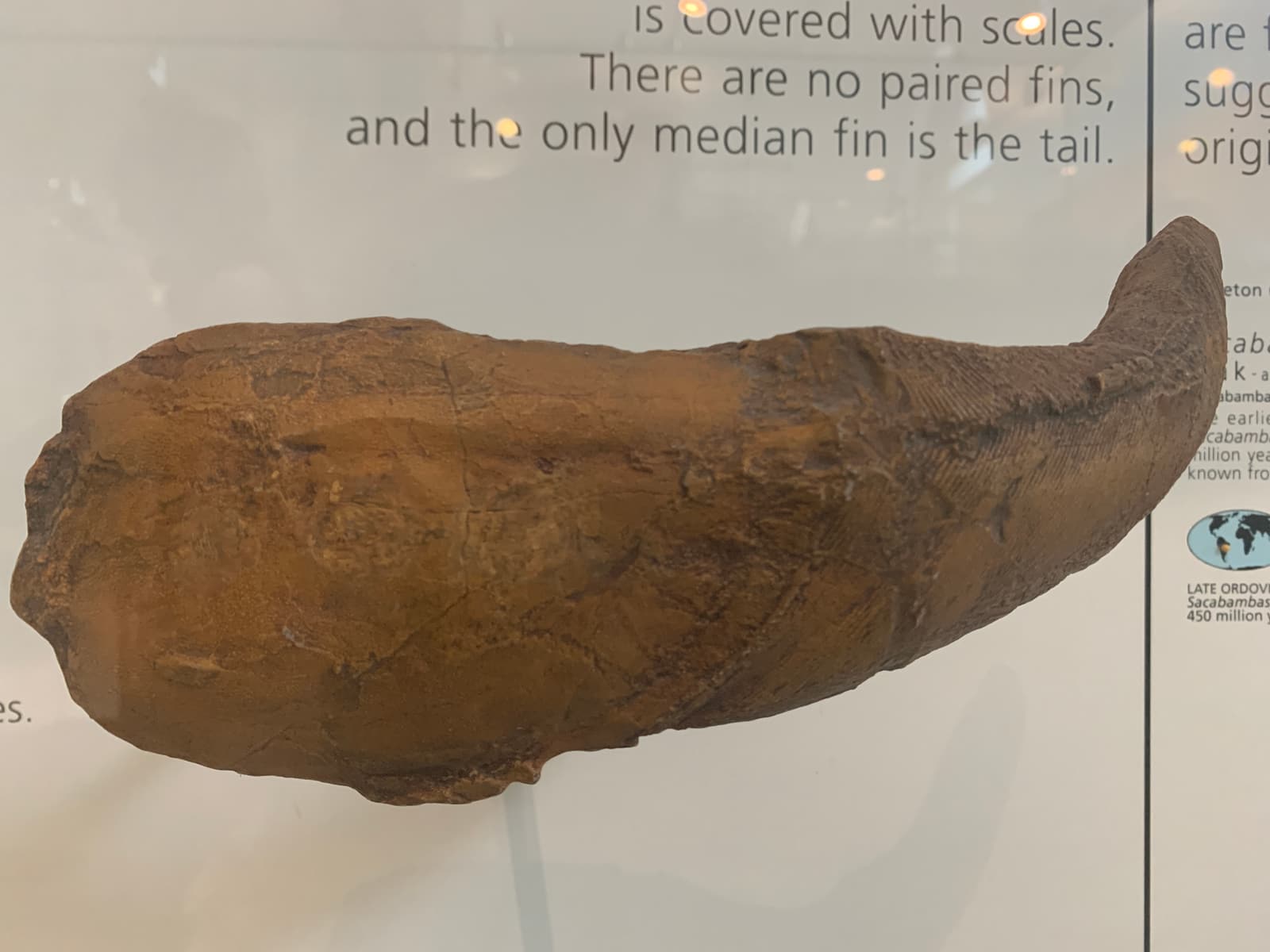
Sacabambaspis janvieri became famous in a way no Ordovician jawless fish can plan for. A model with a blunt little face escaped museum context and turned into an internet mascot. The joke is harmless enough, but it hides the better fossil. Sacabambaspis is not interesting because it looks endearing from the front. It is interesting because a small armored vertebrate from Bolivia preserves several early vertebrate problems in one body: a broad head shield scored by sensory grooves, a dermal skeleton made from mineralized tissues, a tail whose shape had to be re-prepared and reinterpreted, and a nearshore death setting that may explain why so many articulated examples entered the rock record at all.[1][2][3][4]
That makes the fossil a useful close-reading exercise. The safest way to treat Sacabambaspis is not as a first-fish trophy or as a meme with citations attached. It is better read as an Ordovician evidence package. The animal belonged to the arandaspid grade of armored jawless vertebrates, and the original 1986 description placed it in the Anzaldo Formation of central Bolivia, then emphasized how unusual its broad sensory-line grooves were on the exoskeleton.[1] Later work sharpened different parts of that package: the armor tissue, the tail, the habitat, and the broader Gondwanan range.[2][3][4][5]
The cover image follows that same rule. It is not a fantasy reconstruction but a photographic record of an American Museum of Natural History cast, mirrored as a Wikimedia Commons file used for the local article asset.[6]
The head shield is not just a face
The public image of Sacabambaspis tends to start at the front, because the head looks almost comically plain when reconstructed. The fossil argument starts there too, but for a different reason. The broad head shield is a piece of biological infrastructure, not a facial expression. It protected the front of a jawless body and carried sensory-line grooves across the exoskeleton.[1] Those grooves matter because they put the animal in water as a sensing vertebrate, reading flow and disturbance through a surface system rather than relying on jaws, paired fins, or the later equipment of more familiar fishes.
Gagnier, Blieck, and Rodrigo described Sacabambaspis as the first Ordovician vertebrate from South America, from Upper Ordovician rocks in central Bolivia, and treated it as a new jawless vertebrate taxon with resemblance to Astraspis and Arandaspis but with its own diagnostic surface pattern.[1] That combination is the key. The fossil is early, but not vague. It belongs to a small comparative set of armored jawless vertebrates in which plate shape, surface ornament, sensory grooves, and tissue structure are the evidence.
The phrase "jawless fish" can mislead if it makes the animal sound like a defective version of a modern fish. Sacabambaspis lived before the jawed vertebrate body plan had become the default lens for vertebrate success. Its body worked with a different bargain: armor at the front, sensory surfaces in the shield, a scaled body behind, and a tail for propulsion. The absence of jaws is not the main story. The presence of mineralized head armor is.
The armor is tissue, not costume
The 2005 histological study by Sansom, Donoghue, and Albanesi is useful because it moves the argument from outline to material. They described arandaspids as among the earliest skeletonizing vertebrates known from articulated remains and examined the dermoskeleton in detail.[3] Their key result was that the armor had a three-layer construction: a basal laminated layer, a cancellous middle layer, and a superficial layer with tubercles involving dentine and enameloid.[3]
That is the point at which the funny head shield stops being a visual gag. It is a mineralized vertebrate tissue system. The surface ornament is not decoration pasted onto a fish-shaped body; it is part of the dermal skeleton, and it helps place arandaspids inside the early history of armored vertebrates.[3] The animal's scientific value lies partly in that tissue stack. In a fossil record where early vertebrate remains can be fragmentary scales, plates, or microremains, an articulated animal with readable armor lets paleontologists connect surface, tissue, and whole-body anatomy.
There is a boundary here too. Histology does not make Sacabambaspis a direct ancestor of jawed fishes. It does something narrower and more durable. It shows that early vertebrate skeletonization was already using a sophisticated dermal toolkit in a jawless animal. The later vertebrate story would move through teeth, jaws, paired appendages, and internal skeletons in many separate steps. Sacabambaspis catches one earlier step where the outside of the body carried much of the evolutionary signal.
The tail made the animal move differently from the mascot
If the head shield made Sacabambaspis famous, the tail makes it harder to caricature. Pradel and colleagues redescribed the tail in 2007 after further preparation of the best-preserved specimen for that region of the body.[2] Their analysis confirmed a long notochordal lobe with a small terminal web and argued that the tail was best interpreted as hypocercal, with the notochordal lobe bending downward rather than forming a perfectly symmetrical fork.[2]
That sounds technical, but it changes the animal's silhouette in an important way. A tail is a propulsion argument. It tells us how the animal may have moved water, not just how it looked in a display case. The 2007 paper is careful because the evidence came from a specimen in which the tail was unusually extensive but still required preparation and interpretation.[2] The conclusion is therefore not a film of the animal swimming. It is a better-bounded reconstruction of the moving end of the body.
Read with the head shield, the tail helps restore Sacabambaspis as a whole animal. A broad armored front would have imposed drag and stability constraints. A tapering body and caudal web would have provided the propulsive side of that bargain. The result was not a fast modern fish with an armored mask. It was a jawless vertebrate whose movement, sensing, and protection were distributed across a body plan that now feels unfamiliar because later fish evolution solved many of those problems differently.
The shoreline mud explains why we can read it
The Anzaldo Formation context matters because preservation is part of the evidence. Davies and colleagues described Sacabambaspis as the most completely known Ordovician pteraspidomorph in terms of morphology, histology, and paleogeographic range, and they placed the Bolivian material in shallow-marine to offshore-transition environments.[4] More specifically, articulated specimens were associated with a restricted Skolithos ichnofacies and concentrations of lingulid brachiopods.[4]
That habitat is not background scenery. It changes the death-and-preservation story. Davies and colleagues argued that freshwater influxes and terrigenous sediment helped kill and bury the organisms in nearshore obrution deposits.[4] In plain terms, the same unstable shoreline conditions that were dangerous for the animals may have helped preserve them before the body plan fell apart into isolated plates and scales.
This matters because Sacabambaspis can look like a neat textbook organism only after the taphonomy has done extraordinary work. A jawless fish with armor is not automatically an articulated fossil. It has to die, settle, avoid being destroyed, and be buried in a way that keeps the head shield, trunk, and tail close enough to interpret together. The restricted Bolivian setting is part of why this animal became legible.
The geography keeps it from being a local oddity
The Bolivian fossils are central, but the broader arandaspid story is not confined to one valley. The 2009 Palaeontological Association page for Ordovician fish from the Arabian Peninsula notes that arandaspid agnathans referable to Sacabambaspis were found in Oman, extending the group's distribution around the peri-Gondwanan margin.[5] The same account frames these occurrences as tied to a narrow nearshore ecological niche.[5]
That wider range helps keep the animal in proportion. Sacabambaspis is not merely a local curiosity that became over-famous because a model looked funny. It belongs to an early vertebrate radiation distributed along Gondwanan margins, where shallow marine settings repeatedly supplied both habitat and preservation opportunities.[4][5] The Bolivian material remains unusually informative, but its meaning improves when it is read with Argentina, Australia, Oman, and the broader Ordovician vertebrate record in view.[4][5]
The responsible conclusion is therefore stronger than the mascot version and less dramatic than a "first fish" headline. Sacabambaspis shows an early armored jawless vertebrate working with a body plan that no living animal repeats exactly: head shield as sensory armor, dermal skeleton as mineralized tissue archive, tail as propulsion evidence, and shoreline mud as the reason the package survived.[1][2][3][4] Its face may be what made people notice it. The fossil is better than the face.
Sources
- P. Y. Gagnier, A. Blieck, and G. Rodrigo, "First Ordovician vertebrate from South America," Geobios 19 (1986), reference page with DOI, abstract, locality, and taxonomic context.
- A. Pradel, I. J. Sansom, P. Gagnier, R. Cespedes, and P. Janvier, "The tail of the Ordovician fish Sacabambaspis," Biology Letters 3 (2007), reference page with DOI and abstract.
- I. J. Sansom, P. C. J. Donoghue, and G. L. Albanesi, "Histology and affinity of the earliest armoured vertebrate," Biology Letters 1 (2005), University of Bristol publication record.
- N. S. Davies, I. J. Sansom, G. L. Albanesi, and R. Cespedes, "Ichnology, palaeoecology and taphonomy of a Gondwanan early vertebrate habitat," Palaeogeography, Palaeoclimatology, Palaeoecology 249 (2007), reference page with DOI and abstract.
- I. J. Sansom et al., "Ordovician fish from the Arabian Peninsula," Palaeontology 52 (2009), Palaeontological Association page with abstract and references.
- Wikimedia Commons, "File:Sacabambaspis janvieri cast.jpg," photographic source file used for the article image, identifying the cast as AMNH 19442 from Cerro Chakeri, Bolivia.