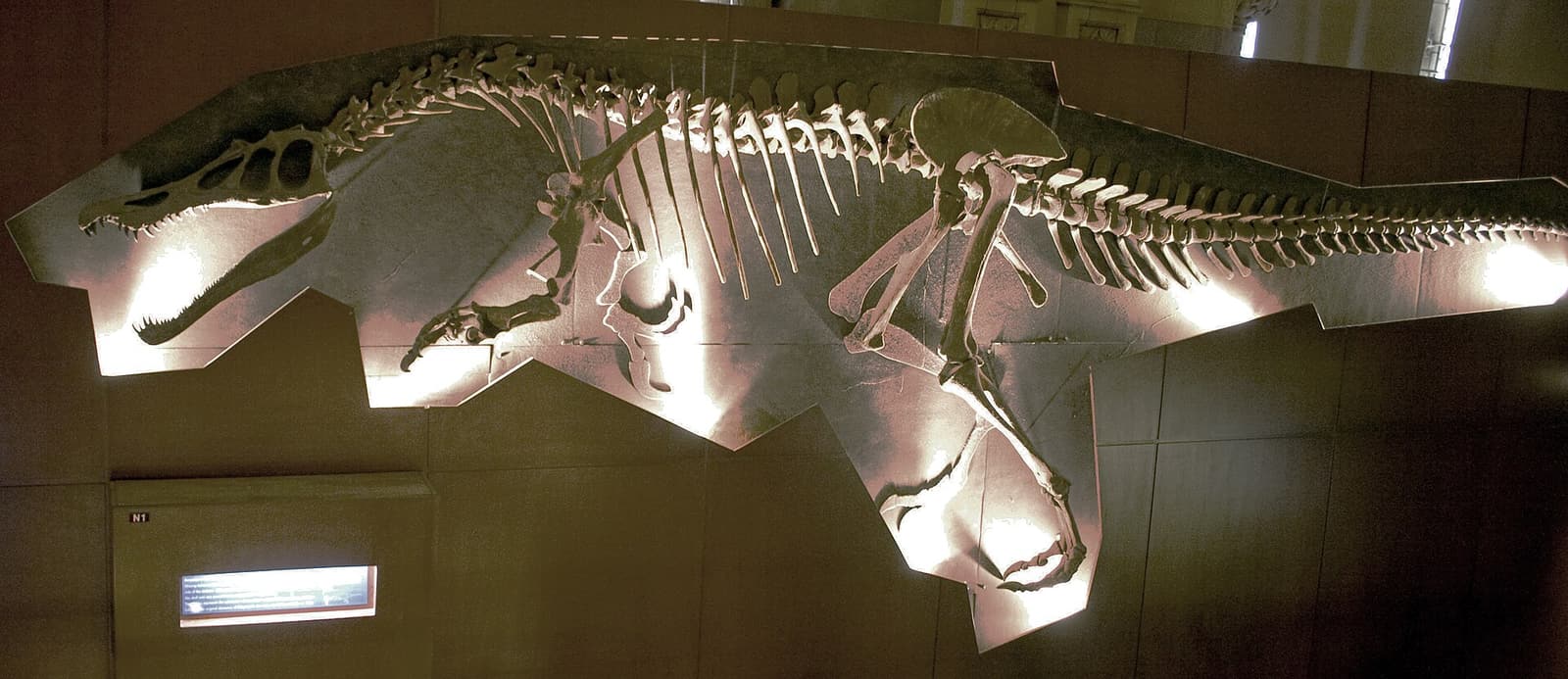
Baryonyx walkeri is easy to remember badly. The shortcut version says it was the fish-eating dinosaur with a huge claw. That is true enough to be useful and too simple to be satisfying. The better profile starts with a stranger point: Baryonyx made fish-eating a theropod problem. It forced paleontologists to think about a large meat-eating dinosaur whose skull, hand, stomach contents, and habitat did not fit the standard image of a blade-toothed terrestrial predator tearing chunks from large prey.
The discovery itself was unusually cinematic without needing embellishment. In January 1983, fossil hunter William J. Walker found part of a giant claw in a Surrey clay pit near Ockley. Natural History Museum staff investigated, and by May and June they had excavated a reasonably complete large theropod from Lower Cretaceous Wealden deposits.[2] Charig and Milner's preliminary 1986 Nature description emphasized why the find felt exceptional: an approximately 30-centimeter claw had led to a new large theropod skeleton from British Lower Cretaceous rocks, a record far more complete than the scattered remains that usually represented big meat-eaters there.[1]
That completeness matters because Baryonyx is not one isolated feature inflated into a whole animal. The Natural History Museum summarizes the animal as a large theropod around 10 meters long and about 2,000 kilograms, living roughly 125 million years ago, with fish and Iguanodon listed among its food.[3] Those plain facts give the outline. The fossil details give the tension. A large animal with a long crocodile-like mouth, finely serrated teeth, a backward-shifted nostril position, and a thumb claw about 31 centimeters along the outer curve does not behave exactly like a generalized allosaur-shaped hunter.[2][3]
The claw was the clue, not the whole animal
The name Baryonyx means "heavy claw," and it has earned that name.[3] But the claw should not be treated as a single-purpose hook with a cartoon instruction label attached. The museum's public account gives the cautious version: the claw may have helped the animal stand at river margins or wade in shallow water and hook fish, a little like a bear using its forelimbs around water.[2] That is plausible as a behavioral image, but the fossil itself does not preserve a fishing motion.
What the claw does preserve is a boundary condition. This was a big theropod with a hand feature large enough to draw attention before the rest of the skeleton had even been understood. It asks what forelimb strength, grasping, prey handling, and riverbank feeding might have looked like in an animal that also carried a long snout and conical-to-crocodilian tooth geometry. The claw is most interesting when it is read with the skull, not instead of the skull.
That distinction keeps the profile from sliding into a single-trait story. Plenty of extinct animals have memorable anatomical props. Baryonyx matters because several props point toward the same ecological neighborhood while stopping short of absolute certainty: hand, snout, teeth, stomach contents, and sedimentary setting all lean toward water-margin feeding, but none requires the animal to have been a dedicated aquatic specialist.
The snout made the diet visible
The Baryonyx skull changed the argument because it gave paleontologists a theropod face that seemed built for a different feeding problem. Natural History Museum researcher Susie Maidment, quoted in the museum's account, points to the rosette shape of the snout and rounded, crocodilian teeth as features linked to fish-eating animals.[2] The museum directory adds the compact version: a crocodile-like mouth shape, sharp finely serrated teeth, and possible shallow-water feeding.[3]
The actual evidence is stronger than external resemblance alone. The Surrey animal's abdominal region preserved fish scales and also iguanodontid bones, so the best reading is not "fish only." It is a predator or scavenger that could exploit aquatic prey and also consume terrestrial dinosaur material.[2] That mixed meal is the key to avoiding the most common mistake. Piscivory in a large theropod does not mean the animal lived like a modern gharial, and it does not mean every meal came from water. It means fish were part of the demonstrated ecology in a clade otherwise known to the public through more terrestrial predator templates.
This is why Baryonyx is a better animal than mascot. The gut evidence gives it a real behavioral anchor, while the non-fish remains keep the anchor from becoming a cage. It could have been a river-edge generalist with a strong aquatic-prey signal rather than an obligate specialist. That is more biologically ordinary and more scientifically useful.
Crocodile-like is not crocodile
The long snout invites crocodile comparisons, but the comparison has to be tested rather than admired. Cuff and Rayfield's 2013 study compared rostral biomechanics in Baryonyx walkeri, a Spinosaurus specimen, and living crocodilians using CT-derived measurements along the snout.[4] Their abstract is especially useful because it complicates the simple analogy. The spinosaur rostra showed similar resistance to bending and torsion despite differing morphologies, and the authors concluded that spinosaurs were not obligate piscivores, with diet influenced by individual size.[4]
That finding does not erase the fish-eating signal. It disciplines it. A long, narrow rostrum can be associated with fish or small prey, but mechanical performance, body size, and available prey all matter. Baryonyx therefore should not be dressed up as a dinosaur wearing a crocodile costume. It was a theropod with some convergent feeding cues and its own body plan.
The difference is important because behavior is where paleontology is most tempting and most fragile. Bone shape can support a feeding hypothesis. Gut contents can directly show at least one feeding event or accumulation. Sediments can place the animal in a wetland or river-influenced landscape. But none of those sources gives a daily diary. The disciplined profile says: Baryonyx had strong evidence for fish in the diet, anatomical traits compatible with water-margin feeding, and a broader prey envelope than the simplest nickname suggests.
The Wealden setting made the animal make sense
The Lower Cretaceous south of England was not a dry stage with a fish-eater awkwardly placed on it. The Natural History Museum describes the Baryonyx rocks as Wealden Group deposits around 125 million years old, formed in a region of swampy lagoons and meandering rivers, with other dinosaurs, crocodiles, and fern-dominated vegetation nearby.[2] That landscape makes the animal's mixed signal coherent. A river-margin predator did not need to choose between fish and dinosaurs as separate worlds; the same floodplain could provide both.
Later spinosaur work has widened the frame. Barker and colleagues' 2021 Scientific Reports paper notes that the Baryonyx walkeri holotype, NHMUK PV R9951, is one of the world's best spinosaurid specimens and the first to reveal the true appearance of members of the group. Their paper also places British spinosaurids within a broader Wealden Supergroup story, including Wessex Formation material from the Isle of Wight and newly named baryonychine taxa.[5] In other words, Baryonyx is not merely a local oddity. It is a key reference point for a larger spinosaur problem: how many related water-margin theropods lived in Early Cretaceous Europe, and how did their anatomy divide ecological space?
That broader context makes the Surrey holotype more valuable, not less. As new fragmentary skulls, teeth, and vertebrae enter the discussion, the relatively complete Baryonyx skeleton remains a calibration specimen. It helps researchers decide whether an isolated tooth belongs near Baryonyx, whether a skull fragment implies a different baryonychine, and how much variation should be expected within a clade known from incomplete material.[5]
What the profile should leave behind
The most useful version of Baryonyx is neither "fish-eating dinosaur" nor "land crocodile." It is a large Early Cretaceous theropod whose evidence comes in layers: a dramatic thumb claw discovered first, a long rosette-tipped snout with crocodilian-style cues, stomach-region fish scales and iguanodontid bones, a swampy Wealden habitat, and later biomechanical work that warns against making piscivory absolute.[1][2][3][4]
That layered profile is why Baryonyx still feels fresh. It does not just add one weird dinosaur to a list. It changes the questions asked of predatory dinosaurs around water. Was the animal catching fish from the bank, scavenging stranded prey, wading through shallow channels, taking small terrestrial animals, or doing several of those things depending on size and opportunity? The answer is probably not a single behavior. The fossil record rarely rewards single behaviors.
The animal's importance is therefore methodological as much as anatomical. Baryonyx teaches a clean reading habit: start with the spectacular claw, but do not stop there; follow the snout into feeding mechanics; use gut contents without turning one meal into a lifestyle; place the skeleton back into the Wealden floodplain; and remember that a spinosaur can be fish-marked without being fish-only. That is a stronger animal than the nickname. It is a predator whose bones made the riverbank visible.
Sources
- Alan J. Charig and Angela C. Milner, "Baryonyx, a remarkable new theropod dinosaur," Nature 324 (1986), original description record.
- Emily Osterloff, "How did Baryonyx change what we knew about spinosaurs?" Natural History Museum, first published 2019 and updated 2021.
- Natural History Museum, "Baryonyx" dino directory entry, morphology, diet, size, and taxonomic summary.
- Andrew R. Cuff and Emily J. Rayfield, "Feeding Mechanics in Spinosaurid Theropods and Extant Crocodilians," PLOS ONE 8, no. 5 (2013).
- Chris T. Barker et al., "New spinosaurids from the Wessex Formation (Early Cretaceous, UK) and the European origins of Spinosauridae," Scientific Reports 11 (2021).
- Wikimedia Commons, "File:Baryonyx NHM.jpg," source page for the Natural History Museum skeletal mount photograph used as the article image.