Climactichnites is a fossil that refuses the usual bargain. There is no skull to rotate, no limb joint to compare, no shell to measure, and no complete animal waiting under a museum label. The evidence is a path through sand. Broad paired ridges, transverse bars and furrows, occasional resting impressions, and rare burrow-like forms preserve the action of a soft-bodied Cambrian animal whose body itself has not been found.[1][2][3]
That absence makes the fossil more interesting, not less. Climactichnites is an anatomy problem written as a trace fossil. The animal becomes visible only if the reader treats the trackway as a physical interaction between a body, a wet sandy surface, microbial binding, and exposure at the edge of a shallow sea.[1][2][4] It is not enough to say "slug-like" and move on. The track is the hard evidence; the animal is the disciplined inference.
The setting keeps the inference grounded. The classic material comes from Late Cambrian sandstones in North America, including central Wisconsin, where Krukowski Quarry and the broader Blackberry Hill assemblage preserve an unusually vivid record of trace fossils and stranded soft-bodied animals on what Earth@Home describes as a roughly 510-million-year-old beach-like setting.[2][4] These were not ordinary sea-floor scratches buried quietly in deep water. The sedimentary clues point toward very shallow to intermittently exposed sand flats, places where a moving animal had to deal with wet grains, air exposure, tides, and microbial surfaces.[1][2][4]
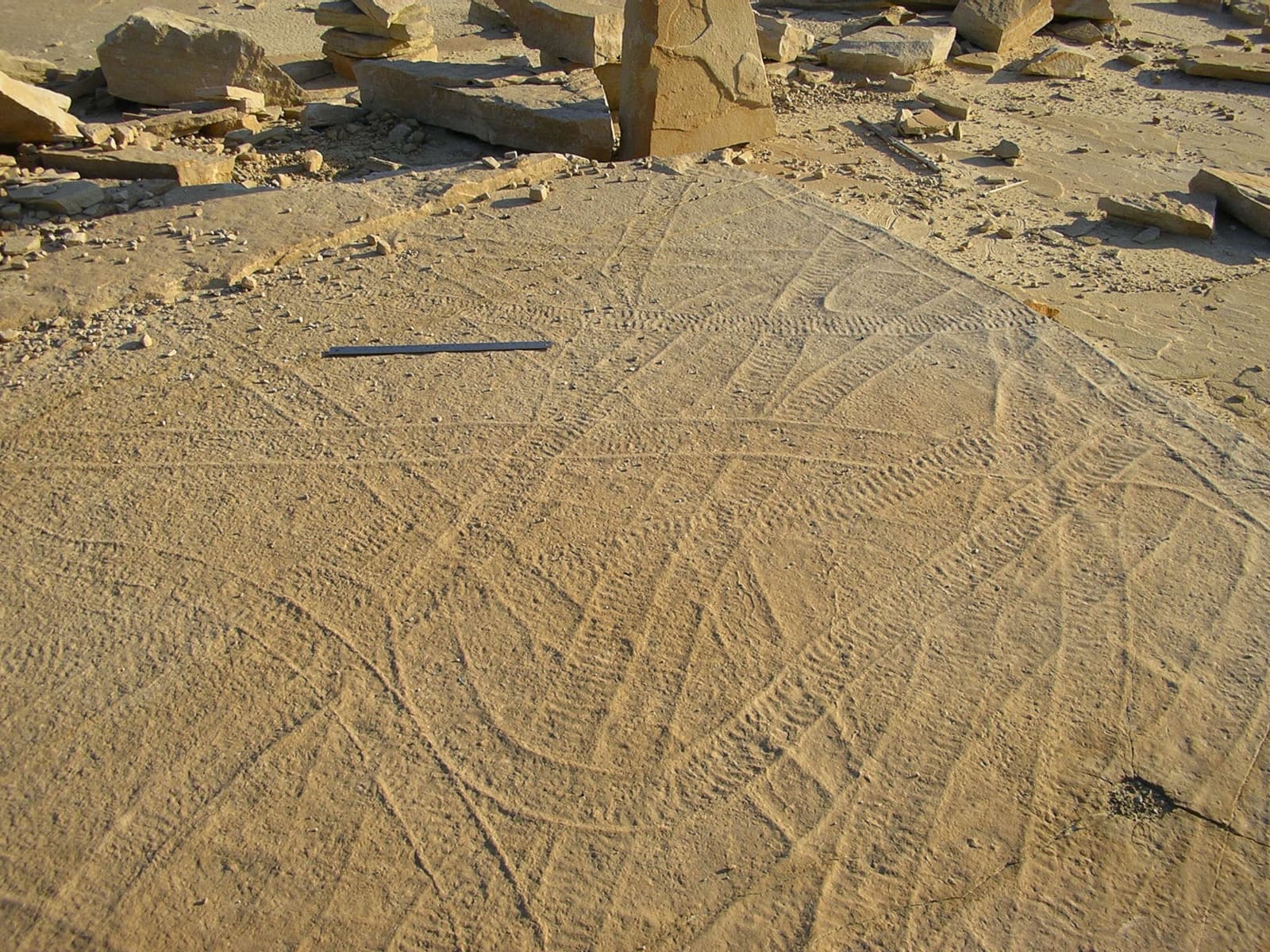
The Track Is Wider Than A Footprint
The first mistake is to read Climactichnites like a normal footprint trail. A walking arthropod leaves repeated contacts: left, right, left, right, with appendages touching the surface in a pattern. Climactichnites does something different. Yochelson and Fedonkin redescribed the fossil as a trail with raised bars and impressed furrows bounded by two parallel raised lateral ridges.[1] In other words, the animal did not simply step. It remodeled a broad strip of damp sand.
That distinction changes the likely body. Getty and Hagadorn's 2009 study argued from field and museum specimens, plus comparisons with modern trail preservation, that the tracemaker was elongate, bilaterally symmetrical, flattened from top to bottom, soft-bodied, and equipped with a muscular foot.[2] The best analog is therefore not a many-legged walker but a mollusc-like animal capable of moving across exposed or nearly exposed sand by waves of muscular motion.[2]
This is where "slug-like" is useful and dangerous at the same time. Useful, because a modern intertidal gastropod gives a reader an honest mechanical image: a broad flexible underside gripping, releasing, and pulling across sediment. Dangerous, because the Cambrian animal was not a modern slug dropped into ancient Wisconsin. The fossil supports a low, broad, soft-bodied mover with foot-like locomotion. It does not preserve eyes, shell, radula, colors, or a full modern gastropod toolkit.[1][2]
The size also matters. Getty and Hagadorn report that the tracemaker could reach considerable size, with estimates up to about 69 centimeters long, making it one of the larger Cambrian animals of its time.[2] That is not trivia. A large soft body crossing an exposed sand flat has to solve support, moisture, adhesion, and propulsion at once. The trackway is the record of that solution.
Sand Preserved The Method, Not Just The Route
Trace fossils are often treated as maps of where an animal went. Climactichnites is more revealing as a record of how a body moved. Getty and Hagadorn reconstructed locomotion as muscular waves along the sole: the foot extended, clamped onto the substrate, and then pulled the body forward by contraction.[2] The repeated transverse bars and furrows fit that kind of body-wide motion better than they fit individual feet.
The lateral ridges are especially important. In the 1993 Smithsonian treatment, Yochelson and Fedonkin interpreted the parallel bounding ridges as damp sand molded by the animal's outer body margins or flap-like edges while the underside compressed and redistributed sediment.[1] Their specific anatomical model is not the final word, but the key methodological point remains strong: the trail edges are not decorative. They are the places where body width, pressure, and sediment behavior meet.
That is why the fossil cannot be cleanly separated from its substrate. A track made in soupy mud, firm sand, dry sand, and microbially bound sediment will not preserve the same way. Getty and Hagadorn emphasized associated desiccation cracks, raindrop impressions, adhesion structures, gas-escape structures, and microbial sedimentary structures as evidence that Climactichnites wilsoni occupied intermittently subaerial environments.[2] The animal was not simply moving "on the seafloor." It was using a temporary surface at the water-land margin.
Microbial mats help explain the preservation problem. Modern animals can make comparable trails on exposed sand flats, but wind, waves, tides, and later burrowing usually erase them.[2] Cambrian microbial binding and relatively low levels of vertical bioturbation could stabilize surfaces long enough for a broad soft-body trail to survive burial.[2] In plain terms, the track was preserved partly because the Cambrian sand flat behaved differently from a heavily reworked modern beach.
Resting And Burrowing Expand The Animal's Behavior
For a long time, the most familiar image of Climactichnites was the surface trail: a broad path like a tire track from an animal no one could see. The later revision by Getty and Hagadorn widened the behavioral frame. Their 2008 Journal of Paleontology paper recognized two trace species as different behavioral variants: C. wilsoni for surface-produced trails and C. youngi for subsurface burrows.[3] They also moved the resting impression of the sedentary animal into the new ichnogenus Musculopodus.[3]
That matters because a surface trail alone could make the animal look like a perpetual crawler. Add resting traces and burrows, and the life habit becomes more complex. The animal could pause with enough body definition to leave an impression. It could also move below the surface, producing forms that lack the same lateral ridges and show fine striations or grooves on transverse structures.[3] This is not a glamorous addition, but it is scientifically decisive. Behavior, not just anatomy, enters the fossil record.
The burrow result also protects against overconfident ecology. A soft-bodied animal on an exposed sand flat faces desiccation, changing water cover, and unstable sediment. Subsurface movement or resting would not be surprising under those conditions, but the claim still needs fossil support. Getty and Hagadorn's distinction between surface trails, burrows, and resting traces supplies that support without pretending to show the body directly.[3]
The geographic boundary is another useful restraint. The same 2008 revision states that Climactichnites is currently known only from very shallow to emergent strata of North America, and that reported occurrences elsewhere were misidentified trails made by other animals.[3] That sentence does a lot of work. It keeps Climactichnites from becoming a generic label for any broad Cambrian smear and preserves the connection between trace shape, environment, and maker.
The Maker Is Inferred, Not Solved
The history of Climactichnites includes many proposed makers: arthropods, worms, mollusks, and stranger possibilities.[1] That history is not an embarrassment. It is what happens when a fossil preserves performance better than anatomy. The trackmaker probably had a broad, soft, flattened body and a muscular undersurface; a primitive mollusc or mollusc-like animal remains the most useful current framing.[2][3] But "mollusc-like" should be read as a mechanical and comparative inference, not as a clean placement in a living group.
The strongest claims are therefore layered. Secure: the fossil is a Late Cambrian trace from shallow to emergent North American sandstones, with surface trails characterized by parallel ridges and transverse structures.[1][2][3] Strong inference: the maker was a large, bilaterally organized, dorsoventrally flattened soft-bodied animal moving by muscular foot-like action across damp sand.[2] More tentative: details of feeding, respiratory anatomy, body flaps, and exact taxonomic identity.[1][2]
That layered reading is why Climactichnites is more than a curiosity. It belongs to the story of animals testing marginal environments long before familiar terrestrial ecosystems existed. Earth@Home frames Krukowski Quarry as a Cambrian beach-like locality where fossilized trackways give clues to how organisms moved around under shallow water, alongside rare preservation of stranded jellyfish-like animals.[4] Climactichnites adds another signal: some large soft-bodied animals were already negotiating surfaces that could be underwater, exposed, sticky, drying, or microbially bound.
The lesson is methodological as much as evolutionary. Paleontology often feels strongest when it has a body. Climactichnites shows how much can be learned when the body is missing but the body's work remains. A trackway can carry width, motion, substrate pressure, behavior, exposure regime, and preservation conditions. Read carefully, that is anatomy by consequence.
The fossil does not give us a face. It gives us a transaction: soft tissue pressing into wet Cambrian sand, microbial surfaces holding the mark, and later stone preserving the path. That is enough. Climactichnites makes a body visible without preserving the body, and it does so by forcing every reconstruction to pass through the track.
Sources
- Ellis L. Yochelson and Mikhail A. Fedonkin, "Paleobiology of Climactichnites, an Enigmatic Late Cambrian Fossil," Smithsonian Contributions to Paleobiology 74 (1993).
- Patrick R. Getty and James W. Hagadorn, "Palaeobiology of the Climactichnites tracemaker," Palaeontology 52, no. 4 (2009).
- Patrick Ryan Getty and James Whitey Hagadorn, "Reinterpretation of Climactichnites Logan 1860 to include subsurface burrows, and erection of Musculopodus for resting traces of the trailmaker," Journal of Paleontology 82, no. 6 (2008).
- Paleontological Research Institution, Earth@Home, "Fossils of the Central Lowland" - Cambrian fossils and Krukowski Quarry context.
- Wikimedia Commons, "File:Climactichnites - Todd Gass.jpg" - source page for the real photographed trace fossil used as the article image.