
The easiest way to misunderstand a fossil coral is to make it too modern too quickly. The word "coral" pulls the mind toward bright reefs, branching colonies, tropical fish, and living scleractinian corals. That image is not useless, but it is a shortcut. Paleozoic corals ask for a slower kind of looking. Their science sits in skeleton architecture: cups, walls, radiating plates, horizontal floors, colony geometry, and the way those structures registered ancient sea floors long before modern reef corals took their familiar place.
The Australian Age of Dinosaurs video is useful because it treats prehistoric corals as hand specimens that have to be turned, compared, and read in pieces rather than as background decoration.[1] That is the right entry point. The British Geological Survey explains the basic body plan in compact terms: a coral is a soft polyp living in a calcareous skeleton, and that skeleton may be strengthened by septa, tabulae, and sometimes dissepiments.[2] Once those parts are in view, the fossil stops being a pretty patterned stone and becomes a record of how a small animal made living space for itself.
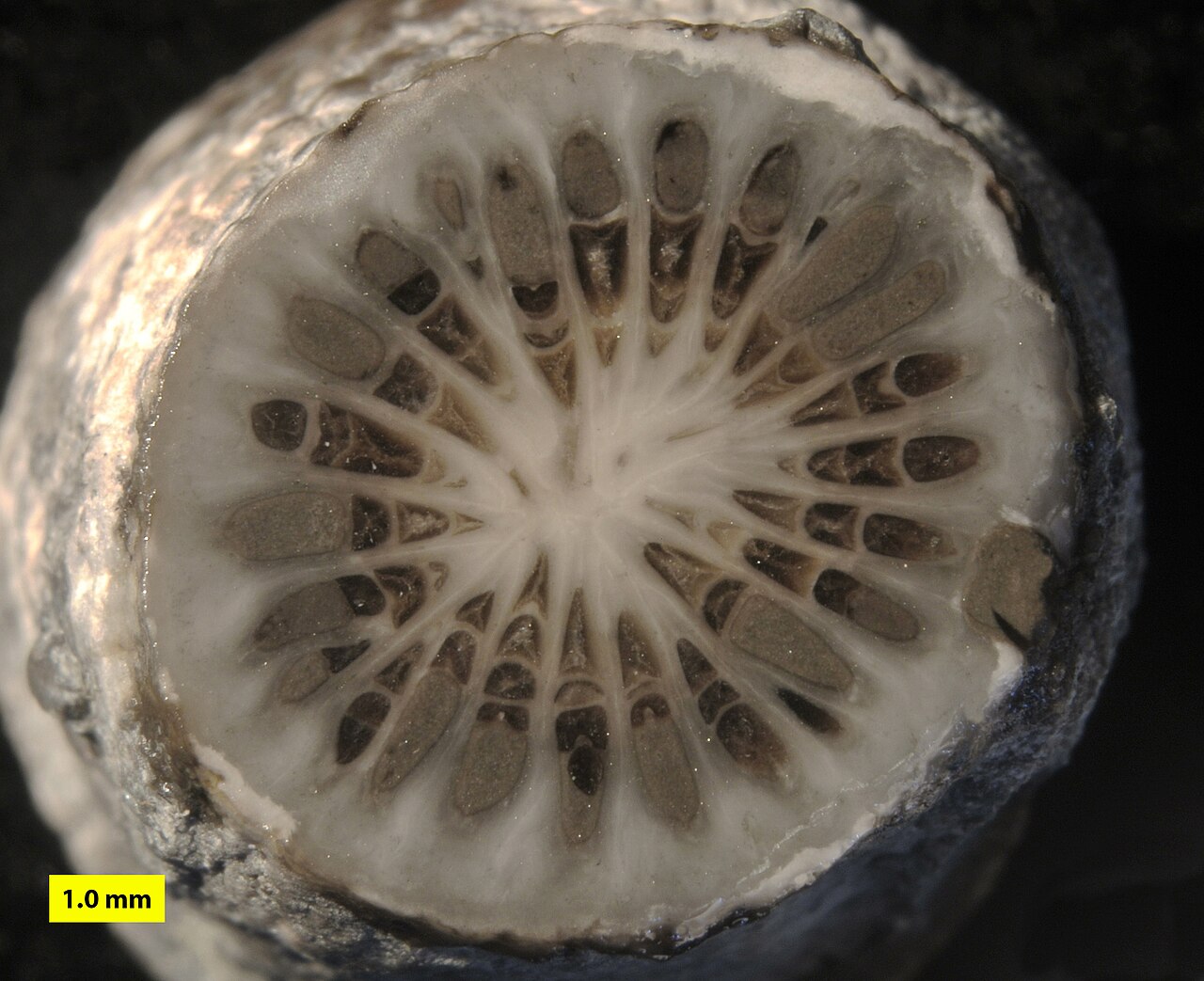
The cover image is deliberately a cross-section rather than a reef panorama. Wikimedia Commons identifies it as Stereolasma rectum, a rugose coral from the Middle Devonian of Erie County, New York.[6] The radiating white partitions show why the specimen belongs in this article. You are not looking at a generic sea object. You are looking into a former corallite, where the internal geometry that supported the polyp has become the fossil's most readable feature.[2][6]
The first thing to watch for is the change in scale. A coral fossil can be handled like a rock, but it records a biological compromise between one polyp and a colony, between soft tissue and mineral support. Sam Noble Museum's guide makes the contrast cleanly: rugose corals could be solitary or colonial, with each polyp producing a cup-shaped corallite reinforced by vertical septa and horizontal partitions; tabulate corals, by contrast, were always colonial and generally had smaller corallites.[4] That difference matters because the fossil surface can mislead. A honeycomb, a chain, a branching mass, and a single horn are all "coral" only after their internal rules are sorted.
Around the video's specimen-comparison moments, the best habit is to ask what the skeleton is doing. In rugose corals, the radiating septa are not decorative spokes. They are part of a support system inside the cup where the polyp sat.[2][4] In solitary horn corals, that cup can make the fossil feel almost individual, like one animal's durable room. In colonial rugose forms, repeated corallites turn that same idea into a shared framework. The distinction between solitary and colonial is therefore not a label to memorize. It changes what kind of ecological unit the fossil represents.
Tabulate corals require a different eye. GeoKansas describes tabulates as exclusively colonial, with calcium carbonate skeletons that could be moundlike, sheetlike, chainlike, or branching, and notes that their name comes from horizontal internal partitions called tabulae.[3] Sam Noble's guide adds a useful visual cue: favositid tabulates pack corallites closely, while halysitid tabulates join more loosely, like links in a chain.[4] This is why a fossil coral should be read from pattern into structure, not the other way around. Honeycomb and chain shapes are not merely visual textures. They are colony plans.
The video also works because it lets prehistoric corals be strange without making them exotic for its own sake.[1] Rugose and tabulate corals were cnidarians, relatives in the broad animal sense of living corals, sea anemones, and jellyfish.[3][4] But they were not simply older versions of the corals that dominate many modern reef images. GeoKansas is especially useful on this boundary: rugose and tabulate corals died out at the end-Permian extinction, and many specialists argue that later corals differ significantly from the Paleozoic forms.[3] The Sam Noble guide states the same broad sequence: Paleozoic rugose and tabulate corals vanish at the end of the Permian, while stony corals appear afterward in the Triassic and remain important today.[4]
That extinction boundary should change how the viewer hears the word "prehistoric." This is not just ancient coral in the sense of old reef life. It is a former coral world that ended. The Field Museum's Devonian reef note gives the ecological scale: Devonian reefs could be built by stromatoporoids, tabulate corals, and large rugose corals, and Late Devonian extinction disrupted many dominant reef builders.[5] The later end-Permian extinction then finished the Paleozoic rugose-tabulate story.[3][4] What survives in hand specimens is therefore not one continuous coral dynasty smoothly leading into a modern snorkel scene. It is a set of reef-building experiments interrupted by extinction and replacement.
The strongest annotation to carry after the video is this: fossil corals reward architectural reading. A beginner sees repeating holes, ridges, and flower-like centers. A better reader asks whether the corallites are solitary or colonial, whether septa are prominent, whether tabulae define the group, whether the colony is packed, branching, moundlike, or chainlike, and what that geometry implies about life on a shallow Paleozoic seafloor.[2][3][4] None of that removes beauty from the specimen. It makes the beauty accountable.
This also protects against a common reef habit. Modern reefs are so culturally vivid that they can become the default picture for any ancient carbonate ecosystem. But deep time was not obligated to anticipate the present. Paleozoic coral communities included rugose and tabulate forms with calcitic skeletons and internal structures that do not map neatly onto living reef-coral categories.[2][3][4] Some were reef builders. Some were local fossils in warm, shallow, sunlit seas without necessarily building reefs everywhere they lived.[3] Some were solitary cups rather than colonies. The point is not to drain the word "coral" of familiarity. The point is to let each fossil earn its familiarity through anatomy.
That is why this short video earns an annotated viewing rather than a quick link. It gives the viewer enough object contact to slow down the category. Once you know what to look for, a rugose coral cross-section becomes a former body space; a tabulate honeycomb becomes a colony plan; a chain coral becomes an arrangement of linked corallites; and a reef becomes an ecological job that different organisms occupied at different times. Prehistoric corals are not aquarium scenery in stone. They are skeletal records of how ancient polyps built, repeated, survived, and finally disappeared.
Sources
- Australian Age of Dinosaurs, "Prehistoric corals | Inside the Lab," YouTube video.
- British Geological Survey, "Corals" - fossil coral guide covering polyps, calcareous skeletons, septa, tabulae, and major fossil coral groups.
- GeoKansas, "Corals" - Kansas Geological Survey overview of rugose and tabulate coral forms, environments, and end-Permian extinction.
- Sam Noble Museum, "Corals" - fossil guide distinguishing solitary and colonial rugose corals from colonial tabulate corals.
- Field Museum, "Devonian Stromatoporoid and Tabulate Coral reef" - Devonian reef context for stromatoporoids, tabulate corals, large rugose corals, and extinction.
- Wikimedia Commons, "File:Stereolasma cross section.jpg" - source page for the real rugose coral cross-section photograph used as the article image.