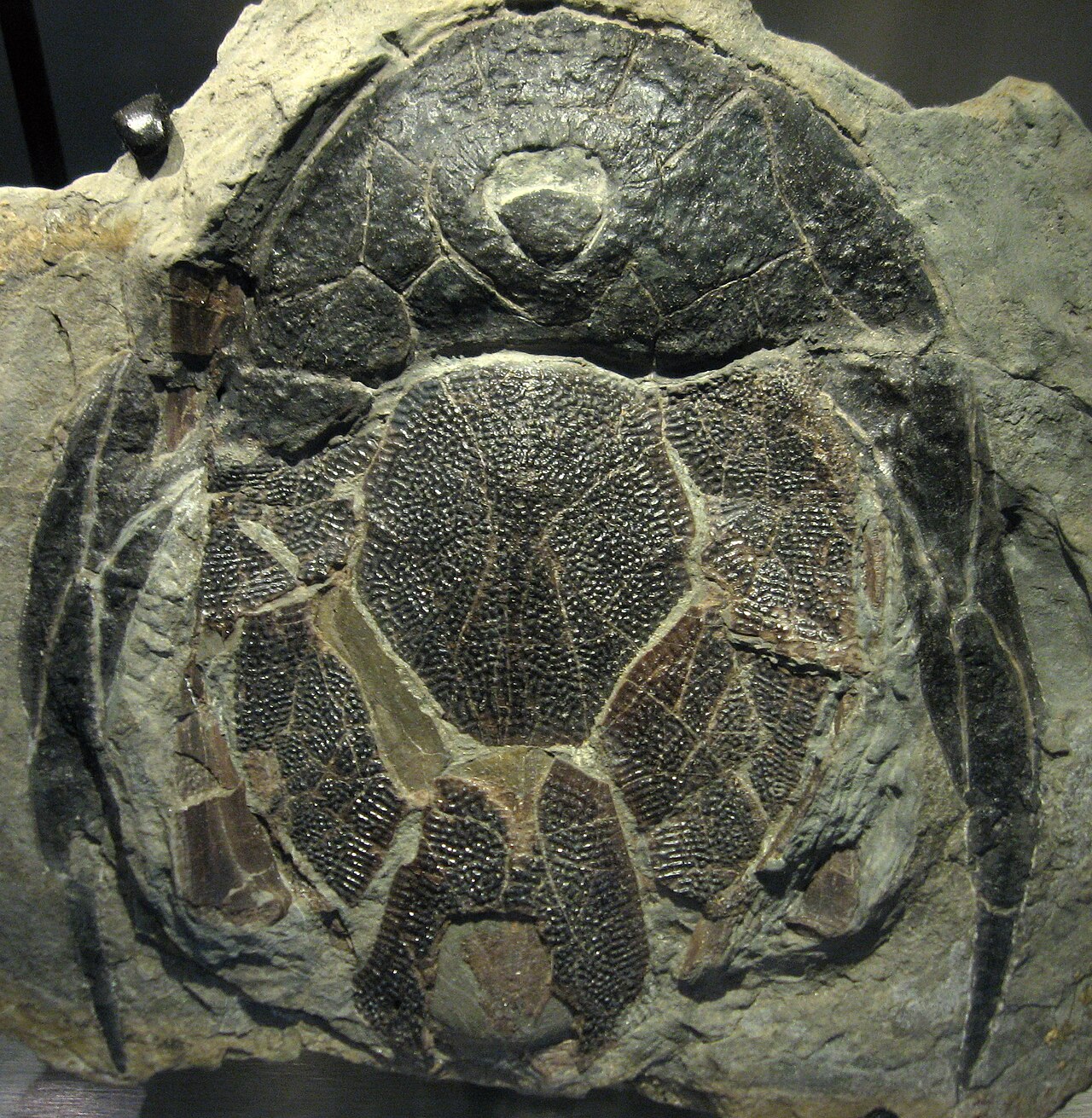
Bothriolepis canadensis is easy to underestimate because it looks overbuilt. A flattened slab shows plates, seams, and paired armored projections where a modern viewer expects a flexible fish. The tempting reading is that this was an awkward Devonian experiment: a jawed vertebrate wrapped in too much bone, moving through the world under the penalty of its own protection. That is too simple. The better profile starts with the possibility that the armor was not a mistake. It was the body plan.
The animal was an antiarch placoderm from the Late Devonian Escuminac Formation at Miguasha in Quebec, part of a fossil site recognized as one of the clearest windows onto the "Age of Fishes" around 370 million years ago.[1] That setting matters. Bothriolepis was not a lone curiosity pulled from an otherwise blank past. It belonged to an assemblage where fossil fishes, plants, invertebrates, and exceptional preservation let paleontologists study early jawed vertebrates as repeated specimens, not as single heroic fragments.[1][3]
Image context: the cover uses a real fossil photograph from Wikimedia Commons, not a life restoration or diagram. It shows the head and fin plates of Bothriolepis canadensis from Scaumenac Bay, Quebec, which keeps the species profile anchored in the actual preserved surface before the article discusses posture, motion, or ecology.[6]
Miguasha makes the fish statistical, not merely spectacular
Miguasha is famous because of evolutionary transitions around fish and early tetrapods, but Bothriolepis earns attention for a different reason: abundance. Bechard and colleagues report that the Miguasha museum houses thousands of B. canadensis specimens across a wide size range, and that a meaningful subset preserves complete dermal armor with articulated pectoral fins.[2] The broader site record also preserves larval and juvenile material for many fish species, making Miguasha unusually good for questions about growth.[3] That changes the scientific value of the animal. A species known from many specimens and size classes can be asked developmental questions that a one-off fossil cannot answer.
This is why the fossil should not be treated as a decorative "armored fish" label. In a growth-sensitive sample, armor becomes a changing structure. Plates can be compared across size classes; juvenile proportions can be separated from adult anatomy; and features that once looked fixed can be tested as developmental patterns.[2][3] The animal becomes less like a museum emblem and more like a dataset with seams.
That abundance also makes caution possible. When a fossil taxon is known from only a few pieces, every interpretation carries a little desperation. With Bothriolepis, the question is more disciplined: which preserved parts are repeated often enough to be trusted, which parts are distorted by flattening, and which soft or posterior structures remain harder to reconstruct? The species is famous not because it solves every problem, but because it gives researchers enough material to notice where the problems still are.
The armor is the first functional clue
Antiarchs are placoderms, part of the broader armored jawed-vertebrate world of the Paleozoic. In Bothriolepis, the most obvious anatomy is a shielded head and thoracic armor, with paired bony appendages projecting from the sides. The 2014 Palaeontologia Electronica study by Bechard, Arsenault, Cloutier, and Kerr treated B. canadensis as one of the best-known Devonian fishes but still found that the standard two-dimensional silhouettes had left important features misread.[2]
That is the profile's central lesson. A fossil that looks familiar from old drawings can still change when the method changes. The authors used three-dimensional surface scanning and modeling to rebuild the dermal armor from well-preserved specimens and to reassess the fleshy posterior body from the available evidence.[2] The result was not a flashy new species name. It was a sharper body.
The 3D reconstruction corrected the animal away from a fully flattened cartoon. The study emphasizes a more hydrodynamic silhouette, a high dorsal median crest, a tight joint between head and thoracic armor, and details around gill openings and body shape that previous reconstructions had smoothed or misplaced.[2] In other words, Bothriolepis was not simply a box with a tail. It was a box organized around water, balance, protection, and limited but specific movement.
The "arms" are not walking legs in disguise
The paired armored appendages are the feature most likely to pull the imagination off course. They look like little jointed arms, and the visual temptation is to make them crawl, row, anchor, or shovel. The 2014 modeling paper is useful because it narrows that freedom. Its reconstruction found that the pectoral fins had restricted mobility and excluded both powerful stroking and anchoring as likely functions.[2]
That boundary improves the animal. It stops Bothriolepis from becoming whatever behavior a reconstruction artist needs. The appendages were real, jointed, and armored; they were also constrained. A careful species profile therefore should not make them proto-limbs, underwater crutches, or oars by analogy alone. They were antiarch pectoral appendages working inside a placoderm body plan, not a preview of tetrapod legs.
This is where the phrase "primitive fish" does the most damage. Bothriolepis did not fail to become a later vertebrate. It occupied its own Devonian solution. Heavy armor protected the front of the body; the posterior body was less completely known and less heavily armored; the pectoral appendages formed part of a bounded mechanical system rather than a blank slate for stories about landward progress.[2]
Even missing pelvic fins are evidence, not absence
One of the best recent corrections to the Bothriolepis picture concerns what the animal lacked. Charest, Johanson, and Cloutier studied the apparent absence of pelvic fins in B. canadensis and the presence of structures they interpreted as paedomorphic pelvic girdles.[4] That claim matters because it turns a negative feature into an evolutionary question. The point is not merely "no pelvic fins." The point is that the developmental and anatomical history behind that absence may still leave a trace in the skeleton.
The finding should stay inside its evidence. It does not mean Bothriolepis secretly had ordinary hind fins, and it does not let us animate the animal like a later fish with a modern fin plan. It suggests a more interesting condition: an early jawed vertebrate in which parts of the pelvic apparatus may persist while the external fin system is reduced or lost.[4] That is a subtler story than absence alone.
It also keeps the species connected to large evolutionary questions without making it serve as a simple ancestor. Bothriolepis sits on the jawed-vertebrate stem side of the story, but it should not be treated as a direct ladder rung to living fish or land vertebrates. Its value is comparative. It shows how much variation early gnathostomes had already generated in armor, paired appendages, and body architecture before later vertebrate designs became familiar.
Bone, preservation, and reconstruction all set limits
The skeleton is not just a suit of plates in the ordinary sense. Downs and Donoghue's histological study of B. canadensis treated the dermal skeleton as evidence in debates about the origin of mineralized skeletons in jawed vertebrates and reported cellular dermal bone in the external skeleton.[5] That makes the armor significant at more than one scale. At the body scale, it protected and shaped the animal. At the tissue scale, it helps researchers compare early skeletal materials across jawed-vertebrate history.
Still, the fossil record is uneven. The 3D reconstruction paper notes that a complete reconstruction of the mouth area was not possible from the scanned material, and that the posterior body is often preserved differently from the armored front.[2] That should temper any confident ecological portrait. A ventral mouth and armored, bottom-oriented form can support inferences about a low, substrate-associated life, but the fossils do not hand us a full day in the animal's life.
The right profile therefore holds two ideas together. Bothriolepis is not mysterious because we know almost nothing; it is still alive scientifically because we know enough to ask better questions. The Miguasha sample makes growth and repeated anatomy visible.[2][3] The 3D model corrects old silhouettes.[2] The pelvic-girdle work complicates a simple story of fin loss.[4] The histology ties the armor to broader questions about early jawed-vertebrate skeletons.[5]
What remains is a fish that feels less like an evolutionary dead end than a successful Devonian specialization. Bothriolepis canadensis made protection, shape, and constrained appendages into one coherent package. It was not a clumsy prelude to something better. It was an armored way of being a jawed vertebrate in the Age of Fishes, and Miguasha preserved enough of that way of life for the seams to keep speaking.
Sources
- International Union of Geological Sciences, "The Late Devonian fossil-fish Lagerstatte of Miguasha."
- Isabelle Bechard, Felix Arsenault, Richard Cloutier, and Johanne Kerr, "The Devonian placoderm fish Bothriolepis canadensis revisited with three-dimensional digital imagery," Palaeontologia Electronica 17, no. 1 (2014).
- Richard Cloutier, Sylvain Desbiens, and Olivier Matton, "The Late Devonian Biota of the Miguasha National Park UNESCO World Heritage Site" (GeoCanada 2010 abstract PDF).
- France Charest, Zerina Johanson, and Richard Cloutier, "Loss in the making: absence of pelvic fins and presence of paedomorphic pelvic girdles in a Late Devonian antiarch placoderm," Biology Letters 14, no. 6 (2018), PMC full text.
- Jason P. Downs and Philip C. J. Donoghue, "Skeletal histology of Bothriolepis canadensis (Placodermi, Antiarchi) and evolution of the skeleton at the origin of jawed vertebrates," Journal of Morphology 270, no. 11 (2009), PubMed record.
- Wikimedia Commons, "File:Bothriolepis canadensis 01.jpg" - photographed fossil of Bothriolepis canadensis from Scaumenac Bay, Quebec.