Cambroraster falcatus arrived in public with a nickname almost too good to survive scientific use. The broad head carapace looked enough like a starship that the species name nodded toward the Millennium Falcon, and the story practically wrote its own headline.[1][2] But the nickname is the least useful way to understand the animal. Cambroraster matters because the "spaceship" shape is not decorative. It is one part of a feeding system built for life close to the Cambrian seafloor.
The species was described in 2019 from the Burgess Shale of British Columbia, especially the Marble Canyon and North Tokumm Creek area of Kootenay National Park.[1][2] That setting matters. These are Middle Cambrian, Wuliuan-age rocks, roughly 507 million years old, preserving animals from one of the classic windows into early complex marine ecosystems.[2] The first surprise was not only that Cambroraster was strange. It was that the animal was abundant enough to move beyond one isolated specimen. The Royal Ontario Museum records more than 100 specimens, with some bedding planes holding dozens of individuals.[2]
That abundance changes the article's proper method. A single bizarre fossil invites speculation. A repeated fossil package invites anatomy. With Cambroraster, the best question is not "what does this outline resemble?" It is "how do the carapace, eyes, appendages, mouth, trunk, and bedding-plane context work together?"
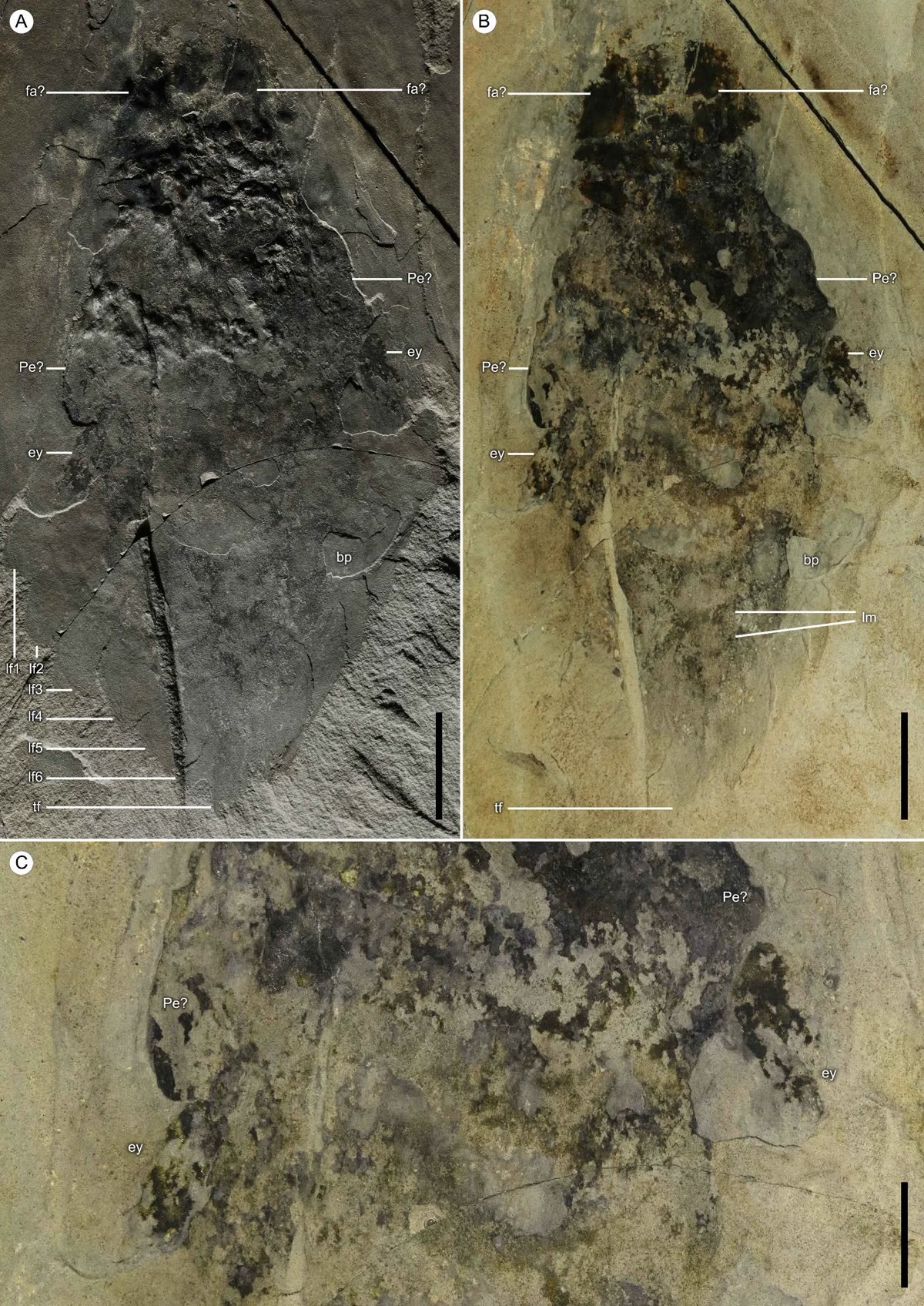
The Carapace Is A Working Surface
The defining feature of Cambroraster is the huge horseshoe-shaped dorsal carapace. ROM's description is precise: the front is rounded, the rear sides project into wing-like extensions, the margins carry small spines, and deep notches hold upward-facing elliptical eyes.[2] That is a very different object from a generic shield. The carapace frames how the animal met the substrate, where the eyes looked, and how the head region protected the feeding apparatus below.
This is why the spaceship comparison gets weaker the longer one looks. A pop-culture shape is recognized from above. The fossil animal had to live in three dimensions. Its eyes faced upward from notches in the carapace, its mouth and appendages worked underneath the front of the head, and the body behind the head was short relative to the shield.[2] The carapace therefore reads less like armor alone and more like a body-positioning device: broad, low, and arranged for a life spent close to the bottom.
The broader hurdiid record strengthens that point. Caron and Moysiuk's 2021 work on Titanokorys gainesi, another giant hurdiid from Burgess Shale deposits, emphasized that carapace shape diversity was not incidental in this family.[4] Titanokorys and Cambroraster are not identical, but placing them together makes the key lesson visible. Hurdiid radiodonts were exploring head-shield geometry as part of ecology. Carapaces were not just taxonomic badges. They were surfaces through which animals met water, sediment, prey, and visual fields.[4]
The Rakes Move The Story Below The Head
The second major piece is the pair of frontal appendages. In older public accounts of radiodonts, the appendages often carry a simple predator image: grasp, seize, crush. Cambroraster is better read as a more specialized machine. Moysiuk and Caron described short frontal appendages with long, curved, rake-like inner spines and many smaller hooked secondary spines.[1] ROM's account frames these as a rigid, basket-like apparatus around the mouth, suited to disturbing sediment and transferring captured organisms toward the oral cone.[2]
This is where the word "predator" needs discipline. Cambroraster was carnivorous in the broad sense, and at about 300 millimeters maximum length it was large for its community.[2] But the prey image should not default to cinematic pursuit. The original paper argued that the animal exploited infaunal food sources: organisms living in or just under the sediment.[1] A rake is not a spear. Its value lies in combing, trapping, and concentrating small targets.
The spacing of those spines matters because it turns feeding into a size filter. ROM notes that the numerous, finely spaced secondary spines could capture minute benthic organisms, although larger prey may also have been consumed.[2] That is a more interesting ecology than a monster label allows. Cambroraster was not simply a scaled-down sea-floor terror. It was a large Cambrian animal with mouthparts and appendages tuned to a particular prey field.
The Mouth Processes What The Rakes Deliver
Radiodonts take their name from the radial mouth apparatus, and Cambroraster keeps that feature in the center of the evidence. The circular, tooth-lined mouth sat near the underside front of the head, close to the paired appendages.[1][2] If the rakes disturbed the sediment and trapped organisms, the mouth was the next station in the system.
That sequencing is important. A circular oral cone can look frightening in isolation, but isolated parts are exactly how Cambrian animals become over-imagined. In Cambroraster, the mouth should be read with the appendages, and the appendages with the head posture. The mouth did not chase prey by itself. It received material from a frontal apparatus whose shape suggests sweeping and sifting.[1][2]
This is also a useful boundary against overconfidence. The fossil record does not hand over stomach contents for every individual or a slow-motion film of feeding. The sediment-sifting model is an inference from anatomy, comparison, preservation, and functional fit.[1][2] It is strong because multiple regions point in the same direction. It remains an inference because fossil anatomy still needs a behavior model to connect form to action.
Mobility Narrows The Feeding Envelope
The 2021 three-dimensional modeling study by De Vivo, Lautenschlager, and Vinther helps explain why Cambroraster should not be treated as a generic grasping predator.[3] Their wider radiodont study modeled appendage form, disparity, and ecology, and the ROM summary of Cambroraster notes that 3D digital modeling found its appendage to have the lowest potential degree of articulation among the studied radiodontans.[2][3]
Low mobility is not a weakness if the job is different. A highly flexible grasping limb and a stouter, more constrained rake solve different problems. If Cambroraster was working near or within the sediment surface, a rigid comb-like apparatus could be useful precisely because it did not behave like a delicate grasping hand. The appendage could disturb, sweep, and hold a capture basket around the mouth.[2][3]
That point changes the whole animal. The broad carapace is no longer only a famous shape. The upward eyes are no longer only a weird detail. The short trunk, lateral flaps, gill blades, underside mouth, and limited-raking appendages all fit a nektobenthic animal spending much of its time close to the seafloor.[2] It was mobile, but the important mobility may have been controlled positioning over a feeding surface rather than fast open-water attack.
The Bedding Planes Make Behavior Plausible
Specimen context keeps the interpretation from floating away. The ROM page notes that Cambroraster can be particularly abundant at North Tokumm, sometimes with dozens of individuals on certain bedding planes, and suggests the possibility of gregarious mass molting behavior.[2] That is not the same as proving social behavior in a modern sense. It is a preservation pattern that makes repeated local life or repeated local accumulation relevant.
Abundance also makes the anatomy more defensible. A rare isolated carapace can create a puzzle. More complete material, isolated appendages, mouth cones, head elements, and bodies let paleontologists test which parts belong together.[1][2] That is one reason Cambroraster feels more settled than many Cambrian icons. Its strangeness is not supported by a single lucky outline. It is supported by a specimen series.
The record outside the Burgess Shale adds another boundary. Liu and colleagues reported Cambroraster from the early Cambrian Chengjiang Lagerstatte in South China, extending the eudemersal radiodont picture beyond one Canadian fossil window, although that record is much more limited than the Burgess material.[5] This is the correct balance: the body plan has wider relevance, but C. falcatus remains clearest where the Canadian specimens preserve a richer anatomical stack.
The Better Animal Is Less Flashy
The famous view of Cambroraster begins with the carapace. The better view begins with the feeding envelope. A large horseshoe-shaped head shield set the animal's posture and eye placement.[2] Rake-like frontal appendages with dense spines swept and filtered near the substrate.[1][2] A circular mouth processed what those appendages delivered.[1] Limited appendage mobility strengthened the case for a rigid sweeping mechanism rather than agile prey-grabbing.[2][3] Bedding-plane abundance made the animal more than a one-specimen curiosity.[2]
That is why Cambroraster is strongest as an anatomy-and-method problem. The spectacular outline is real, but it is only the entry point. The scientific animal appears when the outline is forced to do work. Once the carapace, eyes, rakes, mouth, body, and locality are kept together, the starship joke falls away and a more demanding Cambrian animal comes into focus: a seafloor-feeding radiodont whose body was organized around the small lives hidden in mud.
Sources
- Joseph Moysiuk and Jean-Bernard Caron, "A new hurdiid radiodont from the Burgess Shale evinces the exploitation of Cambrian infaunal food sources," Proceedings of the Royal Society B 286 (2019), PMC full text.
- Royal Ontario Museum, "Cambroraster falcatus," Burgess Shale fossil profile with taxonomy, morphology, age, locality, abundance, and ecological interpretation.
- Giacinto De Vivo, Stephan Lautenschlager, and Jakob Vinther, "Three-dimensional modelling, disparity and ecology of the first Cambrian apex predators," Proceedings of the Royal Society B 288 (2021), PubMed record.
- Jean-Bernard Caron and Joseph Moysiuk, "A giant nektobenthic radiodont from the Burgess Shale and the significance of hurdiid carapace diversity," Royal Society Open Science 8 (2021), PMC full text.
- Yu Liu, Rudy Lerosey-Aubril, Denis Audo, Dayou Zhai, Huijuan Mai, and Javier Ortega-Hernandez, "Occurrence of the eudemersal radiodont Cambroraster in the early Cambrian Chengjiang Lagerstatte and the diversity of hurdiid ecomorphotypes," Geological Magazine 157 (2020).
- Wikimedia Commons, "File:Moysiuk & Caron 2019 Supplementary Information ROMIP 65078 Cambroraster holotype.jpg" - source page for the holotype photograph used as the article image.