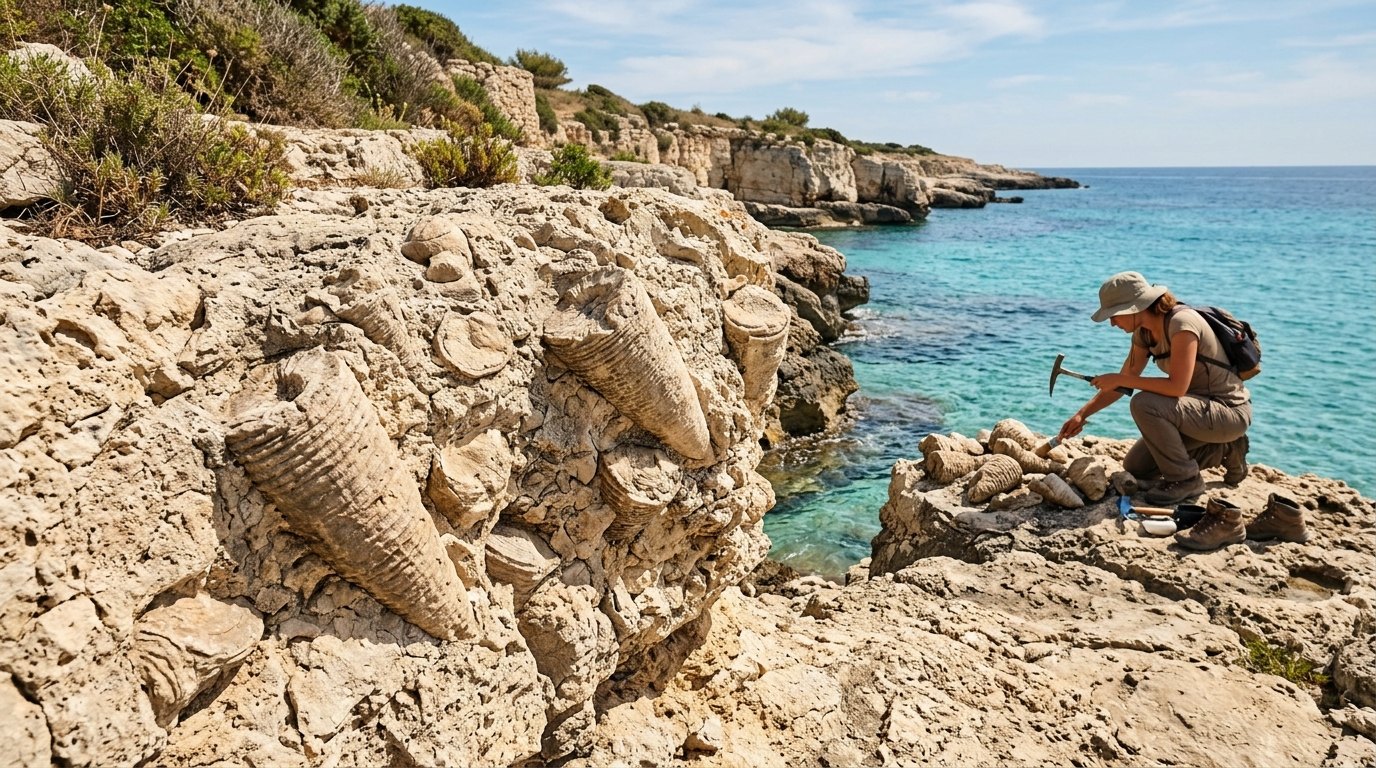
The easiest mistake is to let the word "reef" do too much modern work. Say reef and most readers picture living coral: branching colonies, clear warm water, fish moving through bright structure, calcium carbonate growing upward through animal and algal partnership. That picture is not wrong for many modern seas. It is too narrow for deep time.
Rudists are the cleanest way to break the habit. They were bivalves - relatives, in the broad molluscan sense, of clams and oysters - but they did not behave like the neat two-shelled animals a beachcomber expects. Many Cretaceous rudists grew into cones, cups, cylinders, and horns. One valve could become a tall fixed structure while the other worked more like a lid. In large numbers, those bodies made carbonate frameworks that could dominate tropical shallow seas where a modern imagination might have installed corals by default.[1][2][3]
That is why rudists are more than a fossil oddity. They teach a stricter rule: "reef" is an ecological and sedimentary job before it is a coral brand. A reef builder creates relief, hard substrate, habitat complexity, and carbonate accumulation. Corals can do that job. So can other organisms, depending on the era, water chemistry, competition, extinction, and evolutionary opportunity. Rudists matter because they make that replacement visible at organism scale.
Image context: the lead image shows actual rudist fossils in Cretaceous limestone from the United Arab Emirates.[6] It is useful precisely because the texture is not instantly coral-like. The crowded forms make the main point in stone: an ancient reef framework can be built from bodies that do not match the modern reef stereotype.
The clam that stopped looking like a clam
The basic anatomical surprise is important. Britannica's rudist entry describes them as large, unusual bivalves whose shell could pair a cylindrical or vase-like valve with a flattened cap, and it places them among Cretaceous reeflike framework builders.[1] The Cretaceous Atlas entry for Radiolitidae, one of the major rudist groups, gives the same broad pattern in taxonomic terms: radiolitids were sessile, asymmetric bivalves, often with a conical lower valve and a smaller lid-like upper valve.[2]
Those details matter because rudists were not simply clams living on reefs. In many settings, they were part of the architecture. A normal bivalve mental model emphasizes paired shells, mobility or semi-burial, and feeding from within a recognizable clam outline. A rudist model asks the reader to imagine a shell becoming a fixed vertical structure, crowded against other shells, contributing to limestone body and seafloor relief.
The Field Museum's fossil profile captures that public-facing strangeness well: a Cretaceous rudist can look more like a horn or irregular column than a familiar shell, and some forms became important reef builders before disappearing with the end-Cretaceous extinction.[3] This is the first conceptual correction. Rudists are not interesting because they were "weird clams" in isolation. They are interesting because their weirdness solved a habitat-building problem in seas that no longer exist.
Cretaceous reefs were not one ecosystem wearing coral makeup
The second correction is ecological. Britannica's Cretaceous context is blunt about the scale: rudists were generally more important than corals as framework builders in many reeflike structures, especially within the Tethyan region.[1] That does not mean rudist reefs were just coral reefs with different animals pasted on top. It means the reef function had been captured by a different biological toolkit.
That distinction changes how the Cretaceous should be pictured. The Late Cretaceous was not a modern tropical aquarium with dinosaurs in the background. Sea level, carbonate platforms, greenhouse climate, ocean chemistry, and evolutionary history all helped produce shallow-marine systems whose dominant builders could look alien to a modern snorkeler.[1][4] Rudists thrived in parts of that world because their body plans let them occupy space, bind or baffle sediment, and generate hard carbonate mass in crowded banks and reef-like accumulations.[1][2]
The word "reef-like" is doing real work here. A reef can be a rigid wave-resistant framework, a looser biostrome, a bank, a mound, or a carbonate accumulation with different degrees of relief and binding. Rudists occurred across that spectrum. Some deposits were not reefs in the postcard sense. Some were shell-rich platforms or thickets. The point is not to force every rudist bed into a coral-reef analogy. The point is to stop assuming that coral is the default answer whenever ancient shallow marine limestone gets complicated.
Diversity is the evidence, not decoration
The taxonomic spread also matters. Radiolitids were only one branch of a wider rudist radiation. The Cretaceous Atlas places radiolitids within Hippuritida and emphasizes shell asymmetry, attachment, and reefal or carbonate-platform settings.[2] A recent Journal of Paleontology paper on rudists from Upper Cretaceous strata in the Gulf Coastal Plain and Puerto Rico approaches the group from another angle: taxonomy and paleobiogeography. It treats rudists as ecologically important organisms whose distributions help reconstruct ancient shallow-marine connections and provinciality.[4]
That kind of work is easy to underappreciate because rudists can seem visually repetitive to non-specialists: many cones, many tubes, many broken sections in limestone. But the repetition is part of the archive. Species, shell microstructure, growth form, and geographic distribution can reveal how Cretaceous platforms were connected, how faunas moved across the Caribbean and Gulf margins, and how local carbonate systems differed from one another.[4]
In other words, rudists are not only impressive because some built reefs. They are useful because they help map a vanished tropical geography. A coral-default reading turns the animal into a substitute for something familiar. A paleontological reading lets the animal remain itself: a bivalve lineage with its own anatomy, radiation, habitat preferences, and biogeographic signal.
The extinction was not a minor swap of reef suppliers
Rudists also sharpen the end-Cretaceous story. They disappeared in the same broad extinction interval that removed non-avian dinosaurs, ammonites, many marine reptiles, and many planktonic groups.[3][5] Britannica's overview of the Cretaceous-Paleogene extinction names rudists among the marine losses and places them inside a much larger biological turnover at about 66 million years ago.[5]
That matters because the loss was not merely cosmetic. If an organism has become a major framework builder, its extinction removes architecture as well as species count. A rudist-rich platform is not the same system after the rudists are gone. Space opens, carbonate production changes, habitat structure shifts, and later reef histories have to be built by different organisms under different post-extinction conditions.
This is one reason rudists are a useful antidote to extinction storytelling that focuses only on charismatic animals. Dinosaurs dominate the public memory of the boundary, but the marine world lost entire ways of building habitat. Rudists make that loss tactile. The vanished body was not just an animal inside an ecosystem. In many places, it was part of the ecosystem's physical frame.
Why rudists still matter
The best use of rudists is not as trivia. "A clam built reefs" is memorable, but it is too small. The stronger lesson is that ecological roles migrate across lineages through time. Reef building is not owned permanently by one group. It is a job that different organisms can hold when anatomy, environment, and opportunity line up.
Rudists held that job spectacularly in many Cretaceous settings. Their shells became crowded architecture. Their diversity recorded marine provinces. Their success complicates any straight-line story from ancient reefs to modern coral reefs. Their extinction reminds us that habitat builders can disappear, and that when they do, the shape of the seafloor's living space changes with them.[1][3][4][5]
Read that way, rudist fossils ask for a better imagination. Do not picture the Cretaceous reef as a coral reef with older names attached. Picture a warm shallow sea where the framework may be made from asymmetric bivalves, where a shell can become a column, where carbonate platforms are built by organisms that no longer have a modern equivalent in the same role. The reef is still a reef. It just refuses the modern shortcut.
Sources
- Encyclopaedia Britannica, "rudist" - concise overview of rudists as unusual Cretaceous bivalves and reeflike framework builders.
- Cretaceous Atlas of Ancient Life, "Radiolitidae" - taxonomic and anatomical overview of a major rudist family, including asymmetric shell form and reef-like structures.
- Field Museum, "Cretaceous Rudist Bivalve and coral reefs" - specimen and educational context for rudists as dominant Cretaceous reef organisms.
- S. H. Zimmerman and colleagues, "Taxonomy and paleobiogeography of rudist bivalves from Upper Cretaceous strata, Gulf Coastal Plain and Puerto Rico, USA," Journal of Paleontology (2024) - recent taxonomic and paleobiogeographic treatment of rudists in Cretaceous shallow-marine systems.
- Encyclopaedia Britannica, "K-T extinction" - overview of the end-Cretaceous extinction, including marine losses such as rudist bivalves.
- Wikimedia Commons, "File:RudistCretaceousUAE.jpg" - source page for the real fossil photograph used as the article image.