Araripe is easy to admire too quickly. The shorthand version is simple: northeastern Brazil, extraordinary Cretaceous fossils, fish in pale stone, pterosaurs in nodules, insects and plants preserved with a delicacy that makes the rock look recently opened. That admiration is earned. It is also the first thing that has to be slowed down.
The Araripe Basin is not one magic fossil bed. It is a regional archive whose scientific value depends on keeping its preservation windows separate before putting them back together. The Geopark Araripe site places the territory in the Ceara portion of the basin, across Barbalha, Crato, Juazeiro do Norte, Missao Velha, Nova Olinda, and Santana do Cariri, with Cretaceous records roughly between 150 and 90 million years old and exceptional paleobiological diversity.[1] That is the broad frame. The useful field reading begins inside it, with a narrower distinction: Crato and Romualdo do different work.
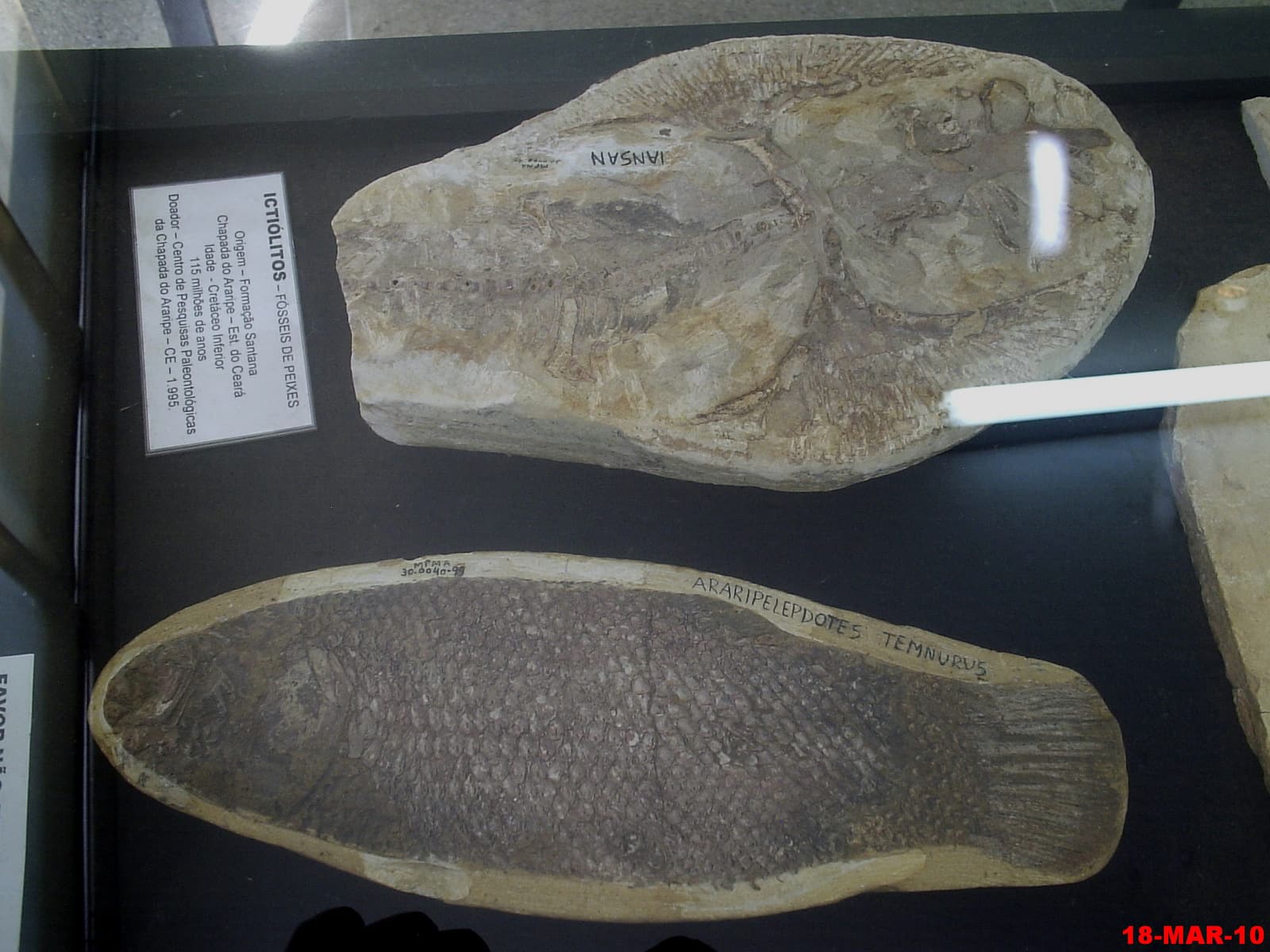
Image context: the lead image shows fossil fish from Chapada do Araripe in a museum case.[6] It is a good public doorway into the basin, but the article's main claim is that the doorway is not the whole building. Araripe becomes clearer when thin limestone slabs, carbonate concretions, dark shales, museum custody, quarrying, and fossil trafficking are read as connected but distinct parts of one archive.
Crato is the thin-sheet window
The Crato Formation is the part of Araripe that makes "fossil as page" feel literal. A 2020 lithostratigraphic study of macrofossils from the C6 layer describes active quarry faces between Nova Olinda and Santana do Cariri where laminated limestone was cut in standard 0.5 by 0.5 meter pieces, around 3 centimeters thick, before paleontological review and later commercial handling.[2] That detail matters because Crato fossils are not only scientific objects. They are also encountered through the mechanics of stone extraction.
The same study identified ten limestone levels in the upper Crato package, with differences in color, thickness, sedimentary features, and fossil content. Levels V and VI, locally associated with "Capa Derradeira" and "Lajao de Peixes," had stronger concentrations of fish, arthropods, and plants, while plants were especially abundant across the sampled outcrops.[2] This is the part of Araripe that rewards bedding-plane thinking. The fossil is often read across a surface: insect outline, fish trace, plant impression, lamination, orientation.
That makes Crato a preservation window with a particular grammar. It is strong at showing a lake-margin world in thin cross-section: repeated carbonate deposition, massed plant material, arthropods, fish, and environmental shifts inside a laminated system.[2] It should not be flattened into a generic "Santana fossil" label, because its scientific force comes from the slab itself. The slab records where the body met the bed, how the bed split, and how quarrying exposed the evidence.
Romualdo is the nodule-and-vertebrate window
Romualdo works differently. The 2020 Scientific Reports paper describing Aratasaurus museunacionali begins with the wider point: the Araripe Basin is globally known for well-preserved and diverse fossil biota, and its most fossiliferous units are the Lower Cretaceous Crato and Romualdo formations.[3] But Romualdo's public personality is more vertebrate-heavy. The same paper notes that pterosaurs are the most common tetrapods in both units, while other tetrapods are rarer, and that Araripe's previously known non-avian dinosaurs came from Romualdo carbonate-concretion levels before the new lower-section find.[3]
That sentence is doing more work than it first appears. It tells us that Romualdo is not simply the same fossil story in thicker rock. It is a unit where carbonate concretions, dark shales, pterosaurs, fish, rare dinosaurs, turtles, crocodilians, and other vertebrate signals can be assembled into a different kind of paleobiological argument.[3] The specimen described as Aratasaurus was not a complete celebrity skeleton. It was an incomplete but articulated right hind limb, housed at the Museu de Paleontologia Placido Cidade Nuvens of URCA, and interpreted as a juvenile coelurosaur about 3.12 meters long.[3] Its importance comes partly from rarity: a dinosaur signal inside a basin where pterosaurs and fish dominate the vertebrate imagination.
Romualdo also supports ecological work beyond naming animals. A 2025 Frontiers study used mercury concentrations in Romualdo fossils to test trophic relationships among an exceptionally preserved, diverse Aptian-Albian assemblage.[4] The authors treated their pterosaur results as preliminary because the sample size was small, which is exactly the kind of boundary worth preserving.[4] Still, the attempt is useful: it shows Romualdo moving from "beautiful fossil animals" toward food-web reconstruction. Fish genera, rays, and pterosaurs become possible ecological data points, not only display specimens.[4]
The basin has a custody problem, not just a preservation miracle
Araripe's beauty creates a second field problem. Fossils that split cleanly from stone, travel well, and look spectacular are also vulnerable to extraction outside scientific custody. UNESCO's account of French customs returning 998 stolen fossils to the Araripe UNESCO Global Geopark makes that plain.[5] The returned material included 348 fish more than a meter long and 650 smaller stone tiles containing insects, fish, and plants, intended for the Placido Cidade Nuvens Paleontology Museum in Araripe.[5]
That is not an administrative footnote. It changes how the basin should be read. A fossil from Araripe is not only an object with a formation name and an age. It is an object with a route: outcrop, quarry face, collection, museum, paper, illicit market, seizure, restitution, or loss. The Brazilian geological-service page for the Pedra Cariri geosite makes the same pressure visible from another direction, noting that fossil-deposit protection is increasingly important and that both mining and systematic collection for commercial specimens can affect preservation.[7]
This is why the field report has to resist the romance of the isolated specimen. A fish in a glass case is beautiful. A Crato insect on a slab is beautiful. A Romualdo pterosaur nodule can be spectacular. But the scientific value rises when those objects remain tied to stratigraphy, locality, preparation history, and institutional custody. Once those ties are cut, the fossil may still be visually impressive, but it loses part of the information that made it evidence.
The better way to read Araripe
A disciplined reading of Araripe starts with three separations.
First, separate Crato from Romualdo. Crato's laminated limestone asks surface, layer, and quarry-context questions. Romualdo's concretions and shales ask more three-dimensional vertebrate, paleoecological, and stratigraphic questions.[2][3][4] Both are exceptional. They are not interchangeable.
Second, separate fossil abundance from ecological simplicity. The basin has yielded famous fish, pterosaurs, insects, plants, turtles, crocodilians, and rare dinosaurs, but abundance in the public record does not mean every group was equally common in life or equally easy to preserve.[3][4] Pterosaurs dominate many Araripe tetrapod discussions because the record supports them there, not because every missing animal was absent from the ecosystem.
Third, separate preservation from possession. The UNESCO restitution case shows that Araripe fossils are cultural and scientific heritage, not merely collectible stone.[5] Conservation is therefore part of the paleontology. The same conditions that make a specimen legible can make it desirable, portable, and vulnerable.
Read this way, Araripe becomes larger than its postcard fossils. It is a Cretaceous basin where thin slabs and nodules preserve different kinds of life, where lake and marine-influenced settings have to be distinguished, where ecology can be reconstructed cautiously, and where local custody is not optional background. The best sentence is not "Araripe has beautiful fossils." It is sharper: Araripe matters because several preservation systems, several research traditions, and several conservation pressures meet in one place, and the fossils only keep their full meaning when those layers stay attached.
Sources
- Geopark Araripe, "Quem somos?" - official overview of municipalities, approximate area, Cretaceous age range, exceptional preservation, UNESCO recognition, and conservation goals.
- Joao Kerensky Rufino Moreira, Geraldo Jorge Barbosa de Moura, and Jose de Araujo Nogueira Neto, "Analise lito-estratigrafica dos macrofosseis da camada C6 da Formacao Crato..." Revista de Geologia (2020) - quarry procedure, limestone levels, fossil concentrations, and environmental interpretation for Crato.
- Juliana Manso Sayao and colleagues, "The first theropod dinosaur (Coelurosauria, Theropoda) from the base of the Romualdo Formation (Albian), Araripe Basin, Northeast Brazil," Scientific Reports 10 (2020) - Romualdo/Crato overview, pterosaur dominance, dinosaur rarity, and Aratasaurus description.
- Tito Aureliano and colleagues, "Reconstructing paleotrophic relationships on the Brazilian Romualdo Formation (Lower Cretaceous) through mercury analysis in fossils," Frontiers in Earth Science (2025) - preliminary food-web reconstruction from Romualdo vertebrate fossils.
- UNESCO, "French customs return 998 stolen fossils to UNESCO Global Geopark in Brazil" (2022) - restitution case, fossil counts, cultural-property framing, and local museum context.
- Wikimedia Commons, "Ictiolitos - Fosseis de Peixes/Fossil Fishs - Chapada Do Araripe/Ceara/Brasil - 115 milhoes de anos" - source page for the real museum photograph used as the article image.
- Geological Survey of Brazil, "Geossitio Pedra Cariri" - geosite record noting Crato fossil displays, Geopark Araripe context, fossil-deposit protection concerns, and mining/collection pressures.