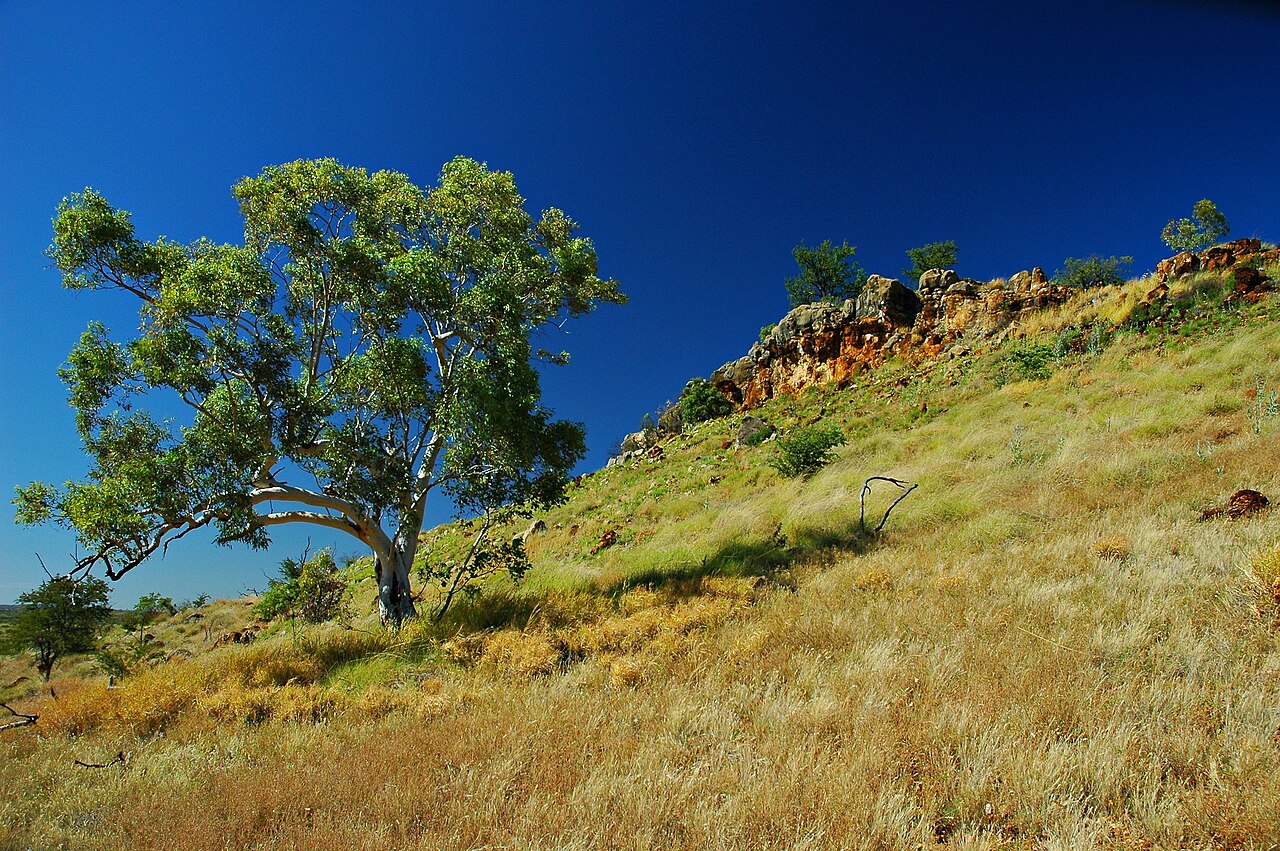
Riversleigh is most useful when the reader lets the modern landscape be a problem. The photograph shows a hot, open, grassy limestone slope in northwest Queensland. The fossils ask for a different scene: wet forest, lime-rich freshwater pools, cave floors, fissures, sinkholes, bats in dark chambers, crocodiles near water, and mammals moving through an Australia whose long isolation was building forms that would not fit comfortably into northern-hemisphere templates.[1][3]
That gap between the visible outcrop and the vanished habitat is the point. Riversleigh is not a single death scene and not just a cabinet of strange animals. It is a field archive made from many deposits, many ages, and many taphonomic pathways. The IUCN World Heritage Outlook page treats Riversleigh and Naracoorte together as the Australian Fossil Mammal Sites, inscribed in 1994, because the pair records key stages in the evolution of Australia's distinctive fauna.[1] Naracoorte carries a younger Pleistocene story. Riversleigh reaches deeper into the Oligo-Miocene, when rainforest communities gave way through time to more open and arid environments.[1][3]
The time scale must stay in view. The World Heritage Outlook assessment describes Riversleigh's fossil assemblages as spanning roughly the Late Oligocene to the present, about 25 million years, while the UNSW exhibition guide frames the Riversleigh record as a 25-million-year archive of dramatic environmental transformation.[1][3] Bassarova's taphonomic study describes more than 300 fossil sites or assemblages at Riversleigh, also spanning at least the last 25 million years.[2] The safe reading is therefore a stacked archive, not a frozen afternoon.
The rock explains why the archive is so rich. Bassarova describes Riversleigh sites as Tertiary limestones formed in fluvio-lacustrine, cave, sinkhole, or fissure-fill situations.[2] The UNSW exhibition guide adds the lab-facing detail: field teams quarry hard limestone into blocks, then use dilute acetic acid to dissolve the limestone and leave chemically fortified fossils exposed.[3] Those words matter because they keep the fossils from becoming generic bones in rock. Some remains accumulated in water-related settings. Some entered caves. Some fell or washed into openings in karst. Some assemblages preserve local ecological signals; others are filtered by transport, trapping, scavenging, digestion, weathering, or breakage.[2]
That is why the field report should begin with process before celebrity animals. Riversleigh's public reputation is full of memorable names: pouched lions, carnivorous kangaroos, giant flightless birds, tree-climbing crocodiles, fossil thylacines, and the old rainforest mammals that make modern Australia feel like a narrowed remnant rather than the whole story.[3][4] Those animals are real evidence, but the deeper scientific claim is that the deposits preserve enough of a long-changing ecosystem to let researchers compare body plans, habitats, communities, and extinction risk across time.[1][2][3]
D Site makes the method visible. The Commons source for the lead photograph identifies the outcrop as one of the first sites where fossil mammals were discovered at Riversleigh and the only site open to the public.[5] It looks modest because field evidence often does. There is no obvious giant skeleton in the frame. The slope matters because it is an access point into a limestone system where fossil-bearing rock has to be read as place, deposit, age, and preservation history together.
The biggest mistake is to treat Riversleigh as a monster catalogue. The UNSW exhibition guide lists the kinds of entry-point animals that make the site memorable: marsupial lions, flesh-eating kangaroos, tree-climbing crocodiles, thylacines, sloth-like marsupials, and other forms now known mainly through Riversleigh's fossil record.[3] The UNSW anniversary account adds the same public-facing shock: giant toothed platypuses, dromornithid birds, flesh-eating kangaroos, tree-dwelling marsupials, and deep-headed land crocodiles.[4] The list is startling, but each example is also a habitat clue. The animals point back to forest structure, water bodies, predator guilds, and the way Australia's mammals and reptiles filled roles under continental isolation.
The bat record sharpens the same lesson. The exhibition guide says palaeontologists have identified at least 44 species of previously unknown extinct fossil bats from Riversleigh deposits, many from fossil cave settings.[3] Bats are not a sideshow here. Cave and karst settings can concentrate bat remains, and a rich bat record turns the site from a marsupial spectacle into a broader ecological instrument: flight, roosting, insect prey, cave use, and rainforest structure all become part of the reconstruction.
The mammal story also reaches living groups in unexpected ways. The World Heritage Outlook assessment notes that Riversleigh provides first fossil evidence for distinctive living groups such as marsupial moles and feather-tailed possums, and the exhibition guide adds first known fossil records for groups such as lyrebirds and striped possums.[1][3] That is a different kind of value from a famous single specimen. Riversleigh is important because it links vanished lineages, living-lineage origins, and environmental change inside one regional record.
UNSW's accounts show how far that preservation can go beyond ordinary bones. The exhibition guide describes the Riversleigh Project as Australia's longest continually running paleontological project, with annual returns across roughly 50 years and collaborators from many institutions.[3] The UNSW anniversary account notes preservation of plants, insects, internal organs, soft tissues, and even fossilized sperm cells with nuclei in 17-million-year-old material.[4] Those are not throwaway curiosities. They show why Riversleigh is a preservation problem as much as a faunal one: limestone deposits can hold biological detail that changes what questions are possible.
Taphonomy keeps that excitement disciplined. Bassarova's study examined six Riversleigh sites ranging from late Oligocene to late Miocene and possibly younger, assessing whether mammal remains were locally derived by checking abrasion, breakage, weathering, digestion or scavenging traces, and skeletal-part representation.[2] That is the unglamorous work behind any confident ecological claim. A deposit full of bones is not automatically a community snapshot. It might be a trap, a den, a washed-in concentration, a cave-floor accumulation, or a time-averaged mix.
This is also why age control matters. Bassarova notes that absolute dating of Riversleigh sites has been a major challenge and that temporal relationships have depended on biocorrelation and stratigraphic analysis.[2] A reader should resist any simple sentence that makes "Riversleigh" stand for one exact moment. The site is a set of windows through time. Some windows may show animals close to where they lived and died. Others may show a filtered record of what water, caves, predators, and decay allowed to survive.
The environmental arc is still strong. The World Heritage Outlook assessment says Riversleigh assemblages document habitat change from humid lowland rainforest toward dry forests, woodlands, and grasslands.[1] The exhibition guide puts the same arc in reader-facing terms: ancient rainforests were reshaped over time into the open forests, woodlands, and grasslands of today.[3] This is the article's central frame: Riversleigh is not just old Australia. It is a record of how a changing continent sorted life through forests, pools, caves, limestone, and time.
Seen that way, the outcrop in the lead image becomes less plain. Its dry grass and exposed rock are the last page of a long archive. Beneath the ordinary slope sits a record made by carbonate water, karst openings, animal movement, decay, trapping, and research labor. Riversleigh matters because it turns the Australian mammal story into a sedimentary problem. The animals are memorable, but the archive is the bigger achievement: limestone made a vanished rainforest legible after the forest itself was gone.
Sources
- IUCN World Heritage Outlook, "Australian Fossil Mammal Sites (Riversleigh / Naracoorte)" - World Heritage context, criteria, fossil values, faunal change, and conservation assessment.
- Mina Bassarova, "Taphonomy of Oligo-Miocene fossil sites of the Riversleigh World Heritage Area, Australia," Ameghiniana 41, no. 4 (2004) - deposit types, site count, dating caveats, and taphonomic method.
- UNSW Library, Revealing Riversleigh: Exhibition Guide (2025) - project history, limestone preparation, AL90 cave context, fossil bats, and rainforest-to-grassland framing.
- Lachlan Gilbert, "Plenty of life in them yet: 25 years since World Heritage listing of Riversleigh fossils," UNSW Sydney, 2019 - research history, notable taxa, and preservation examples.
- Wikimedia Commons, "File:D Site, Riversleigh, Australian Fossil Mammal Site.jpg" - source page for the real D Site photograph used as the lead image.