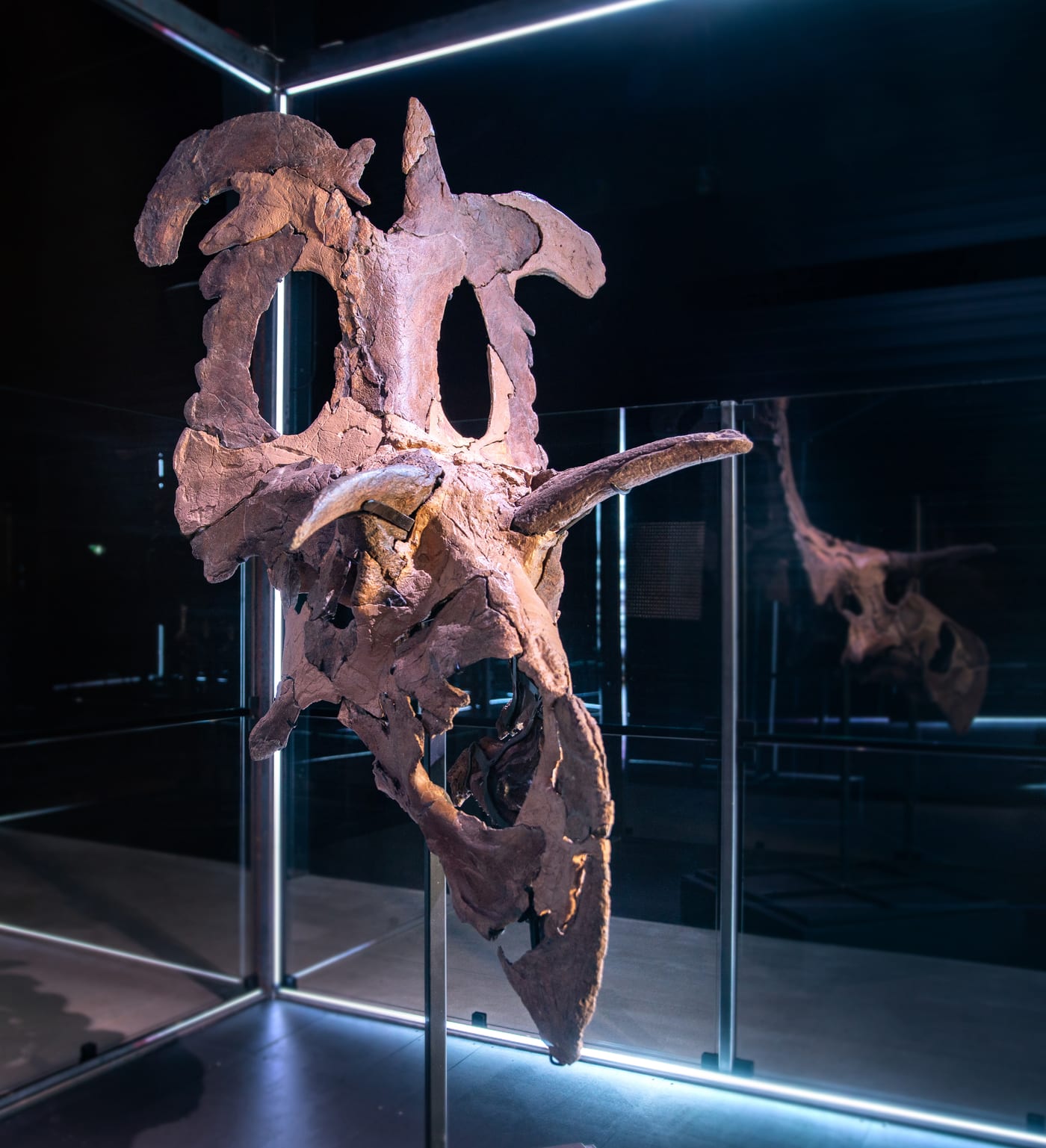
Lokiceratops rangiformis is almost impossible to introduce without sounding theatrical. The name points to Loki. The species name points to caribou-like asymmetry. The mounted skull looks like a horned animal that has been pushed to the edge of display logic: long brow horns, a broad frill, and large curved ornaments along the rear margin. But the most useful way to read the fossil is not as a bigger costume for the ceratopsian stage. It is a local radiation problem made visible by one skull.
The 2024 description placed Lokiceratops in the lower McClelland Ferry Member of the Judith River Formation, from the Kennedy Coulee region along the Canada-USA border.[1] That geography matters as much as the horns. The same paper argued that nearby, roughly equivalent horizons in northern Montana and southern Alberta preserve an unusually crowded ceratopsid scene: four sympatric centrosaurines and one chasmosaurine from a small regional interval.[1] In that frame, the skull is not just showing off. It is evidence for how fast, how locally, and how extravagantly horned dinosaurs could diversify.
The lead photograph shows why the animal tempts exaggeration. A mounted ceratopsian skull is built for first impressions. Yet the scientific story begins by slowing the view down. The holotype, EMK 0012, is an associated but disarticulated skull and partial skeleton, not a complete body pulled whole from the rock.[1] The mandible was not found with the specimen, and parts of the mounted skull rely on reconstruction and cast support.[1] That does not weaken the fossil. It tells us what kind of evidence we have: enough skull to diagnose a new animal, enough missing anatomy to keep the reconstruction honest.
The Frill Is Evidence, Not Just Ornament
The public hook for Lokiceratops is its headgear, but the diagnostic details are more precise than "big horns." The PeerJ description identified an unadorned nasal region, elongate ornamentation along the rear edge of the parietosquamosal frill, a hypertrophied laterally curving epiparietal, deeply excavated postorbital horncore bases, and a kinked ischium among the key features.[1] The Natural History Museum of Utah summarized the same animal for a general audience as a large centrosaurine lacking the usual nose-horn emphasis and carrying huge blade-like frill horns.[2]
That distinction matters because ceratopsian skulls are easy to read like logos. A horn becomes a brand. A frill edge becomes a silhouette. A named dinosaur becomes a trading card. The fossil record asks for a tougher reading. In Lokiceratops, the rear-frill ornaments are important because they sit inside a comparative framework: what differs from Medusaceratops, Albertaceratops, Wendiceratops, and other nearby or related forms?[1][5] The article is not simply saying "this skull looks different." It is saying that the difference falls in repeatable anatomical positions that can be compared across taxa.
The absence of a nose-horn centerpiece is part of the same argument. Many public images of horned dinosaurs are built around the nasal horn, because Triceratops trained the eye that way. Lokiceratops pushes attention backward, toward the frill margin and lateral ornament. That does not mean the animal was "more advanced" or "more bizarre" in a ladder-like sense. It means centrosaurines were distributing display anatomy across the skull in different ways, and this specimen preserves one of those local solutions.[1][2]
The Quarry Narrows The Claim
The fossil is also unusually place-bound. EMK 0012 came from Loki Quarry in Kennedy Coulee, south of the Milk River in northern Montana, about 3.6 kilometers from the Montana-Alberta border.[1] The paper ties the horizon to the lower Judith River Formation and correlates it with the McClelland Ferry Member to the south and the lower Oldman Formation in Alberta.[1] Those correlations are not decorative stratigraphy. They decide whether several horned dinosaurs are truly close neighbors in time or only appear crowded because the rock record has been blurred.
The authors put the quarry near other important ceratopsian sites in a narrow package of mudstones, siltstones, sandstones, and carbonaceous seams, with Medusaceratops from the Mansfield Bonebed occurring at a close stratigraphic level.[1][5] They also used volcanic ash dates and newer age modeling to frame the Lokiceratops interval near 78 million years ago.[1] The safe reading is not "all these animals posed together." It is that northern Laramidia preserves a surprisingly dense, closely spaced ceratopsid record around this interval.
That is why Lokiceratops is a fossil-find close reading rather than a species postcard. If the skull came from an isolated quarry with no nearby comparators, the story would be mostly diagnosis: new animal, new name, striking horns. Because it comes from a region already thick with ceratopsian finds, the skull changes the scale of the question. How many horned dinosaurs could share a landscape? How restricted were their ranges? How often did headgear mark small regional lineages rather than continent-wide types?
Local Diversity Was Already A Live Debate
The Lokiceratops paper did not invent Laramidian endemism as an idea. A 2010 PLOS ONE study on Utah ceratopsids argued that late Campanian horned dinosaurs from southern Laramidia supported a pattern of intracontinental dinosaur endemism.[4] That earlier work helped make dinosaur provinciality a serious research frame: perhaps northern and southern faunas differed sharply across the Western Interior, not merely because collectors had sampled unevenly but because dinosaur lineages were regionally structured.[4]
Lokiceratops sharpens that conversation at a smaller scale. The describing authors place Lokiceratops, Albertaceratops, and Medusaceratops within Albertaceratopsini, a clade restricted to a small part of northern Laramidia around 78 million years ago.[1] They contrast that with other centrosaurine clades distributed elsewhere, including southern Nasutuceratopsini and more northern groups.[1] The point is not that every valley had a unique horned dinosaur. The point is that centrosaurine evolution may have been more geographically partitioned than a broad-brush map of western North America suggests.
This is where the horns become biological evidence without becoming a simple sexual-selection fable. The paper treats regional endemism as associated with high speciation rates and diversity, and it offers several possible drivers, including competition, sexual selection, and uneven climatic or floral gradients.[1] Those are hypotheses, not a finished script. The skull ornaments may have mattered for display, recognition, or mate choice, but the fossil cannot show the social behavior directly. What it can show is that display-bearing skull architecture differed sharply among closely placed taxa.
Comparison Keeps The Name Honest
The hardest part of a new dinosaur is not the announcement. It is the boundary. Is the fossil a new genus, a species-level variant, a growth stage, a distorted individual, or a member of a known taxon with unexpected anatomy? Lokiceratops is strongest when that taxonomic pressure stays visible.
The nearby Medusaceratops record is a useful caution. New material and systematic reevaluation have already changed how paleontologists read Medusaceratops lokii from the Judith River Formation.[5] That kind of revision is normal science, not instability for its own sake. Ceratopsian skulls preserve a rich mixture of species signal, growth change, sexual or individual variation, and deformation. A new name must therefore survive comparison with the regional record, not just look spectacular in isolation.
The Lokiceratops authors address that directly by listing differences from stratigraphically proximate taxa, including Medusaceratops, Albertaceratops, Wendiceratops, and the chasmosaurine Judiceratops.[1] Their case depends on patterns: nasal ornamentation versus an unadorned nasal, number and form of epiparietals, frill-edge shapes, horncore pneumaticity, squamosal shape, and the kinked ischium.[1] The better public memory is therefore not "new dinosaur with wild horns." It is "new diagnosis built from a skull and partial skeleton in a crowded regional comparison set."
The Museum of Evolution's role also matters here. EMK 0012 is reposited at Evolutionsmuseet, Knuthenborg, in Maribo, Denmark, and the museum describes the authentic fossils as on display there.[1][3] The paper notes that legal ownership was transferred to the museum and that the specimen is available to researchers.[1] For a privately collected or internationally displayed fossil, that access point is not a footnote. The specimen has to remain examinable if the diagnosis is going to be tested, challenged, or refined.
A Better Way To Remember Lokiceratops
The cleanest way to remember Lokiceratops is to resist making it a horn contest. It may have been among the largest known North American centrosaurines, and the frill ornaments are genuinely dramatic.[2] But size and drama are not the core. The animal matters because the skull makes local diversity visible.
At the specimen level, Lokiceratops is a partly reconstructed mounted skull and partial skeleton with a strong but bounded diagnosis.[1][6] At the quarry level, it sits in a narrow Judith River and Oldman regional problem, close to other horned dinosaur localities whose exact stratigraphic relationships matter.[1][5] At the evolutionary level, it supports a picture of centrosaurines radiating in geographically restricted ways, with skull display evolving fast enough that small regions could host several distinct horned forms at nearly the same time.[1][4]
That is more interesting than the easy version. A monster headline turns the animal into a costume. A close reading turns the horns into evidence. Lokiceratops asks us to treat a frill not as a decorative edge but as a map of local evolution: bone, quarry, comparison, and geography all pressed into one skull.
Sources
- Mark A. Loewen et al., "Lokiceratops rangiformis gen. et sp. nov. (Ceratopsidae: Centrosaurinae) from the Campanian Judith River Formation of Montana reveals rapid regional radiations and extreme endemism within centrosaurine dinosaurs," PeerJ 12 (2024), open full text via PubMed Central.
- Natural History Museum of Utah, "New, giant horned dinosaur discovered in the ancient swamps of Montana" (June 20, 2024) - public research summary, locality, horn anatomy, and regional diversity context.
- Museum of Evolution, "International Research Team Discovers a Brand-New Dinosaur Species Named After a Norse God: Now Exhibited in Denmark" (June 20, 2024) - museum repository and exhibit context.
- Scott D. Sampson et al., "New Horned Dinosaurs from Utah Provide Evidence for Intracontinental Dinosaur Endemism," PLOS ONE 5, no. 9 (2010) - broader Laramidian endemism context.
- Michael J. Ryan et al., "New material and systematic re-evaluation of Medusaceratops lokii (Dinosauria, Ceratopsidae) from the Judith River Formation (Campanian, Montana)," Journal of Paleontology 91, no. 2 (2017) - nearby taxon and Judith River comparison context.
- EurekAlert / Colorado State University, "Lokiceratops reconstructed skull" - source page for the real mounted-skull photograph used as the lead image.