Blastoids are easy to dismiss for exactly the reason they are useful. A common Pentremites theca looks like a small rounded nut with a five-petaled star stamped into the top. The nickname "fossil hickory nut" catches the shape and loses the animal. A better anatomy reading starts by refusing both shortcuts: a blastoid was not a plant bud, not a loose crinoid head, and not a decorative symmetry exercise. It was a stalked Paleozoic echinoderm whose hard parts turned current, posture, feeding, breathing, and preservation into one compact system.[1][3]
The time range gives the group its first boundary. UCMP describes blastoids as extinct echinoderms that originated in the Ordovician, reached their greatest diversity in the Mississippian, and persisted until the end-Permian extinction.[1] Missouri's geological survey gives the broader public range as early Silurian to late Permian, roughly 440 to 255 million years ago.[4] Either framing puts the familiar Pentremites fossils inside a long Paleozoic experiment in how to live attached to the seafloor while harvesting suspended food from moving water.
The method problem is that the most durable part is not always the whole organism. The theca, or calyx, was a tight shell of interlocking calcite plates that housed the organs.[1][3] It fossilized well because the plates held together after death.[1] Stems, rootlets, and delicate feeding structures were much easier to scatter, decay, or lose from a slab.[3][4] That is why many blastoid fossils arrive as isolated thecae. The surviving object is central, but it is also biased. A good reading has to reconstruct the living animal from the part most likely to survive.
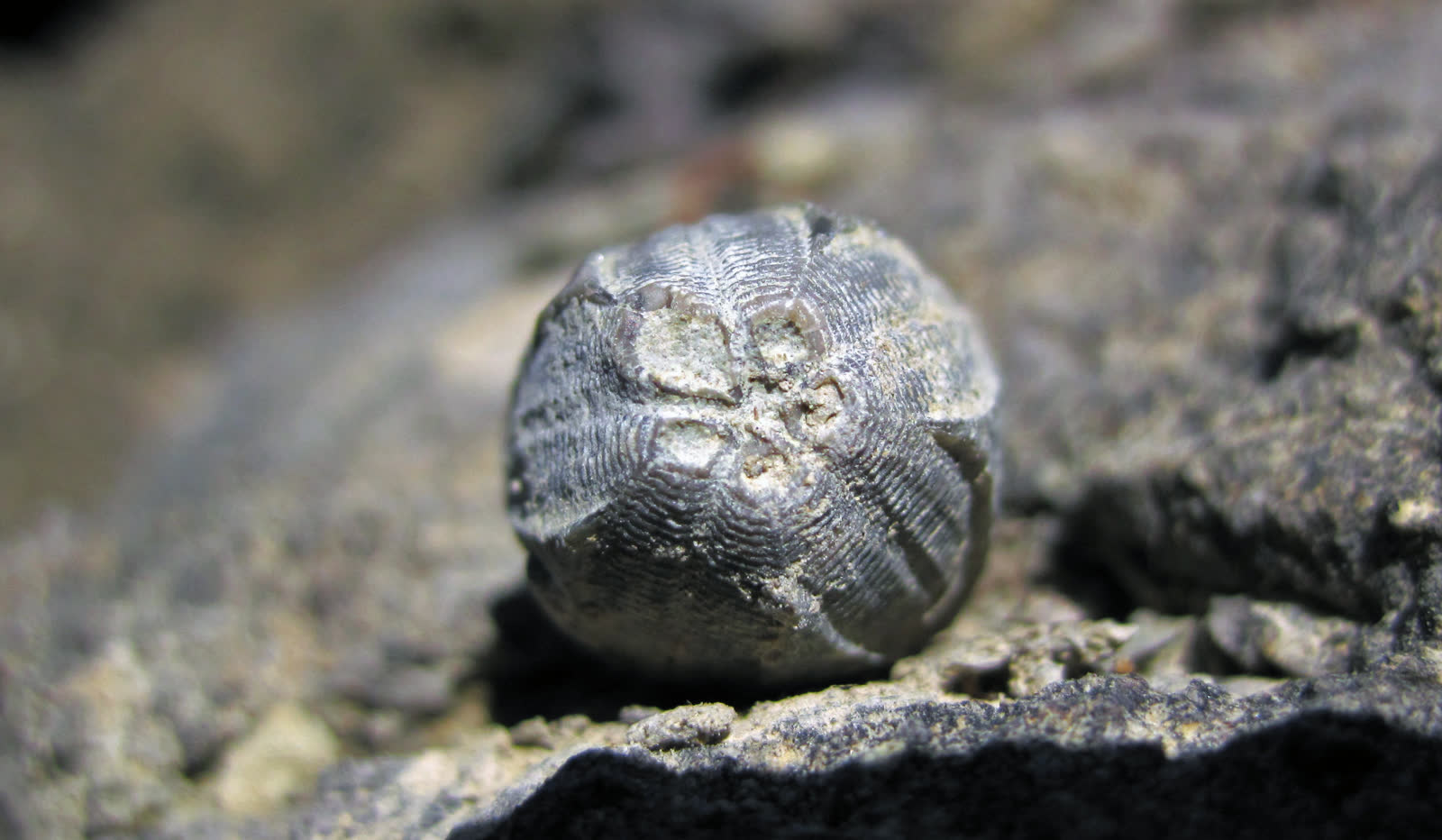
Image context: the lead image uses a real Wikimedia Commons photograph of Pentremites meganae from the Upper Mississippian Glen Dean Formation of Kentucky.[6] It suits this article because a summit view shows the feature that makes blastoids legible: five ambulacral fields radiating around the mouth region. The photograph also shows what is missing. The brachioles that once extended from those fields are gone, so the visible fossil has to be read as a durable frame for a more delicate feeding apparatus.
The fivefold pattern is the core. In a typical blastoid, the mouth sat at the summit of the theca. Five ambulacra radiated outward and downward from that summit like grooves in a star.[1][3] Along those ambulacra, fine brachioles extended in life and captured small food particles from seawater, moving food toward the mouth.[1][2][3] The fossil therefore does not show a decorative flower. It shows the anchor points and traffic lanes of a suspension-feeding animal.
That matters because the brachioles are usually the least visible part of the story. Palaeontology Online notes that the stem generally lifted the animal above the seafloor and that the brachioles aided feeding, but also stresses how much remains uncertain about their exact posture and performance.[2] Some interpretations imagine flexible brachioles moving passively with current; others treat them as more rigid structures held out from the theca. Work with digital models and fluid-flow simulations has been used to test how water speed and reconstructed brachiole arrangement might have affected feeding.[2] In other words, blastoid anatomy is not settled by naming the parts. The living machine has to be tested against current.
The respiratory system makes the summit even stranger. Around the star-shaped mouth, small openings led into folded respiratory organs called hydrospires; the larger nearby opening was the anus.[1][3] Kentucky's Pentremites guide is useful because it puts these openings at hand-specimen scale: a reader can look at the summit and see not just symmetry but a packed interface where feeding grooves, mouth, spiracles, and waste exit all crowd into a small top surface.[3] The theca was not simply armor. It was a controlled exchange surface.
This is where comparison with crinoids helps and then has to stop. Blastoids and crinoids were both stalked, benthic, filter-feeding echinoderms, and both attached to the seafloor by a column in many forms.[1][4] But their feeding architecture differed. Crinoids present arms in a way that can make the blastoid look like a miniaturized relative with the arms removed. That is the wrong endpoint. Blastoids concentrated their working anatomy into a closed theca, five ambulacra, brachioles along the margins, and hydrospires inside the body wall.[1][3][4] The animal was not a simplified crinoid. It was a different way to solve stalked suspension feeding.
Preservation reinforces the point. Missouri DNR notes that blastoid arms, stems, and rootlets readily fell apart after death, while the calyx resisted disarticulation and became the main fossil evidence.[4] That selective survival explains why public memory often mistakes the animal for the theca alone. A living blastoid had height, attachment, food-collecting appendages, respiratory folds, and a current-facing posture. A collected blastoid often has only the hard seed-like capsule. The gap between those two states is the method problem.
Modern morphometrics shows how much information still remains in that capsule. Atwood and Sumrall's 2012 study of the Glen Dean Formation Pentremites fauna used 3D laser scanning and landmark analysis to quantify thecal shape in specimens from a single Upper Mississippian shale unit near Hopkinsville, Kentucky.[5] Their mixture modeling separated four species by shape alone and identified three new species, including Pentremites meganae, the species represented in the lead image.[5][6] That result is a useful correction to the "fossil nut" joke. Subtle curvature, ambulacral form, vault shape, and plate geometry can carry taxonomic signal when measured carefully.
Kentucky Geological Survey makes the same caution in a more field-facing way. More than 40 Pentremites species have been reported from Mississippian rocks in Kentucky and surrounding states, but many older names have been collapsed or treated as less useful because the shape differences were not always strong enough.[3] The current lesson is not that every little blastoid variation deserves a name. It is that species claims have to be disciplined by measurable shape, comparable specimens, and stratigraphic context.
The ecological setting also keeps the animal from becoming a loose museum token. Missouri DNR places blastoids in marine environments with enough water agitation for filter feeding and notes their common association with rugose corals, fenestrate bryozoans, brachiopods, and crinoids.[4] That is a working community, not a blank seafloor. A blastoid needed current, attachment, and enough elevation or exposure for the brachioles to meet suspended particles. The theca's beautiful symmetry only matters because it sat inside that moving water.
The safest reconstruction is therefore layered. High confidence: blastoids were extinct stalked echinoderms with durable plated thecae, five ambulacra, brachioles used in suspension feeding, and hydrospires tied to respiration.[1][3][4] Strong inference: their success depended on posture and current flow, but the exact behavior of the brachioles remains model-sensitive because those structures are rarely preserved in place.[2] Method boundary: isolated thecae are abundant and informative, but they are not the whole animal.[4][5]
Read this way, the small fossil becomes more impressive, not less. The nut shape is a preservation artifact of success: a compact, well-armored body that survived when softer working parts disappeared. The five-pointed top is not ornament. It is the trace of food handling, respiration, and anatomical integration compressed into a fossil small enough to vanish in a hand sample. Blastoids matter because they make paleontology do the honest work between a durable object and a living system.
Sources
- University of California Museum of Paleontology, "Introduction to the Blastoidea" - anatomy, time range, theca preservation, ambulacra, brachioles, and hydrospires.
- Sarah Sheffield and Bradley Deline, "Fossil Focus: Blastoids," Palaeontology Online - functional interpretation, brachiole uncertainty, and fluid-flow modeling context.
- Kentucky Geological Survey, "Fossil of the month: Pentremites" - hand-specimen anatomy, Kentucky occurrence, species caveats, and Pentremites morphology.
- Missouri Department of Natural Resources, "Blastoids - PUB2914" - Paleozoic range, calyx preservation bias, ecology, and associated marine fossils.
- James W. Atwood and Colin D. Sumrall, "Morphometric investigation of the Pentremites fauna from the Glen Dean Formation, Kentucky," Journal of Paleontology 86, no. 5 (2012).
- Wikimedia Commons, "File:Pentremites meganae (fossil blastoid) ... 3 (41631173074).jpg" - source page for the real fossil photograph used as the lead image.