Elasmosaurus platyurus is famous for one measurement so extreme that it can erase the rest of the animal: the neck. That is how it slides so easily into the old sea-serpent imagination, all curve and spectacle. But the better reading is more mechanical and more interesting. Elasmosaurus was not simply a reptile with "a very long neck." It was a Late Cretaceous marine predator that pushed reach out in front of a compact four-flipper body while keeping the head small and the bite relatively delicate.[1][2][3][4] The body plan only makes sense when those features are read together.
The history of the specimen points in the same direction. The Kansas fossil was so anatomically strange that Edward Drinker Cope famously put the head on the wrong end in his first reconstruction.[1][5] That error has become paleontological gossip, but it is also a clue. The proportions of Elasmosaurus were not merely large. They violated the expectations nineteenth-century comparators brought to big reptiles in the water. Modern work has not made the animal less strange. It has made the strangeness more measurable.[1][2][3]
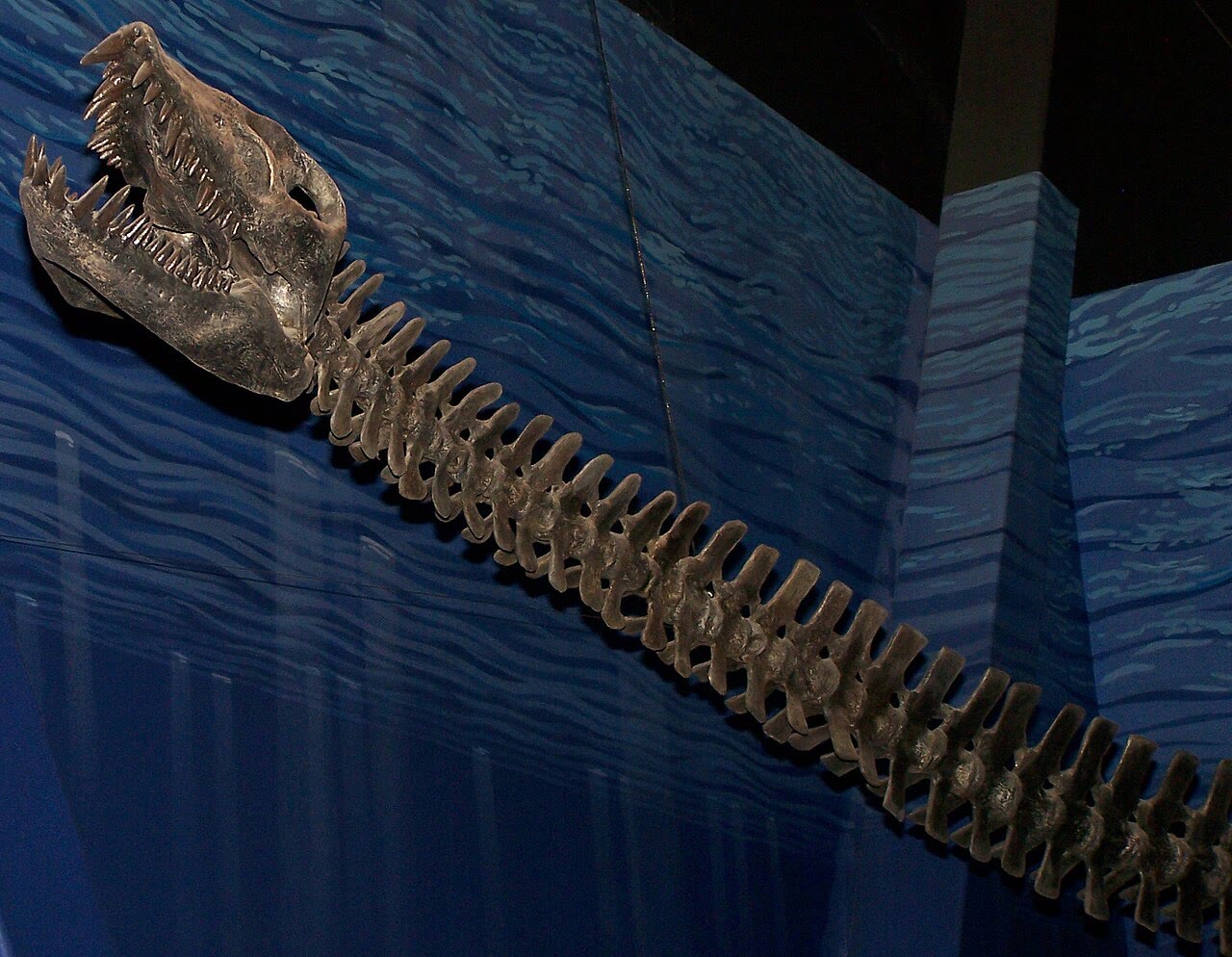
Image context: the cover uses a real photographic museum image of an Elasmosaurus skull from Wikimedia Commons rather than a life restoration.[6] That choice matters because this article is about anatomy and evidence boundaries. A skull on display keeps attention on preserved structure: narrow jaws, tooth placement, and the mismatch between the small head and the immense neck behind it.
1) Kansas first, legend second
The type specimen of Elasmosaurus platyurus came from western Kansas, near Fort Wallace, in rocks assigned to the Sharon Springs Shale Member of the Pierre Shale, a lower Campanian marine setting.[1][5] Sven Sachs's 2005 redescription still gives the cleanest specimen-level account: parts of the skull, an almost complete vertebral column, and girdle elements from the holotype ANSP 10081.[1] The Kansas Geological Survey places the discovery in a larger regional frame, noting that Cope's description of Elasmosaurus marked the first recorded vertebrate fossil from the Upper Cretaceous of Kansas.[5]
That geographic frame matters because it keeps the animal inside the Western Interior Seaway rather than outside it as a cartoon monster. Kansas in the Late Cretaceous was marine, and Elasmosaurus belongs to that world of open water, shale deposition, and large swimming reptiles.[1][5] The fossil is therefore not just "the long-necked one." It is one of the signature products of an inland sea that preserved marine bodies on a continental scale.
The discovery history also explains why the taxon stayed culturally famous. Army physician Theophilus H. Turner found the remains in 1867, the Academy of Natural Sciences backed recovery of the rest, and Cope rushed into description in 1868.[1] The speed helped produce the famous reconstruction mistake. It also ensured that Elasmosaurus entered paleontology early enough to become a template for what an elasmosaurid even was.
2) The neck is not one fact. It is an entire anatomical budget
Later work has made the neck more precise instead of merely more legendary. The 2013 PLOS ONE reassessment by O'Keefe and Hiller documented a "lost" cervical centrum and argued that the maximum number of neck vertebrae preserved in E. platyurus is 72, making the animal one of the longest-necked vertebrates ever known.[2] The Natural History Museum summarizes the result in more reader-facing terms: 72 neck vertebrae and a neck more than seven meters long.[4]
Those numbers are impressive, but the 2024 analysis by Jose Patricio O'Gorman helps explain why they should not be read as a counting stunt.[3] His study focuses on elongation patterns and on how taphonomic distortion can mislead vertebral indices. The important takeaway is that elasmosaurid neck extremity is not produced by count alone. Vertebral shape matters too, and Elasmosaurus belongs inside the extreme end of that design space.[3]
This is why "long neck" is an incomplete description. A giraffe, a swan, and an elasmosaurid can all be called long-necked, but they arrive there through different structural compromises. In Elasmosaurus, the neck is a major redistribution of the body plan: an immense cervical chain placed in front of a comparatively small head and a trunk that still has to be propelled through water by four large paddles.[2][3][4] That budget has consequences for what the animal could plausibly do.
3) The skull keeps the feeding question honest
Sachs's redescription is useful here because it puts detail back into a head that is easy to forget.[1] The preserved premaxillae indicate six teeth per side, and the jaws carried prominent fang-like teeth rather than a crushing or shearing apparatus.[1] That does not give a complete menu by itself, but it does constrain the style of feeding. The skull is narrow, the teeth are built to seize, and the whole front end looks much better suited to gripping manageable prey than to dismembering something large and resistant.[1][4]
This is where interpretive discipline matters. Fossil evidence gives the anatomy directly. Ecology has to be inferred from that anatomy, from broader elasmosaurid comparisons, and from biomechanical work on the neck.[1][2][4] The safest version of the claim is also the strongest one: Elasmosaurus was probably not a brute-force macropredator. Its head and dentition fit a reach-and-grab envelope better than a bone-splitting one.
That is also why the skull deserves to sit near the center of the article instead of at the margins. A popular silhouette of Elasmosaurus can make the animal look like "mostly neck." The fossil skull corrects that impression. The business end is small. The animal's advantage was not head size. It was the distance at which that head could be placed in front of the body.[1][6]
4) Reach is not the same thing as unlimited flexibility
The old swan-neck image assumed that a longer neck automatically meant broad, graceful motion in every direction. That is not what later biomechanical work suggests. In their study of elasmosaur neck flexibility, Maria Zammit and colleagues used associated cervical series to measure potential flexion and framed the result around feeding constraints rather than spectacle.[7] The long neck was functionally important, but it was not a free-form hose.
That conclusion aligns well with how later papers talk about the vertebral column. O'Keefe and Hiller's discussion of the cervical-dorsal transition emphasizes that the series is anatomically structured, with distinct pectoral vertebrae marking the handoff from neck to trunk.[2] In other words, the neck is long because it is built from many coordinated elements, not because it abandoned mechanical boundaries.
So what does that imply in life? It implies a predator whose trunk and paddles did much of the transport work while the neck extended the strike zone forward.[4][7] That is a different idea from a reptile holding its head high like a swan, or knotting itself into dramatic loops above the surface. Some movement was clearly available. Unlimited posing is the part that belongs to artwork, not to the preserved column.
5) Why Elasmosaurus still matters
Plenty of fossil animals are memorable because they are big. Elasmosaurus stays memorable because it reorganized size in an unusual way. Instead of putting mass into a huge skull, a battering torso, or visibly weaponized jaws, it invested heavily in distance.[1][2][3] The body remained a four-flipper marine chassis. The head stayed comparatively slight. The neck did the extravagant work.
That is why Cope's first mistake still has explanatory value. The animal confounded a talented anatomist because its proportions were genuinely counterintuitive.[1][5] Modern redescription, recounting, and elongation analysis have not dissolved that problem; they have clarified it. Elasmosaurus was built for reach, not for theatrical swan poses and not for a giant-mouthed ambush fantasy.[2][3][7]
Read that way, the species profile becomes cleaner. Elasmosaurus is not a sea-serpent icon accidentally touched by science. It is a precisely weird marine reptile whose neck, skull, and paddles only make sense as one integrated feeding design.
Sources
- Sven Sachs, "Redescription of Elasmosaurus platyurus Cope 1868 (Plesiosauria: Elasmosauridae) from the Upper Cretaceous (lower Campanian) of Kansas, U.S.A." Paludicola 5(3) (2005) PDF.
- F. Robin O'Keefe and Nate Hiller, "Revised Vertebral Count in the 'Longest-Necked Vertebrate' Elasmosaurus platyurus Cope 1868, and Clarification of the Cervical-Dorsal Transition in Plesiosauria," PLOS ONE 8(8) (2013).
- Jose Patricio O'Gorman, "How Elongated? The Pattern of Elongation of Cervical Centra of Elasmosaurus platyurus with Comments on Cervical Elongation Patterns among Plesiosauromorphs," CONICET repository page for Diversity 16(2) (2024).
- James Ashworth, "What is a plesiosaur? The prehistoric sea creatures that inspired the Loch Ness Monster," Natural History Museum.
- Karl M. Waage, "Geology of Wallace County -- Introduction," Kansas Geological Survey Bulletin 18 (1931), on the discovery context of Elasmosaurus platyurus.
- Wikimedia Commons file page for the lead image, "Elasmosaurusskull.jpg."
- Maria Zammit, Christopher B. Daniels, and Benjamin P. Kear, "Elasmosaur (Reptilia: Sauropterygia) neck flexibility: Implications for feeding strategies," DOI landing page for Comparative Biochemistry and Physiology Part A 150(2) (2008).