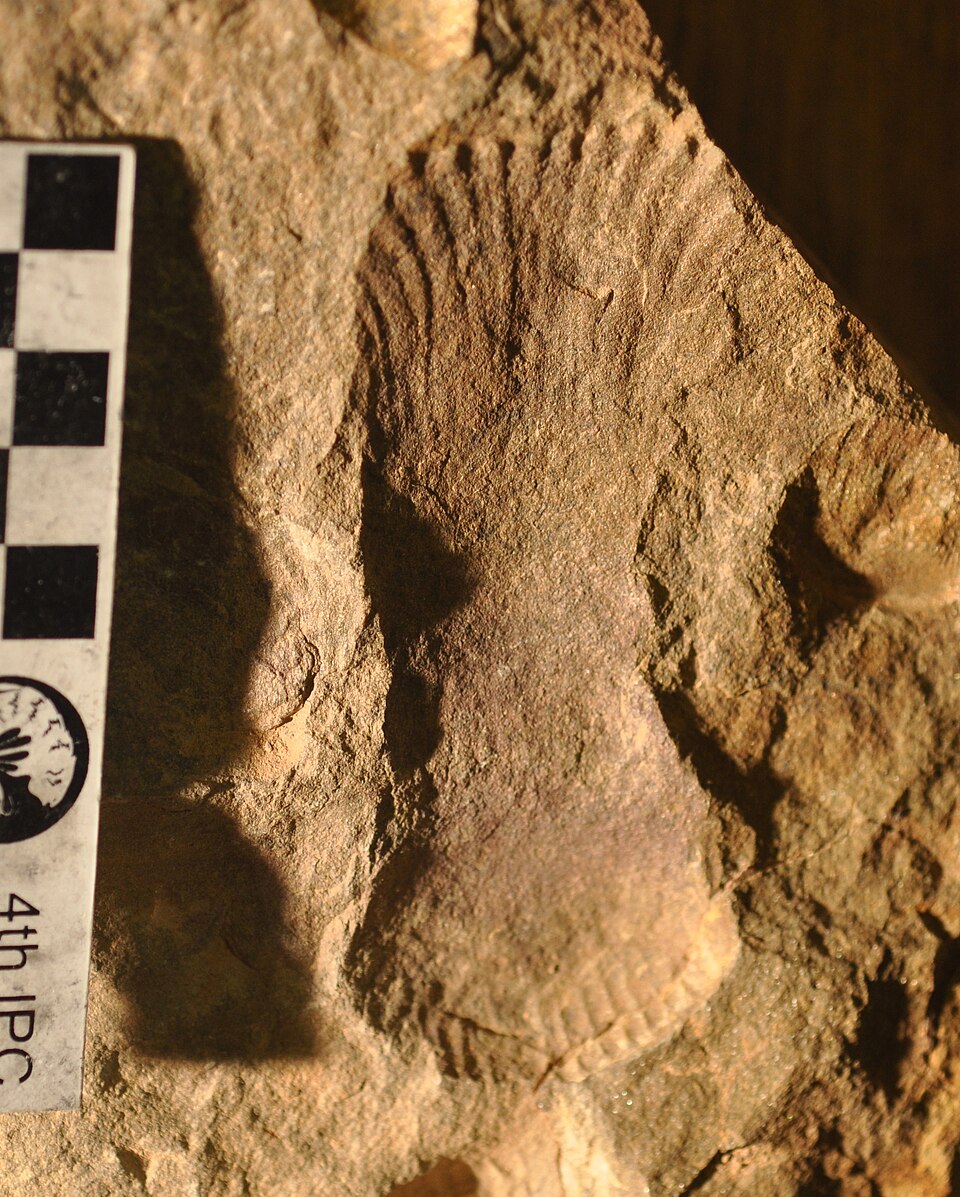
Ernietta plateauensis is the kind of Ediacaran fossil that punishes a quick label. It looks at first like a small ribbed pouch or folded bag pressed into sandstone. That visual simplicity is misleading. The better profile starts with a stranger sentence: Ernietta was probably a semi-infaunal, modular, macroscopic eukaryote of uncertain affinity that lived in latest Ediacaran shallow seas of Namibia, roughly 548-539 million years ago, and became most informative when many individuals were preserved together.[2][3]
That makes it different from the usual celebrity fossil. Ernietta does not matter because it hands over a clean ancestor of a modern animal. It matters because it turns body shape, sediment, water flow, and population arrangement into one paleobiological problem. The fossil is strongest when read as a current-fed community, not as a stranded sack.
Image context: the cover uses a real photograph of Ernietta plateauensis from the Ediacaran Kliphoek Member of the Dabis Formation near Aus, Namibia, hosted by Wikimedia Commons.[5] It belongs here because the article's claims depend on the visible material object: a ribbed fossil in rock, not a speculative life reconstruction.
The body was not just a pouch
The 2016 Lethaia study by Ivantsov, Narbonne, Trusler, Greentree, and Vickers-Rich changed the reading order for Ernietta. Exceptionally preserved specimens from southern Namibia suggested that many previously figured examples were incomplete, preserving only the basal portion of a larger organism.[1] Their reconstruction interpreted the complete animal as including a buried, sand-filled anchor, a trunk, and two facing fan-like surfaces that extended into the water column.[1]
That matters because it moves Ernietta out of the cabinet of "weird impressions" and into the mechanics of life position. The familiar ribbed structure was not necessarily the whole organism. It may have been part of a body architecture built from tubular elements that did different jobs while keeping the same modular construction.[1]
This is also why the fossil should not be cleaned up too quickly into a familiar animal category. The Frontiers study describes E. plateauensis as a macroscopic eukaryote of unknown affinities, not as a settled member of a living phylum.[3] That uncertainty is not a failure. It is the point. The late Ediacaran record contains large organisms that were ecologically active before they were anatomically familiar.
The sediment-water boundary is the main stage
The strongest current profile treats Ernietta as semi-infaunal: partly buried in the seafloor, with an upper portion exposed to moving water.[2][3] In this view, the animal's shape only makes sense when the sediment-water interface is held in the same frame as the body. The buried portion could stabilize the organism, while the exposed cavity or fan surfaces interacted with currents.
The environmental setting supports that reading. Frontiers summarizes Ernietta as common in latest Ediacaran shallow marine settings in Namibia, with fossils associated with ripple-laminated fine-grained sandstones and microbial mat evidence.[3] This was not an abstract deep-time backdrop. It was a world of shallow water, periodic sediment supply, microbial surfaces, and currents strong enough to matter but not so violent that every body became unreadable.
That is why the fossil's sack-like outline is deceptive. A loose sack is passive. Ernietta looks more like a body designed around a boundary: partly held in sediment, partly lifted into water, and shaped so that flow could enter, recirculate, or pass across its exposed anatomy.[2][3]
CFD made the cavity ecological
The major step came when researchers paired new fossil data with computational fluid dynamics. Gibson, Rahman, Maloney, Racicot, Mocke, Laflamme, and Darroch tested competing feeding models and argued that Ernietta lived gregariously in latest Ediacaran aggregations.[2] Their simulations supported a suspension-feeding interpretation: moving water was redirected into body cavities, while grouped individuals enhanced mixing above the population.[2]
That claim is powerful because it gives the organism an ecological job without pretending to find a modern mouth, gut, or filter. The article's inference is more disciplined. If Ernietta lacked preserved specialized feeding structures, the question becomes whether its body geometry and community layout could still support nutrient acquisition from water flow. The 2019 study answered yes, with an important caveat: the precise capture mechanism remained uncertain.[2]
This is where Ernietta becomes unusually interesting. Many Ediacaran fossils invite arguments about identity. Ernietta invites an argument about performance. How did water move around the body? Did the cavity recirculate fluid? Did individuals change the flow environment for neighbors? Those questions turn the fossil from a taxonomic riddle into a community-scale experiment.[2][3]
The crowd may have mattered as much as the individual
The 2021 Frontiers study sharpened that population reading. It modeled aggregations with individuals of different sizes and reconstructed a preserved Farm Hansburg population.[3] The result was not a simple "bigger is always better" story. Smaller individuals had weaker cavity recirculation when isolated, but smaller individuals positioned downstream of larger ones could receive enhanced cavity mixing.[3]
That is a subtle but important ecological claim. In a current-fed organism, location can become biology. A small Ernietta in the wrong place may have had less favorable flow through its cavity. A small individual downstream of larger adults may have benefited from water movement shaped by the group.[3] The authors therefore suggested that adult aggregations may have created localized conditions favorable to younger individuals, effectively a nursery-like setting.[3]
The word "nursery" should be read carefully. It does not mean parental care in the modern animal sense. It means the spatial structure of a population may have improved conditions for settlement and growth. That is still a remarkable result for an organism more than half a billion years old. It suggests that some late Ediacaran communities were not just collections of bodies on a mat; they were physical arrangements with consequences for feeding and recruitment.[2][3]
The boundary is still contested
The best profile keeps one hand on caution. A 2024 Journal of Paleontology synthesis on the Nama Group notes that Ernietta taphonomy and life orientation remain difficult, even while recent work often favors life-position interpretations for clustered specimens.[4] The same discussion warns that some seam-down accumulations could be affected by transport or settling behavior after disturbance.[4]
That caution improves the fossil rather than weakening it. Ernietta should not be turned into an overconfident diagram of Ediacaran social life. The actual evidence is more interesting: clustered fossils, common orientations, sediment-filled bodies, semi-infaunal models, CFD flow patterns, and competing taphonomic explanations that have to be sorted bed by bed.[1][2][3][4]
The safest conclusion is therefore layered. High confidence: Ernietta plateauensis was a late Ediacaran modular organism from Namibia, built from repeated tubular elements and commonly preserved in clustered shallow-marine settings.[1][3] Strong inference: it probably lived partly buried, with exposed body regions interacting with currents.[2][3] Plausible ecological model: grouped individuals could have improved flow and nutrient delivery, with population layout affecting smaller organisms.[2][3] Open boundary: not every cluster automatically proves a living community, and not every anatomical surface has a resolved feeding function.[2][4]
That is enough to make Ernietta one of the more useful Ediacaran fossils. It does not need to become a modern animal in disguise. It shows that before the Cambrian's louder record of shells, limbs, burrows, and predators, large organisms were already solving ecological problems with body architecture, water movement, and group placement. Read that way, the ribbed sack becomes something better: a fossilized argument about how communities began to matter.
Sources
- Andrey Yu. Ivantsov, Guy M. Narbonne, Peter W. Trusler, Carolyn Greentree, and Patricia Vickers-Rich, "Elucidating Ernietta: new insights from exceptional specimens in the Ediacaran of Namibia," Lethaia 49, no. 4 (2016), Monash University record with DOI.
- Brandt M. Gibson, Imran A. Rahman, Katie M. Maloney, Rachel A. Racicot, Helke Mocke, Marc Laflamme, and Simon A. F. Darroch, "Gregarious suspension feeding in a modular Ediacaran organism," Science Advances 5, no. 6 (2019), PubMed record.
- Brandt M. Gibson, Simon A. F. Darroch, Katie M. Maloney, and Marc Laflamme, "The Importance of Size and Location Within Gregarious Populations of Ernietta plateauensis," Frontiers in Earth Science 9 (2021).
- M. A. S. McMenamin and colleagues, "Ediacaran paleobiology and biostratigraphy of the Nama Group, Namibia, with emphasis on the erniettomorphs, tubular and trace fossils, and a new sponge, Arimasia germsi n. gen. n. sp.," Journal of Paleontology (Cambridge Core, 2024).
- Wikimedia Commons, "File:Ernietta plateauensis 1.jpg" - source page for the real fossil photograph used as the lead image.