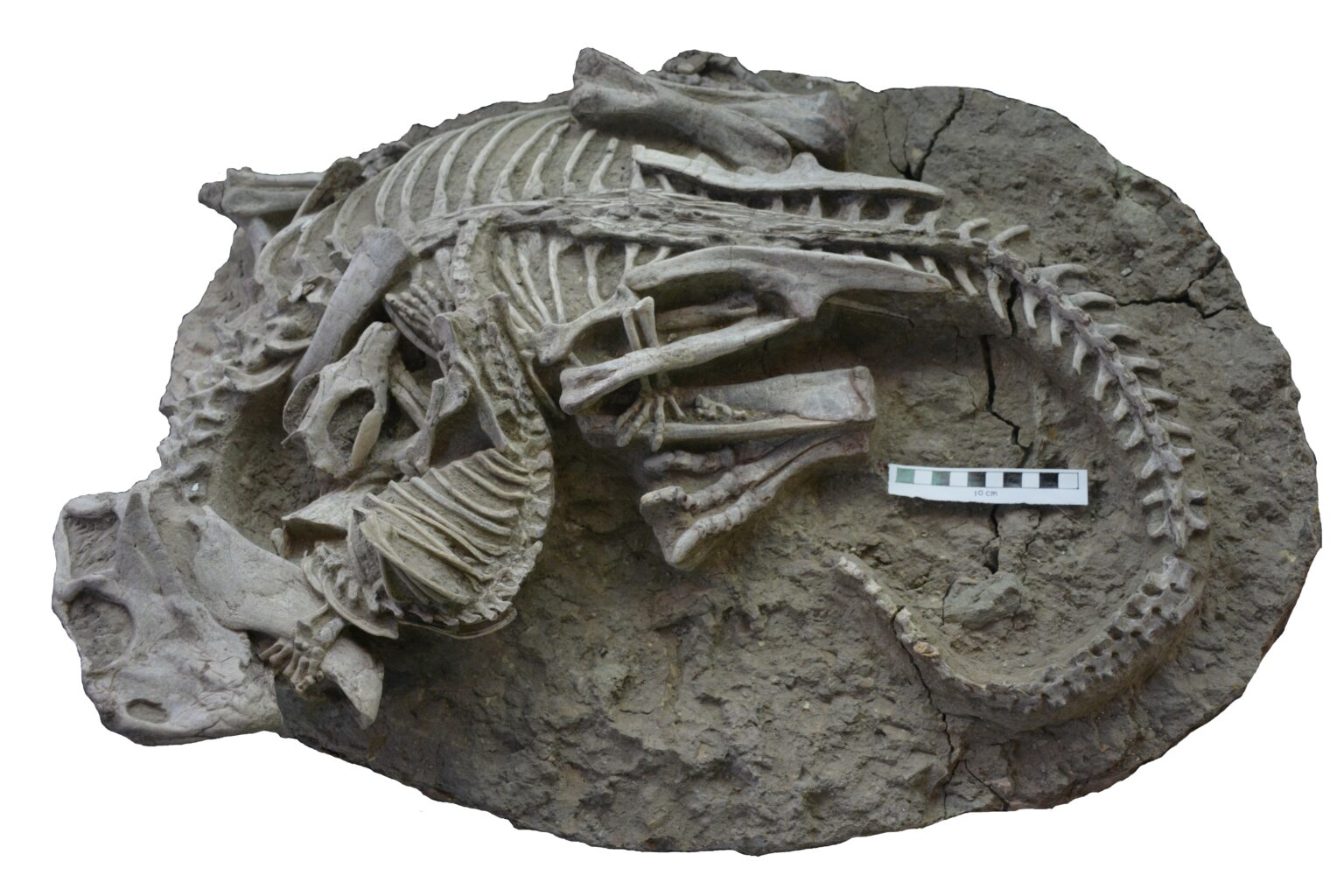

The Canadian Museum of Nature's short 2023 video on the Repenomamus and Psittacosaurus combat fossil does something unusual for public paleontology.[1][2] It gives viewers a dramatic claim, then keeps dragging that claim back to the slab. A badger-sized mammal appears to be attacking a larger dinosaur. That is the headline. The more valuable lesson is narrower and better. Fossil behavior becomes convincing only when anatomy, taphonomy, and older comparative evidence all pull in the same direction.[2][3][4]
That distinction matters because Mesozoic mammals are still easy to flatten into a stock image: small, nocturnal, marginal, always avoiding dinosaurs rather than troubling them.[3][4] The Lujiatun specimen does not erase that broader ecological asymmetry, and the video is strongest when it refuses to pretend otherwise.[1][2] Instead, it focuses on one preserved interaction from the Lower Cretaceous Yixian Formation of northeastern China, where abrupt volcaniclastic burial captured the bodies in a tightly entangled position.[2][3] The scientific value lies in the conjunction. The fossil is visually dramatic, but the argument only stands because the burial setting and the body positions are read together.
That is why this works in annotated-viewing mode. The clip is only about four minutes long, yet it stages the real paleontological problem clearly: how much behavior can one slab carry before spectacle outruns evidence?[1] Around the opening half-minute, the film pushes close to the jaw and forelimb contacts. Around the one-minute mark, it widens to the Lujiatun landscape and the volcanic-debris-flow explanation. Later it toggles between the museum speaker, specimen views, and reconstructions, but the fossil itself keeps reclaiming authority.[1][2] The best way to watch is to treat every reconstruction shot as provisional and every return to the slab as the place where the argument is either saved or lost.
Image context: the lead image uses the Canadian Museum of Nature's documentary photograph of the actual fossil pair. It belongs here because this article is not about generic dinosaur-era atmosphere. It is about a single evidentiary surface on which a mammal's hand, jaw, and body position have to be judged against the dinosaur's posture and the burial process that froze both in place.[2]
Around 0:20, the video makes the fossil surface do the first argumentative work
The opening close-ups are the video's most important editorial choice.[1] Rather than beginning with a cartoon of mammalian triumph, the clip shows the actual slab and lets the positions accumulate: the mammal over the dinosaur, the forelimb around the lower jaw, the bite at the ribs, and the tight bodily overlap.[1][2] Those details matter because behavior claims in paleontology often fail at exactly this point. A fossil can look dramatic while still being taphonomically vague. Here, the video keeps insisting that the interaction must be read from contact points, not mood.
The museum release spells out the same evidentiary chain in prose. It notes that the Psittacosaurus lies prone with hindlimbs folded beneath the body, while Repenomamus sits atop it, grips the jaw, and bites into the rib region.[2] The 2023 Scientific Reports paper reaches the same conclusion more formally: alternative explanations were considered, but the balance of the evidence favored a predation attempt rather than an accidental juxtaposition.[3] That phrase, "balance of the evidence," is the right one to keep in mind while watching. The case is persuasive not because any single bone shouts "attack," but because several positional cues align.
This is also where the video quietly improves on sensational retellings. It does not need to exaggerate the mammal into a Cretaceous superhero. The fossil already carries enough tension. The mammal was smaller than the dinosaur and still appears to have been the aggressor.[2][3] That asymmetry is scientifically more interesting than a simple upset narrative. It suggests that at least some large gobiconodont mammals were capable of dangerous attacks on prey that public memory still assigns automatically to the dinosaur side of the food web.[3][4]
Around 1:00, the Lujiatun landscape enters the frame and stops the fossil from becoming a pure action still
The video's landscape and site shots do more than supply atmosphere.[1] They answer the immediate skeptical question: if two animals are found together, why assume they were interacting before burial? The paper's answer is that the Lujiatun Member is known for abrupt burial in volcanically derived debris flows, the same kind of deposit that can preserve life positions and rare moments of interaction.[3] The museum release translates that into plainer language by describing the pair as caught in the roiling aftermath of a volcanic event while the attack was underway.[2]
That burial context is not a background note. It is half the argument. Without rapid burial, the scene could dissolve into scavenging, transport, or post-mortem overlap. With rapid burial, the entanglement becomes harder to dismiss as coincidence.[2][3] The video is smart to move from slab to landscape so early, because it teaches viewers that behavior fossils are always two problems at once: what the bodies are doing, and what sediment had to do quickly enough to preserve that arrangement.
This is also the point where the article should keep a limit in view. The specimen does not prove that Mesozoic mammals routinely hunted dinosaurs, nor does it overturn the broad fact that dinosaurs dominated most terrestrial food webs of the time.[3][4] What it does show is that a large Cretaceous mammal could become a direct threat to a near fully grown Psittacosaurus under real ecological conditions.[3] That is a narrower claim, but a more defensible one.
Around 1:20 to 2:40, the video links one spectacular fossil to a longer Repenomamus record
Once the museum narrator reappears and the film cuts between trays, fossil views, and highlighted overlays, the real comparative frame becomes visible.[1] This combat fossil is not a free-floating miracle. It lands in a lineage that was already anomalous within the usual picture of Mesozoic mammals. The earlier 2005 Nature paper on Repenomamus argued that the genus included large-bodied triconodont mammals and reported juvenile Psittacosaurus bones preserved in the stomach contents of R. robustus.[4] In other words, the new fossil did not introduce dinosaur consumption from nowhere. It shifted the evidence from diet after death to behavior during life.
That is the most useful conceptual upgrade the video offers. Fossil stomach contents already showed that some Repenomamus ate dinosaurs.[4] The Lujiatun slab adds a different category of evidence: body position during apparent attack.[2][3] Those are not interchangeable. Gut contents prove ingestion. The combat fossil bears on agency, posture, and encounter structure. Seen together, the older and newer records make the mammal less anomalous and the attack interpretation less theatrical.[3][4]
This is where the public headline can be refined into a stronger paleontological statement. The surprise is not merely that a mammal bit a dinosaur. The surprise is that multiple evidence layers now exist for a genus large enough and carnivorous enough to trouble the old "shadow mammal" story without replacing it with a fantasy of mammalian dominance.[3][4] The video's best virtue is that it stays close to that boundary.
Around 2:40 and after, reconstruction is useful only because the slab keeps control
The later reconstruction scenes are vivid, and they earn their place only because the fossil keeps returning to discipline them.[1][2] A life reconstruction can help a viewer understand scale, posture, and the violence of the encounter, but reconstructions are always tempted to overspecify: speed, expression, exact environment, and motive all become more concrete than the evidence really allows. The video avoids the worst version of that trap by cutting back to the slab, the circled contact zones, and the museum speaker's narrower phrasing.[1][2]
That restraint is what makes the clip worth embedding rather than merely citing. A weaker public-facing video would sell the scene as a prehistoric upset story and stop there. This one repeatedly reminds viewers that the fossil itself is the controlling object.[1][2] The hand on the jaw, the bite at the ribs, the mammal's dorsal position, and the burial context do the work. The reconstruction is there to help the eye, not to replace the fossil with a finished narrative.
The article's main lesson therefore survives even if a reader never presses play. The Repenomamus-Psittacosaurus fossil matters because it binds three normally separate things into one specimen: ecological conflict, body size revision for Mesozoic mammals, and a burial mode quick enough to preserve interaction instead of aftermath.[2][3][4] The video earns its place because it keeps those layers together. Once predation and burial are read on the same evidentiary surface, the fossil stops being a curiosity and becomes one of the rare places where vertebrate behavior in deep time feels momentarily close to direct.[1][2][3][4]
Sources
- Canadian Museum of Nature, "Rare Fossil Shows Mammal Attacking a Dinosaur," YouTube video, published July 18, 2023.
- Canadian Museum of Nature, "Fossil: Mammal attacks dinosaur" (media-centre article with specimen photographs, anatomical details, and burial interpretation).
- Gang Han, Jordan C. Mallon, Aaron J. Lussier, Xiao-Chun Wu, Robert Mitchell, and Ling-Ji Li, "An extraordinary fossil captures the struggle for existence during the Mesozoic," Scientific Reports (2023).
- Yaoming Hu, Jin Meng, Yuanqing Wang, and Chuankui Li, "Large Mesozoic mammals fed on young dinosaurs," Nature (2005).