The word "mummy" does bad work in paleontology when it makes readers imagine a dinosaur sealed like a miracle. Dakota is more useful than that fantasy. The specimen, an Edmontosaurus mummy from the Hell Creek Formation of North Dakota, matters because it preserves not only skin but sequence: body surface, damage, collapse, drying, and burial can all be read together if the fossil is handled carefully.[1][3] That is the stronger lesson. Dakota is not a dinosaur that somehow skipped decomposition. It is a dinosaur whose decomposition was channeled in a way that let durable soft tissues survive long enough to enter the rock record.[1]
That distinction resets the specimen at once. In popular writing, dinosaur mummies often drift toward spectacle. Skin survives, so the fossil starts to feel like a time capsule that carried the animal almost intact into the present. The 2022 PLOS ONE analysis points in a different direction. Dakota's skin is preserved in three dimensions and still carries biomarkers, but the body surface is also described as deflated and marked by injuries consistent with carnivore activity during the perimortem interval.[1] Preservation, in other words, did not arrive by keeping the carcass untouched. It arrived after the carcass was opened.
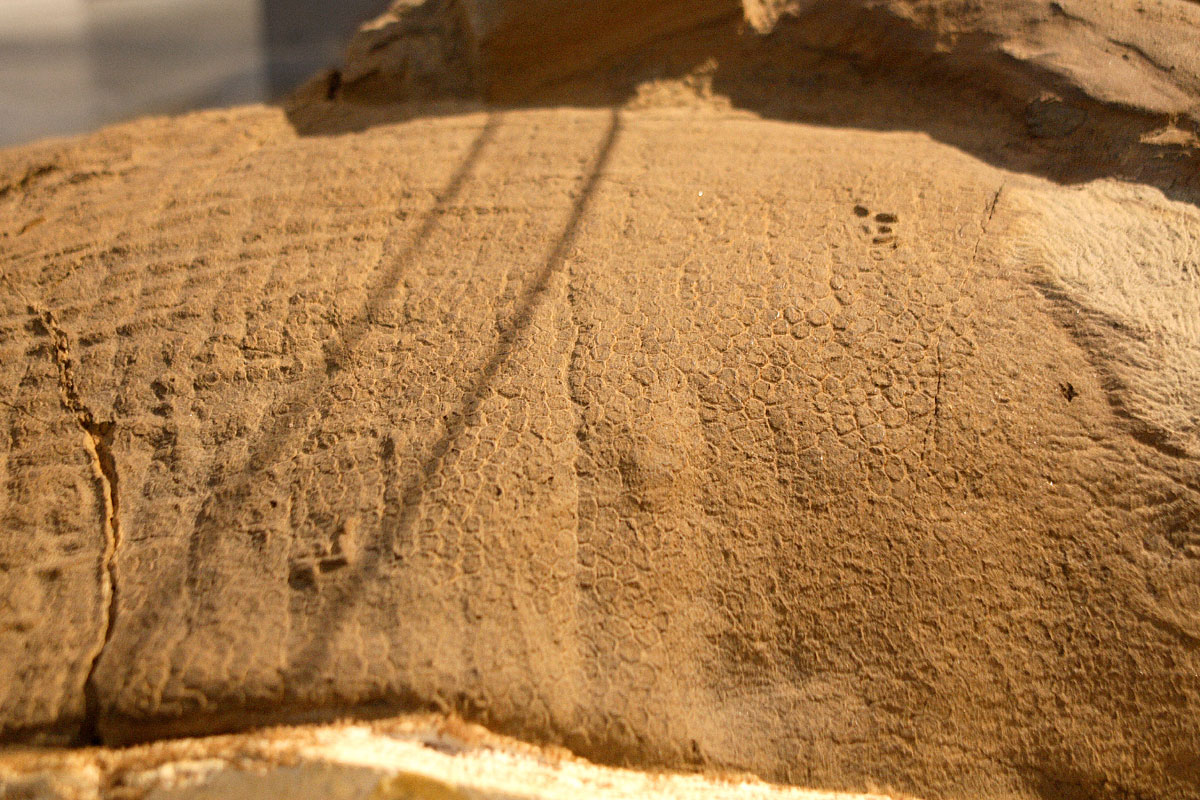
Image context: the lead image is a close photograph of Dakota's skin impression from Wikimedia Commons. It belongs here because the argument begins at the surface. A scale field with visible punctures is a better guide to this fossil than a heroic skeletal mount or a dramatic life restoration: it keeps the eye on preserved tissue and on the damage that helped make that tissue preservable.[4]
Dakota is strongest when read as a body envelope, not as a flesh miracle
Dakota's public fame is easy to understand. The North Dakota Heritage Center presents it as an extremely rare mummified duck-billed dinosaur, and that description is fair as long as the word "mummified" is read with paleontological discipline.[3] What is rare here is not the survival of untouched meat. What is rare is the preservation of external body tissues at unusual fidelity in a large dinosaur from the latest Cretaceous.
That is why the specimen has to be read from the outside inward. The skin is not decorative wrapping around a more important skeleton. It is part of the evidence center. Polygonal scale textures, the continuity of the body surface, and the condition of the preserved tissue all constrain how the carcass behaved after death.[1][4] Once those details come into focus, Dakota stops being a generic "dinosaur mummy" and becomes a taphonomic document.
This is also the right place to keep the taxonomic boundary visible. The 2022 paper treats the specimen as Edmontosaurus, but the article's real force does not depend on a melodramatic species identity claim.[1] The high-value information lies in preservation state, body covering, and postmortem process. Close reading the fossil as a body envelope keeps the science on its strongest ground.
The damage is part of the preservation story
The most important move in the 2022 study is conceptual. Instead of asking why Dakota escaped decay, the authors ask what kind of decay left this result.[1] Their answer is not rapid sealing under impossible conditions. They argue that incomplete scavenging or predation opened the carcass, giving gases, fluids, and microbes routes to escape while more resistant tissues such as skin and nails remained long enough to desiccate over weeks to months before final entombment.[1]
That sequence matters because it turns wounds into mechanism. The injuries are not unfortunate noise on top of an otherwise pristine specimen. They are evidence that the carcass was vented. A swollen, closed body is harder to dry in an orderly way. A damaged one can lose internal pressure and moisture while still retaining parts of its exterior envelope. Dakota therefore preserves a paradox that matters far beyond one hadrosaur: sometimes a body enters the fossil record well because it was opened, not because it was protected.[1]
This is the point at which the word "mummy" becomes worth keeping. It no longer means "perfectly preserved dinosaur." It means a carcass whose outer tissues outlasted the soft interior long enough to become fossil evidence. That is a much less cinematic definition, and a much better one.
Hadrosaur skin matters because it carries chemistry as well as shape
Dakota is not the only hadrosaur mummy that pushes paleontology toward this more disciplined reading. A 2009 Proceedings of the Royal Society B paper on another mummified hadrosaur from the Hell Creek Formation reported mineralized soft-tissue structures and endogenous organic signatures associated with a preserved skin envelope.[2] That comparative case matters because it shows that hadrosaur soft-tissue preservation is not only about visual texture. Skin can carry structural and chemical information together.[2]
Placed next to Dakota, the lesson gets sharper. The exterior body surface is not merely what makes a fossil crowd-pleasing in a museum. It is a data-bearing layer. Scale pattern, three-dimensional relief, and associated organics can all constrain what survived, how it survived, and which claims about life appearance or body contour can actually be defended.[1][2]
That still requires restraint. A preserved skin envelope is not a blank check for overconfident life reconstruction. Dakota's surface is preserved after collapse and drying, not as a frozen snapshot of a fully fleshed living dinosaur.[1] The fossil gives paleontology access to exterior tissues, but those tissues have already been through damage, dehydration, and burial. The correct reading therefore keeps two facts together: the skin is exceptionally informative, and it is not innocent.
Dakota narrows the gap between anatomy and taphonomy
One reason Dakota matters so much is that it prevents anatomy from being discussed apart from preservation process. Dinosaur images in books and documentaries often treat those as separate lanes. First comes the animal. Then comes the fossilization backstory as a footnote. Dakota does not allow that split. Here, anatomy survives in the very form shaped by taphonomy.[1][4]
That makes the specimen unusually useful for training the eye. The scale field shows that durable exterior tissue persisted. The punctures show that the carcass was physically compromised. The deflated state shows that this is not a simple cast of a living body at full volume. Put together, those features tell a coherent story: Dakota is best read as a collapsed archive of the body's exterior, not as an untouched carcass magically transferred into stone.[1]
This is also why the fossil belongs in a public museum setting. The North Dakota Heritage Center displays Dakota as a rare object from the state's late Cretaceous world.[3] The scientific value of that display is not just wonder. It is the chance to make readers and visitors see that soft-tissue fossils are strongest when they are read as process-rich evidence rather than as exceptions to process.
What Dakota can actually support
The secure claims are strong enough on their own. Dakota shows that large dinosaur skin could survive in three dimensions, that the carcass carried injuries consistent with perimortem scavenger activity, and that desiccation before burial can help explain why a dinosaur "mummy" exists without invoking fantastical conditions.[1] Comparative hadrosaur work also supports the broader point that preserved skin envelopes can retain meaningful structural and chemical information.[2]
The limits matter just as much. Dakota does not preserve a whole living body in a neutral state. It does not solve every question about hadrosaur color, exact mass distribution, or the soft-tissue profile of the entire clade.[1][2] What it does give paleontology is more exact and more durable than a miracle story. It gives a specimen in which surface texture, damage, collapse, and burial all remain visible enough to be argued together.
That is why Dakota rewards close reading. The fossil's power is not that it defeats decay. Its power is that decay itself is still legible in the preserved skin.
Sources
- Phillip L. Manning, Kathleen M. Schroeter, Lisa A. Hall, et al., "Biostratinomic alterations of an Edmontosaurus 'mummy' reveal a pathway for soft tissue preservation without invoking 'exceptional conditions'," PLOS ONE (2022), via PMC.
- Johan Lindgren, Phillip J. Currie, Peter Sjovall, et al., "Mineralized soft-tissue structure and chemistry in a mummified hadrosaur from the Hell Creek Formation, North Dakota (USA)," Proceedings of the Royal Society B (2009), via PMC.
- North Dakota Heritage Center & State Museum, "When Dinosaurs Ruled" exhibit page.
- Wikimedia Commons file page for the Dakota skin-impression photograph used as the article image.