Marine reptile birth is easy to oversimplify because modern analogies arrive too quickly. Whales are usually invoked, water is assumed to reward tail-first delivery, and ichthyosaurs get folded into the same rule by habit. The fossil record no longer supports that tidy version. What it shows instead is a lineage-level shift with visible intermediate texture: the Early Triassic Chaohusaurus specimen preserves a head-first birth, Middle Triassic Mixosaurus does not settle on a single orientation, and Jurassic Stenopterygius really does lean tail-first without turning that preference into an absolute law.[1][2][3]
That matters because birth orientation is not a trivial detail. In fully aquatic vertebrates, it is one of the clearest places where body plan, locomotion, maternal anatomy, and evolutionary history meet. If ichthyosaurs had always been tail-first, the story would be simple. Early forms returned to the sea, selection penalized the wrong orientation, and the whole clade locked into one aquatic solution. But the published record does not behave like a clean lock-in.[1][2]
The better reading is staged. A head-first condition appears near the base of the ichthyosaur story. Mixed evidence follows in more derived Triassic forms. A stronger tail-first preference emerges later in the sleek pelagic lineages, where body streamlining and pelvic reduction had advanced much further.[2][3] That sequence does not make the group less coherent. It makes ichthyosaur evolution look more like other good paleontological transitions: one function is being solved while the anatomy capable of solving it is still changing shape.
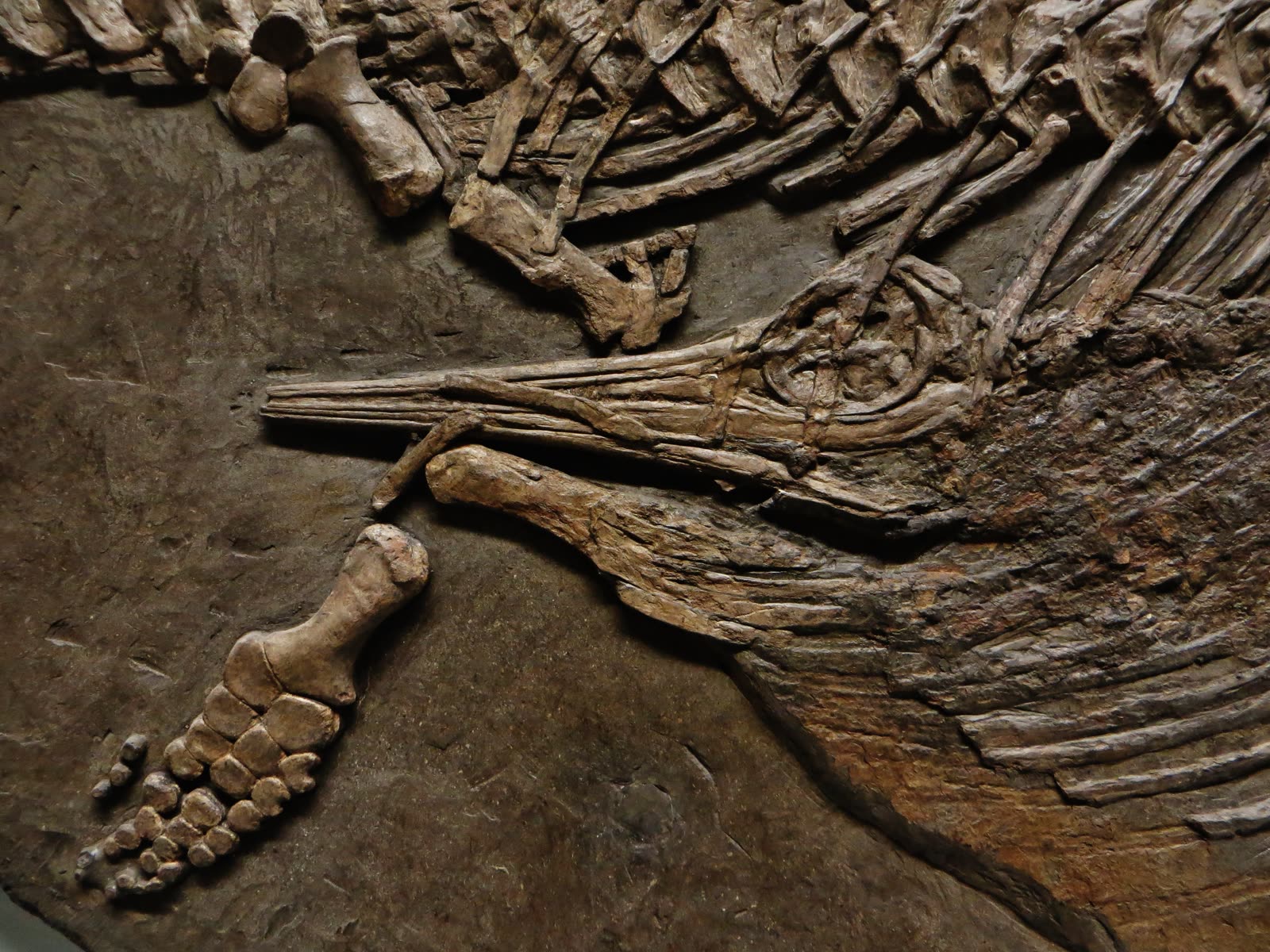
Image context: the cover uses a real Wikimedia Commons photograph of a female Stenopterygius slab with embryo preservation. It fits this article because the argument depends on preserved orientation inside the body cavity. A documentary fossil image does more work than a life restoration here: it keeps attention on axis, posture, and what the rock can actually support.[4]
Chaohusaurus keeps the old story from becoming too neat
The 2014 PLOS ONE paper on Chaohusaurus remains the starting point because it preserved exactly the kind of detail that broad theories usually have to infer.[1] The specimen contained three embryos, and one of them was caught in birth position with the skull just emerging from the maternal pelvis.[1] That matters not only because the fossil is rare, but because the posture was head-first. Motani and colleagues argued that this was unlikely to represent a breech exception and instead strongly indicated that viviparity in ichthyopterygians had terrestrial roots.[1]
That conclusion changed the older default view. Viviparity in Mesozoic marine reptiles had often been treated as an aquatic adaptation that arose after these animals were already committed to life at sea.[1] The Chaohusaurus embryo complicates that. If one of the oldest known ichthyosaur-grade reptiles is giving birth head-first, then the earliest reproductive condition in the clade cannot simply be read backward from later dolphin-like forms.[1][2]
The deeper value of the Chaohusaurus fossil is that it relocates the problem. The real question stops being "Why were ichthyosaurs tail-first?" and becomes "When did a tail-first preference become strong, and what anatomical or mechanical changes made that preference useful?" That is a much better lineage-context question because it assumes change over time rather than one timeless aquatic rule.[1][2]
Mixosaurus is where the easy switch theory starts to fray
If the old schematic had been right, the next step after Chaohusaurus should have been simple. A somewhat more derived Triassic ichthyosaur ought to show a clean and stable tail-first preference, making the evolutionary pivot easy to place. The 2023 BMC paper does not give that clean pivot.[2] Miedema and colleagues reexamined three gravid Mixosaurus specimens and found two with tail-first orientation and one with head-first orientation.[2]
That is not a huge sample, and the authors are careful about that limit.[2] Still, the small dataset is informative in exactly the right way. It blocks the temptation to imagine that birth orientation switched once and then never looked back. The paper's conclusion is more measured: a slight preference for tail-first parturition may have arisen near the base of Merriamosauria, while more basal ichthyopterygians either preferred head-first birth or showed little preference at all.[2]
This is where ichthyosaur reproduction starts looking evolutionarily staged rather than symbolically aquatic. Mixosaurus does not behave like a perfect transitional icon, but it does behave like a lineage with unresolved internal variance. That is often what real transitions look like in fossils. The important shift is underway, yet the distribution has not collapsed into one exclusive pattern.[2]
Stenopterygius shows a preference, not a commandment
By the time we reach Stenopterygius, the case for a tail-first bias is much stronger. The same 2023 study reanalyzed Böttcher's classic dataset and concluded that tail-first birth predominated in Stenopterygius by a factor of 3.6 to 1.[2] That is a real skew, not just a guess. It also fits the broader look of later ichthyosaurs: more streamlined bodies, more reduced pelvic regions, and a thoroughly pelagic mode of life.[2][3]
But the crucial word is "predominated," not "monopolized." The Stuttgart museum summary makes the point plainly: although tail-first birth is preferred in Stenopterygius, head-first births still occur on a regular basis.[3] That sentence matters because it prevents a second oversimplification from replacing the first. Once a preference exists, it is tempting to turn it into a universal functional law. The fossil evidence does not require that move.
That is also why the photographed Stenopterygius slab is such a useful lead image. It reminds the reader that we are not inferring birth orientation from vague ecological analogy alone. We are dealing with specific maternal specimens, fetal placement, and body-axis evidence preserved in stone.[2][4]
The old drowning explanation now looks too narrow
Tail-first birth in ichthyosaurs has often been explained through a single intuition: if the head emerges first in water, the newborn risks drowning during a prolonged delivery.[2][3] It is a clean idea, and perhaps too clean. The 2023 paper revisits that argument directly and finds the evidence for it weaker than tradition suggests.[2] The problem is comparative as much as paleontological. Head-first and tail-first births both occur in aquatic and terrestrial viviparous animals, and head-first delivery does not consistently map to catastrophic birth difficulty in the living groups used as analogs.[2][3]
Miedema and colleagues therefore propose alternative explanations that are more mechanical and less slogan-like.[2] As ichthyosaurs became more streamlined and their pelvic region reduced over time, it may have become advantageous for maternal expulsive forces to act on the fetal cranium rather than the pelvis during birth, favoring a tail-first outcome. They also raise a second possibility: fetal orientation in utero may have helped maternal trim control by placing the heavier fetal skulls in a more favorable position while the mother was swimming.[2] The Stuttgart summary echoes the same shift in emphasis, arguing that the traditional drowning story is unlikely to be the whole explanation.[3]
These alternatives are attractive because they fit the lineage pattern better. They do not require one abrupt behavioral innovation right at the point where the clade entered the sea. They allow preference to strengthen gradually as the body becomes more thunniform, the pelvis shrinks, and swimming energetics matter more.[2] That is exactly the shape the fossil sequence seems to suggest.
What the lineage context can actually support
The secure version of the story is now strong enough to tell plainly. Chaohusaurus preserves head-first birth near the base of ichthyosaur history and supports the view that viviparity was inherited from terrestrial ancestors rather than invented from scratch in the sea.[1] Mixosaurus complicates any single-switch model by preserving both head-first and tail-first orientations.[2] Stenopterygius shows that later ichthyosaurs developed a genuine tail-first preference, but not an exclusive one.[2][3]
The limits are just as important. We do not have enough gravid specimens from every branch to turn one lineage-wide trend into a rigid universal law.[2] The fossil record is still sparse, and orientation counts are tiny outside Stenopterygius.[2] That means the best reconstruction remains proportional rather than absolute.
Even with that caution, one conclusion holds. Ichthyosaur birth did not become tail-first all at once. The clade moved toward that preference through time, and the fossils preserve enough friction in the transition to keep the old aquatic cliché from surviving unchanged.[1][2][3]
Sources
- Ryosuke Motani, Da-yong Jiang, Andrea Tintori, Olivier Rieppel, and Guan-bao Chen, "Terrestrial Origin of Viviparity in Mesozoic Marine Reptiles Indicated by Early Triassic Embryonic Fossils," PLOS ONE 9, no. 2 (2014).
- Femke Miedema, Erin E. Maxwell, and Torsten M. Scheyer, "Heads or tails first? Evolution of fetal orientation in ichthyosaurs, with a scrutiny of the prevailing hypothesis," BMC Ecology and Evolution 23 (2023).
- State Museum of Natural History Stuttgart, "Heads or tails first? New insights into fetal orientation in ichthyosaurs" (science news summary of the 2023 study).
- Wikimedia Commons file page for the photographed Stenopterygius quadriscissus fossil with embryo used as the lead image.