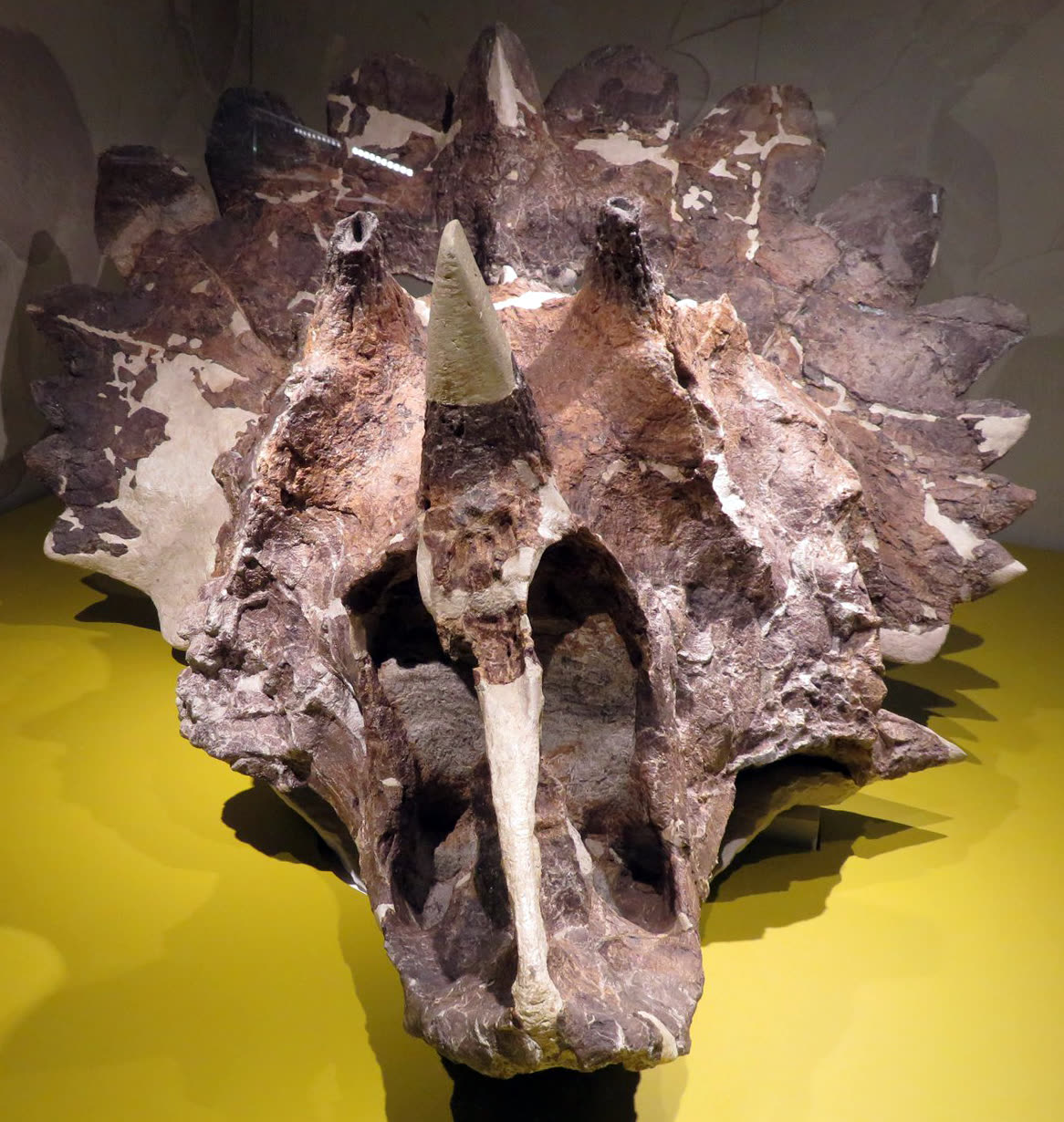

Horned-dinosaur evolution is easy to tell badly. One branch gets reduced to the long-frilled, big-browed line that leads toward Triceratops; the other becomes the short-frilled, big-nosed line of Centrosaurus and Styracosaurus. The problem with that neat split is that Regaliceratops peterhewsi turned up late in the record and made the boundary look less like a law than a habit of reading. In the original Current Biology paper, Caleb Brown and Donald Henderson describe a nearly complete skull from the uppermost St. Mary River Formation of southwestern Alberta and emphasize the combination that makes the animal so startling: a large nasal horn, very small postorbital horns, and massive frill ornamentation on a derived chasmosaurine skull.[2]
Brown's Royal Tyrrell Museum lecture is valuable because it does not present that combination as a novelty item and stop there. He spends most of the talk rebuilding the background that makes the surprise matter: what horned-dinosaur display structures are, why older defensive interpretations gave way to signalling arguments, which subtle skull traits still place Regaliceratops among chasmosaurines, and why the skull's surface outline nevertheless drifts toward a centrosaurine-looking display package.[1] The Cell Press writeup preserves the same discovery arc in compressed form. Peter Hews found bones weathering from a cliff in 2005, the skull was slowly prepared in the lab, and the anatomy only became fully legible as preparation exposed how odd the whole suite of characters really was.[3]
That is why this works as an annotated viewing instead of as a simple lecture recommendation. Around the seven-minute mark, Brown reframes horns and frills as display structures rather than armored shields. Around the half-hour mark, he explains why deeper anatomical characters still keep the skull in chasmosaurine territory. Around the thirty-seven to forty-minute stretch, the horn-ratio plot and comparative diagrams turn the specimen from "weird skull" into a convergence argument. Read with the paper, the lecture does something stronger than announce a new taxon. It shows that late horned-dinosaur evolution still had room to reopen a visual solution associated with another clade after that clade had already vanished.[1][2][4]
Image context: the cover uses a real museum photograph of the Regaliceratops skull on display at the Royal Tyrrell Museum. That choice matters because this article is about the tension between instant visual impression and slower anatomical placement. The skull's big nasal horn and halo-like frill edge are exactly what pull the eye toward centrosaurines first, and exactly what the later analysis has to reinterpret.[5]
Around 6:50, Brown moves the horns and frill out of the armor story and into the display story
One of the most useful stretches in the lecture comes early, when Brown reviews the older habit of reading ceratopsian horns and frills through combat and predator defense, then shifts toward the now stronger display interpretation.[1] In the transcript, he notes that because Triceratops was found early and lived alongside Tyrannosaurus rex, the big frill and horns were long imagined as defensive gear.[1] He then pivots to the more recent view that these structures were primarily for show: impressing mates, intimidating rivals of the same species, or communicating within the species.[1]
That move matters because Regaliceratops only becomes intelligible once the reader accepts that horned dinosaurs were evolving display packages, not merely building better shields. If horns and frills were mostly constrained by a defensive job, the convergent combination would be less surprising. But if selection was working strongly through signalling, recognition, and visual emphasis, then shape can travel in more than one direction.[1][2] The Protoceratops morphometric study is useful here as a written partner because it supports a socio-sexual signalling role for the ceratopsian frill without reducing every frill to one simplistic male-versus-female script.[4] Brown's lecture is operating inside that broader display framework. The point is not that every spike had one fixed message. The point is that the face and frill were evolutionary real estate for communication.
Around 31:30 to 34:25, the lecture insists that surface resemblance is weaker than deeper skull characters
The middle of the talk is where Brown earns the right to call the animal surprising without letting surprise replace anatomy. Beginning around 31:30, he explains that the phylogenetic question is not just whether the specimen is distinct, but which horned dinosaurs it is actually closest to.[1] His answer runs through characters that do not fit on a toy box or a poster: the premaxillary septal fossa, the vertical bridge of bone in the nose, the shape of the squamosal, the arrangement of frill ornamentation, and other structural details that still tie the skull to chasmosaurines and specifically toward the Triceratops-side of the family tree.[1][2]
That is the section that prevents the whole article from collapsing into "late dinosaur looked like another late dinosaur." The lecture keeps showing that ancestry is not decided by the most flamboyant parts alone. Brown's argument, and the paper's, is that Regaliceratops has the subtle cranial architecture of a derived chasmosaurine even while its more conspicuous display structures push the eye elsewhere.[1][2] This is a good paleontological discipline to keep in view. Famous fossils often tempt readers into treating the most visible structure as the most taxonomically decisive structure. Here the reverse is closer to the truth. The flashy parts cause the confusion; the quieter parts solve it.
The discovery story in the Cell Press release sharpens that point. Brown says the anatomy only became obvious as the specimen was slowly prepared in the lab.[3] That makes sense. A convergence argument like this depends on preparation exposing enough of the skull that subtle characters and headline-grabbing ones can be evaluated together. Without preparation, the fossil might have remained only a dramatic face. With preparation, it became a phylogenetic problem.
Around 36:55 to 40:20, the horn-ratio plot turns a strange skull into a convergence argument
The lecture's real payoff arrives in the late comparison section. Brown says that by the Maastrichtian, chasmosaurines had largely settled into a long-brow-horn pattern, then calls Regaliceratops "the exception to the rule."[1] He walks through the skull's package one more time: the postorbital horns are unusually small, the nasal horn is bigger than expected, the frill is short, and the frill ornamentation is enlarged in a way that visually recalls centrosaurines.[1] Then he plots horn proportions and shows where the specimen falls. Instead of clustering with late chasmosaurines in display terms, it drops into the territory of the other clade.[1]
That is exactly the argument summarized in the paper. Brown and Henderson write that Regaliceratops explores "novel display morphospace" within late chasmosaurines and shows convergence in horn morphology with recently extinct centrosaurines.[2] Brown says the same thing more narratively in the lecture when he suggests that once centrosaurines were gone, a chasmosaurine lineage could move into that now-unoccupied visual space.[1] That last step is an inference from the lecture and paper rather than a proven ecological mechanism, but it is a disciplined one: the skull implies that horned-dinosaur evolution did not simply preserve two fixed design lanes until the end. Display structure could be reassembled in a new lineage after the old one had disappeared.[1][2]
The comparison with Styracosaurus and Triceratops makes the logic easy to remember. Brown's diagrams show that Triceratops and Regaliceratops are the closer relatives, but Regaliceratops and Styracosaurus share the more similar outward display look.[1] Similarity of face, in this case, is not similarity of branch. That is the deeper reason the specimen matters. It teaches the reader not to mistake outline for ancestry.
Why this video is worth keeping
Watched casually, the lecture offers a satisfying new dinosaur with a strong nickname and an even stronger silhouette. Watched carefully, it does something better. It reopens the late ceratopsid record and shows that the final phase of horned-dinosaur evolution was not only about refining the path to Triceratops. There was still room for sideways experimentation in display, enough to make a chasmosaurine face look as if it had borrowed a dead centrosaurine vocabulary.[1][2][3]
That is why Regaliceratops belongs in video curation. The skull is visually memorable enough to make the problem immediate, but the lecture's real value lies in the written reconstruction it invites: defense gives way to display, display gets separated from ancestry, and a late fossil turns morphospace back into an active evolutionary question.[1][2][4]
Sources
- Royal Tyrrell Museum of Palaeontology, "Regaliceratops: What this New Horned Dinosaur Tells us About The Evolution of Ceratopsians," YouTube lecture.
- Caleb M. Brown and Donald M. Henderson, "A New Horned Dinosaur Reveals Convergent Evolution in Cranial Ornamentation in Ceratopsidae," Current Biology 25(12) (2015).
- Cell Press via Phys.org, "New species of horned dinosaur with 'bizarre' features revealed" (discovery, preparation history, and summary of the finding).
- A. Knapp, R. J. Knell, and D. W. E. Hone, "Three-dimensional geometric morphometric analysis of the skull of Protoceratops andrewsi supports a socio-sexual signalling role for the ceratopsian frill," Proceedings of the Royal Society B via PMC (2021).
- Wikimedia Commons file page for the lead image, "File:Regaliceratops - Royal Tyrrell Museum.jpg".