Ottoia prolifica is easy to flatten into Cambrian weirdness.[1][2][3] A worm with an eversible mouth full of hooks already sounds like a museum one-liner. The stronger reading is narrower and more useful. Ottoia matters because Burgess Shale preservation lets paleontologists hold three layers together at once: body plan, feeding apparatus, and actual food remains inside the gut.[1][2] That combination is rare. Many fossil animals are known well enough to support mechanical guesses about diet. Ottoia repeatedly preserves direct trophic evidence. In a Middle Cambrian ecosystem about 505 million years old, that makes it less a curiosity than a controlled ecological witness.[1][2][5]
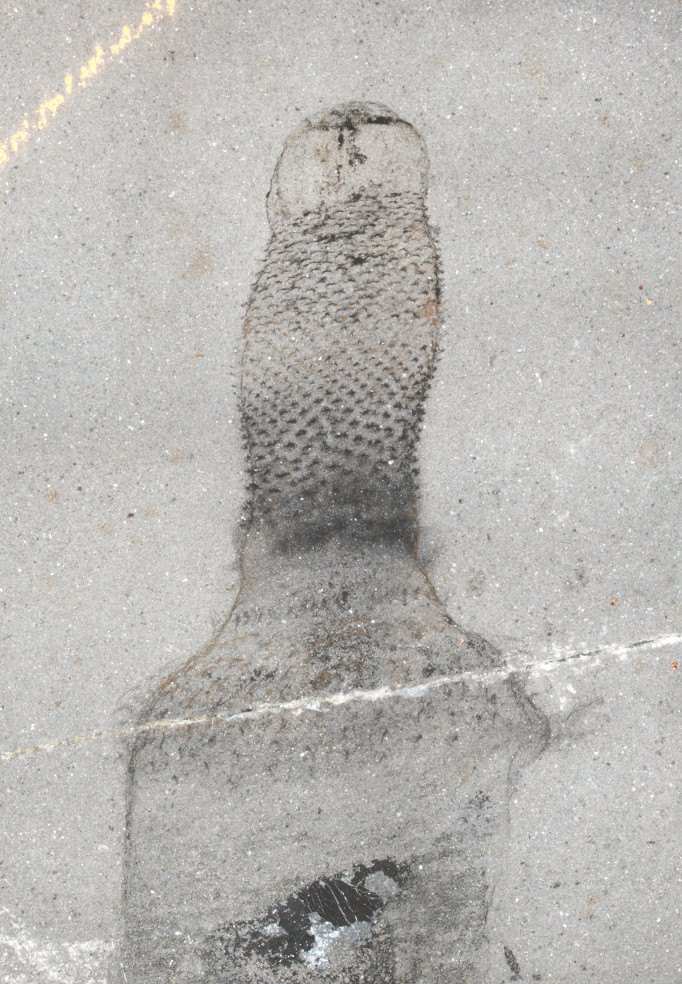
Image context: the cover uses a real Royal Ontario Museum specimen photograph of Ottoia prolifica with the proboscis extended and gut contents visible. That choice fits the article because the central claim depends on keeping anatomy and feeding evidence in the same image. Ottoia is not important merely because it was a worm with hooks. It is important because the hooks, gut trace, and swallowed shelly remains can still be read together on the slab.[1]
The body plan is built for grasping first, not for passive mud eating
The Burgess Shale species page gives the clearest starting outline. Ottoia was a priapulid-grade worm reaching up to 150 millimetres in length, with an annulated trunk, a short posterior tail extension, and an eversible proboscis lined with teeth, hooks, and spines.[1] The proboscis carried 28 rows of hooks interspersed with larger spines, which immediately separates the animal from any peaceful image of a simple sediment tube.[1] Specimens are often preserved bent into a U-shape, and the gut commonly runs as a visible line down the center of the body.[1][3]
That does not mean every dramatic reconstruction is justified. Ottoia is generally treated as a stem-group priapulid rather than a straightforward modern priapulid in old dress, so the safest comparisons are functional, not literal.[1] The body tells us that the worm could evert a grasping mouthpart and move food down a simple tubular gut. It does not license fantasies about an apex predator rampaging across the Cambrian seafloor. The first discipline is anatomical scale. Ottoia was modest in size, soft-bodied, and working close to the sediment-water interface, where grabbing, swallowing, and opportunistic feeding could matter more than speed or long pursuit.[1][2][5]
The gut is what turns Ottoia from a strange worm into a serious ecological data point
This is the real payoff of the species. The same ROM page notes specimens of the hyolith Haplophrentis carinatus preserved in Ottoia guts, and the separate Haplophrentis page confirms that numerous individuals have been found either aggregated or swallowed by the worm.[1][4] Those conical shells are important because they keep the food-web argument anchored to material evidence rather than to a mouthpart analogy alone.
Jean Vannier's 2012 PLOS ONE study pushed that evidence much further.[2] Working from gut contents, Vannier identified remains of hyolithids, brachiopods, arthropods, polychaetes, and wiwaxiids, then argued that Ottoia was a dietary generalist rather than a specialist hunter.[2] That shift matters. A famous fossil often gets promoted by narrowing its behavior into one clean role. Ottoia becomes more convincing when the role broadens. Its feeding system looks comparatively simple, and the direct evidence suggests it took whatever small invertebrate material was available at or near the seafloor, including both living prey and decaying organic matter.[2]
The Smithsonian restudy helps here by restoring the animal to specimen-level discipline.[3] Ottoia is not known from a single miraculous slab. It is known from many specimens that repeat the same basic body logic: annulated trunk, introvert, hooked mouth region, and a gut that can remain visible enough to support ecological interpretation.[1][3] That repetition is what gives later dietary claims weight. One gut could be anecdote. A record of abundant, similarly built worms plus multiple informative guts becomes a pattern.
Abundance makes the worm matter at community scale
Ottoia would already be notable if it were rare. It is more valuable because it was common. The ROM species page states that Ottoia accounts for more than 80% of Walcott Quarry priapulids and over 1.3% of the entire Walcott Quarry community, with thousands of specimens known.[1] That abundance means the animal is not a marginal oddity in the Burgess story. It is part of the ordinary operating machinery of the community.[1][5]
Community context sharpens the point. The Walcott Quarry page describes a seafloor ecosystem whose feeding relationships already look surprisingly modern in structure, with grazing, filtering, scavenging, and predation braided together rather than stacked into one simple line.[5] Ottoia fits that setting neatly. Vannier's study argues that the worm's generalist feeding reveals a trophic web that was already too complex to be reduced to a simple linear chain.[2] In other words, Ottoia does not merely tell us what one worm ate. It helps show that Cambrian ecosystems had already developed overlapping consumption pathways, fallback foods, and detrital opportunities that made the food web resilient and crowded.[2][5]
That is why the famous carcass-feeding slab matters as a boundary, not as a headline. The ROM page notes a specimen showing multiple Ottoia individuals feeding on a dead Sidneyia.[1] The lesson is not that Ottoia was a cinematic killer. The lesson is that scavenging belonged inside its repertoire. Vannier reaches the same general conclusion from the gut evidence: Ottoia should be read as an opportunist whose ecology included living prey, carrion, and incidental sediment intake, not as a single-mode predator.[2]
Ottoia is therefore best kept in proportion. It was not the ruler of the Burgess Shale. It was something more informative: a common, hook-mouthed seafloor worm whose body and gut preserve one of the clearest direct links between anatomy and trophic behavior in the Cambrian fossil record.[1][2][3][5] Once the hooks and gut stay together, the animal stops looking like a poster for prehistoric weirdness and starts looking like evidence that early animal ecosystems were already thick with opportunism, overlap, and ecological texture.[2][5]
Sources
- Royal Ontario Museum, "Ottoia prolifica" - species page with specimen photographs, body-plan description, abundance estimates, and ecological notes.
- Jean Vannier, "Gut Contents as Direct Indicators for Trophic Relationships in the Cambrian Marine Ecosystem," PLOS ONE 7, no. 12 (2012).
- Mary E. Rice and W. C. Banta, "A restudy of the Middle Cambrian Burgess Shale fossil worm, Ottoia prolifica" - Smithsonian repository record.
- Royal Ontario Museum, "Haplophrentis carinatus" - hyolith page documenting repeated occurrence in the gut of Ottoia.
- Royal Ontario Museum, "The Walcott Quarry Community" - community structure, food-web context, and gut-content examples from the Burgess Shale.