Joggins is often introduced through one irresistible sentence: this is where some of the earliest reptiles were found inside hollow fossil trees.[1][5] The sentence is true, and it is also too small for the site. Joggins is strongest when read as an archive cut open by tides. The famous upright trees, trackways, land snails, millipedes, amphibians, and early amniotes matter because they are not floating museum curiosities detached from setting. They sit inside a long coastal exposure where sedimentary context, ecological context, and discovery history remain unusually close together.[1][2][4][5]
That is what makes the site still feel alive in 2026. UNESCO's statement emphasizes the Joggins Fossil Cliffs as a 689-hectare coastal palaeontological site and calls it the "coal age Galápagos," while the current Joggins site stresses the more tactile fact on the ground: the Bay of Fundy's tides withdraw twice daily and expose hundreds of metres of shoreline beneath cliffs that are typically more than 30 metres high.[2][3] In other words, Joggins is not simply a place where important fossils were once found. It is a place where the physical mechanism of exposure still controls what can be seen, studied, and protected.
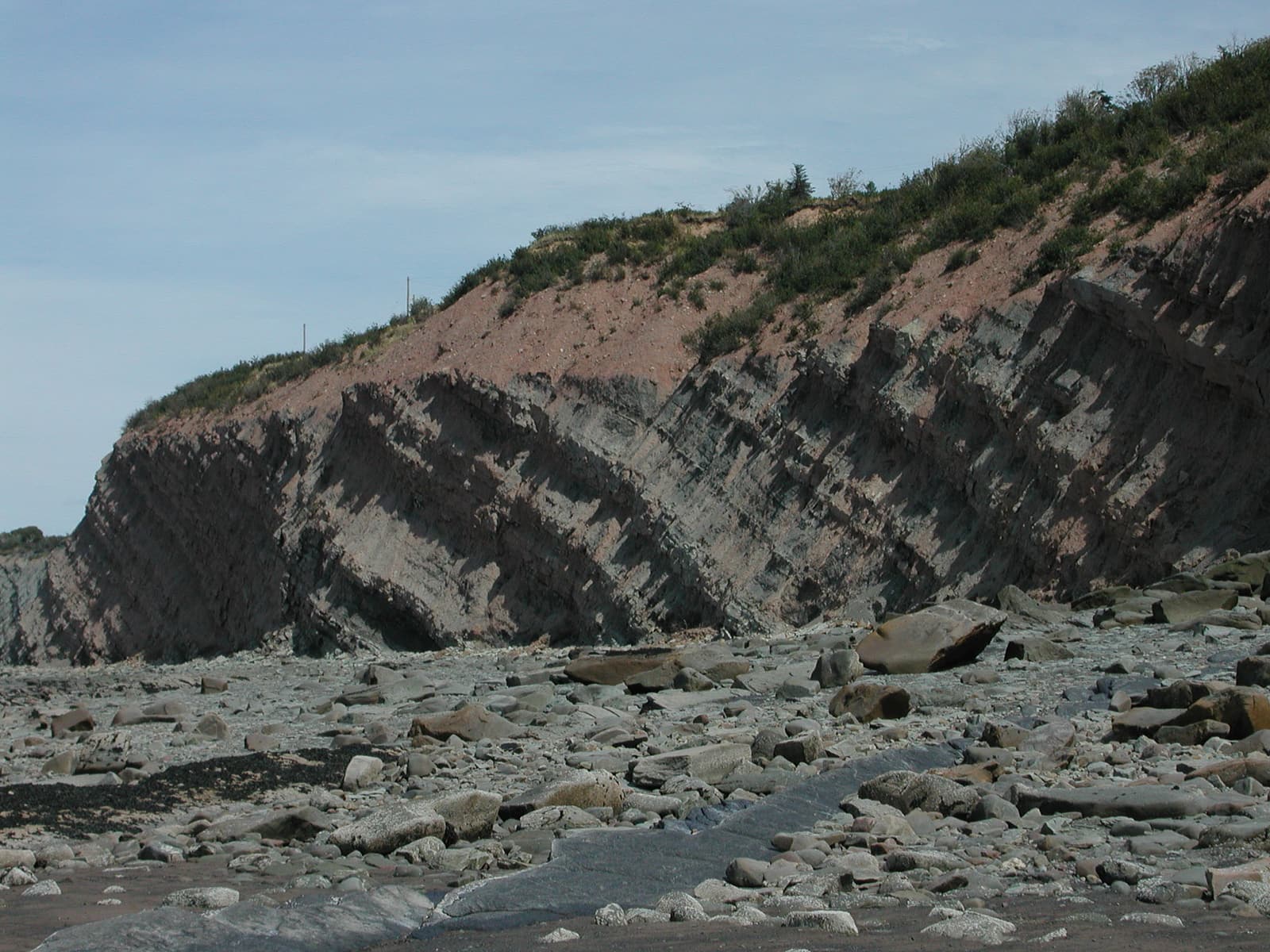
Image context: the cover uses a real Wikimedia Commons photograph of the Joggins cliffs at low tide. It fits this article because the field-report argument begins with the section itself. Long before the reader reaches a named fossil, the photo shows alternating beds, active coastal exposure, and the foreshore that lets the Carboniferous stack be read in profile.[7]
The cliff is the instrument
The official property page makes a point that is easy to miss if attention goes straight to the fossil trees: if the cliffs did not exist, the fossil record at Joggins would not be visible in the way that changed science.[3] The present-day exposure depends on two comparatively recent agents, not on Carboniferous conditions alone. The site explains that the cliffs owe their current form to the last Ice Age and to the extreme tides of the Bay of Fundy, which keep stripping, refreshing, and reopening the foreshore.[3]
That sounds like logistics, but it is actually interpretation. A fossil site exposed by active coastal erosion behaves differently from a single quarry face or an isolated museum specimen. Joggins keeps presenting the record as a sequence. You do not just meet one tree stump or one tetrapod cavity; you meet a cliff-scale stack of rocks that forces every fossil back into a larger sedimentary story.[2][3][4]
Grey and Finkel's review sharpens the same point from the research side. They describe the World Heritage Site as a 14.7-km-long coastal section and stress that major progress at Joggins has come from sedimentology and stratigraphy, because those provide the framework for everything else.[4] Once that framework is restored to the front of the story, Joggins stops being a collection of wonders and becomes a reading surface for an entire Coal Age landscape.
The site's real luxury is context
The Joggins overview page says the fossil wealth is exceptional, but its strongest phrase is simpler: fossils are preserved in their original setting.[1] That is the decisive advantage. The page does not advertise Joggins as a random concentration of pretty objects. It describes trees standing where they grew, footprints frozen where animals once walked, dens preserved with traces of their occupants, and early reptiles entombed within once-hollow trunks.[1]
This is why the upright lycopsid trees matter so much. They are not just oddities with vertical posture. They tell the reader that at least part of the record is still organized around habitat structure rather than mere transport. The same is true of the trackways and the hollow-tree tetrapods. These finds are meaningful not simply because the organisms are old, but because the site retains unusually strong ties between body, behavior, and place.[1][4][5]
Grey and Finkel state the point explicitly: an important factor in Joggins' World Heritage designation was that fossils are preserved in situ, in their palaeoenvironmental context.[4] For paleontology, that phrase does heavy lifting. It means the site is valuable not only for taxonomy but for reconstructing how land plants, invertebrates, vertebrates, channels, soils, and peats related to one another on the late Carboniferous alluvial plain.[4]
Earliest reptile, yes; single-fossil legend, no
The historical importance of Joggins is real and should stay visible. The official history page recounts the work of Lyell and Dawson and notes that Hylonomus lyelli, reported by Dawson in 1859, remains the earliest known amniote in the fossil record.[5] That is a major evolutionary landmark. It helps explain why Joggins entered arguments about the history of life far beyond Nova Scotia.[2][5]
But the same history page also makes clear why the site should not collapse into one milestone fossil. In 1877 Dawson exposed an entire fossil forest horizon with 25 lycopsid trees, and 15 of those productive trees yielded more than 100 individual tetrapods.[5] That is a different scale of story. Instead of one heroic specimen, the cliffs deliver a whole terrestrial scene: standing forest structure, hollow trunks used as shelters or traps, and a vertebrate sample dense enough to matter at community level as well as at headline level.[5]
That broader scale is also why Joggins still belongs to field-report writing rather than museum-label summary. The site overview page emphasizes creatures found nowhere else and fossils of life on dry land.[1] The review adds that more than 200 species have been recovered from the section.[4] Those numbers do not just certify richness. They tell the reader that Joggins was a working landscape with ecological variety, not a single perfect snapshot frozen on one afternoon.
Floodplain stacking is the hidden subject
The best way to read Joggins is therefore sideways through the beds, not only forward through the discovery timeline. UNESCO notes that the property boundaries include both the most fossiliferous strata and the younger and older rocks needed for geological context.[2] That phrasing matters because it refuses to isolate the showiest layers from the rest of the section. Joggins is informative precisely because channel deposits, forested horizons, paleosols, coals, and associated strata can still be read as a connected sedimentary stack.[2][4]
Grey and Finkel go further, describing a section that spans multiple formations and likely represents nearly 15 million years of time.[4] The article does not need every formation name to make its point. What matters is the scale of repetition. Joggins keeps returning the reader to a Carboniferous world where forests, wet ground, channels, and burial events were not singular episodes but recurring arrangements on an alluvial and coastal plain.[4] The site's famous fossils sit inside that rhythm.
This is also where recent research keeps the cliffs current. The Joggins research page highlights CT scanning of bones inside fossil trees, continued work on fauna preserved in hollow trunks, and LiDAR monitoring of cliff erosion.[6] Those projects are tellingly practical. They treat Joggins not as a solved Victorian monument but as an active exposure whose preservation, internal tree-fill anatomy, and erosion dynamics still change what researchers can ask.[6]
Why the site still holds
The cleanest summary is that Joggins is a geological delivery system for terrestrial Carboniferous evidence. Tides reveal it, erosion refreshes it, and the length of the section prevents the reader from reducing it to one celebrated stump or one famous reptile.[1][2][3][4][5][6] That is why the site remains so persuasive. It gives paleontology one of its rare chances to study land life, behavior, and habitat structure in something close to their original arrangement.
The reptile legend survives, and it should. But the stronger field reading starts one level lower, with the cliff itself. At Joggins, the real star is the exposure: a tide-cut archive where upright trees, footprints, hollow trunks, and floodplain beds keep insisting that context is the fossil.
Sources
- Joggins Fossil Cliffs, "The Joggins Fossil Cliffs" - official overview stressing in situ preservation, upright trees, trackways, and early reptiles in hollow trees.
- UNESCO World Heritage Centre, "Joggins Fossil Cliffs" - official site description and statement of geological significance.
- Joggins Fossil Cliffs, "About the property" - official page on the cliffs, Bay of Fundy tides, and why the exposure exists.
- Melissa Grey and Zoe V. Finkel, "The Joggins Fossil Cliffs UNESCO World Heritage site: a review of recent research," Atlantic Geology 47 (2011).
- Joggins Fossil Cliffs, "Historical research" - official history page covering Lyell, Dawson, Hylonomus, and the fossil forest horizon.
- Joggins Fossil Cliffs, "Current and recent research" - official page on CT scanning fossil trees, erosion monitoring, and ongoing site research.
- Wikimedia Commons file page for the Joggins cliff photograph used as the article image.