
Radiolarians are easy to misplace in the imagination. They are too small for the dinosaur wing of public paleontology, too beautiful under the microscope to look like work, and too numerous in marine sediment to behave like a single spectacular discovery. That is exactly why U.S. Scientific Ocean Drilling's short video is useful. It does not try to make a radiolarian into a celebrity fossil. It shows the moment when a shipboard micropaleontologist turns a muddy core-catcher sample into a time constraint.[1][3]
The core catcher is the lowest part of an ocean-drilling core. In the video, Giuseppe Cortese is not admiring loose beauty; he is sampling the oldest material in that core section, looking for radiolarian species whose appearances and disappearances can narrow sediment age. JOIDES Resolution's companion explanation states the logic plainly: useful microfossils need broad geographic distribution, many species in the sediment, and enough evolutionary turnover that some species have short ranges.[3] A long-lived species gives a vague signal. A short-lived species, read with others, helps convert mud into a time interval.
That practical scene matters because radiolarians are not just tiny shells. UCL's micropalaeontology overview describes them as wholly marine planktonic protozoans, solitary or colonial, with the commonly preserved polycystine forms building opaline skeletons that resist dissolution better than more fragile radiolarian groups.[2] That durable skeleton is both the basis of classification and the reason radiolarians can leave such a strong fossil record. The video compresses all of that into a bench-top act: rinse, sort, identify, date.
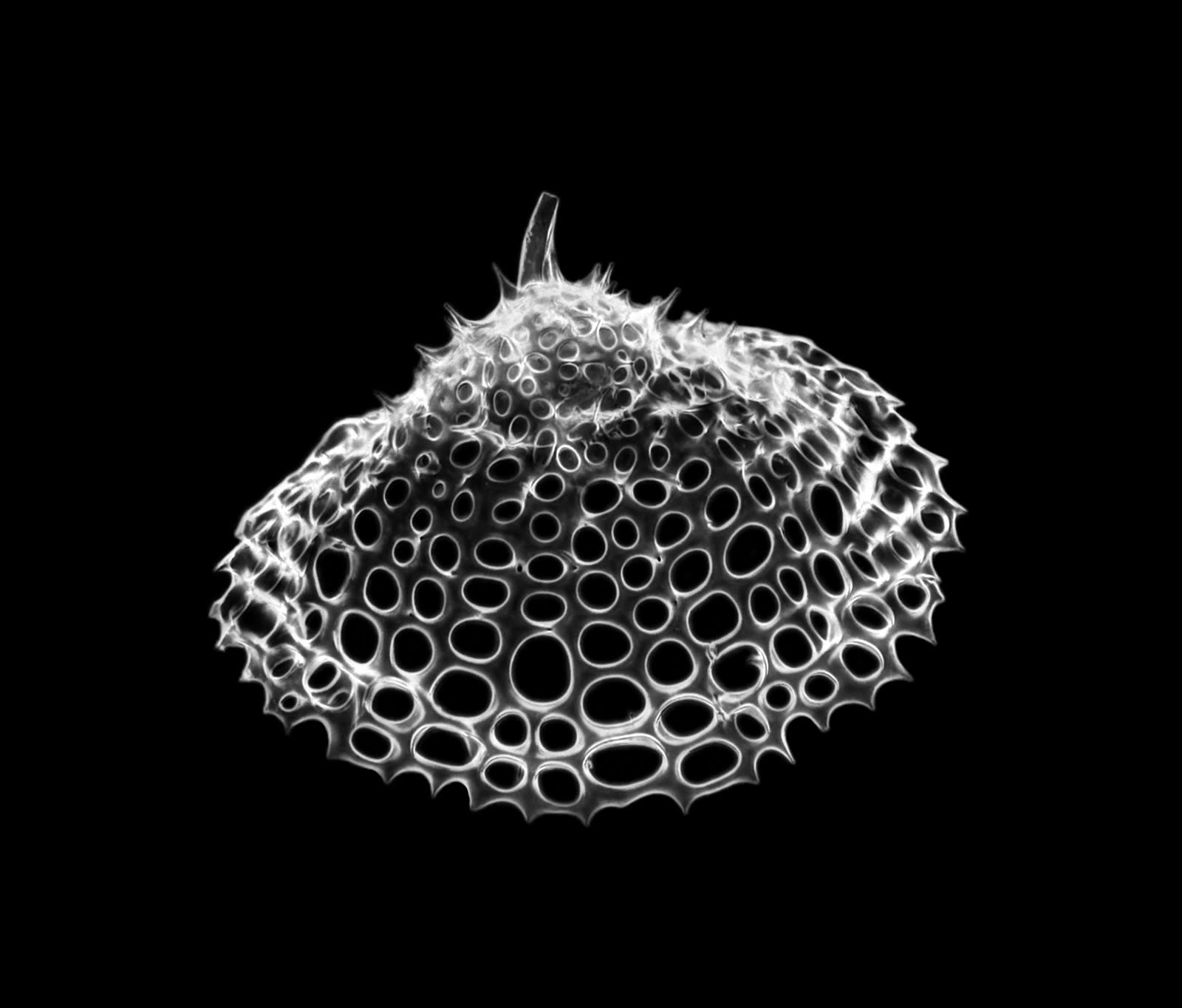
The first thing to watch is how little drama the sample offers at normal scale. A core-catcher residue does not look like an archive until the microscope intervenes. That is the first useful correction. Paleontology often asks viewers to move from a large object to a larger story: a skull to an animal, a trackway to behavior, a bonebed to population. Radiolarians reverse the movement. The object is almost too small, so the story has to be built from repetition. One specimen may be pretty; an assemblage becomes evidence.
Around the middle of the video, the act of recognition becomes the main event. Cortese is looking for forms that a trained eye can match to a known range. JOIDES Resolution's written exercise gives a concrete example from the same Expedition 374 context: one radiolarian species shows a sample must be older than a given extinction point, while another narrows the range further because it lived only within a shorter interval.[3] The important habit is not memorizing those names. It is understanding that age control improves when several species overlap. The sediment date is not handed down by one fossil; it is triangulated by an assemblage.
That is also why radiolarians are different from decorative microscope subjects. UCL places their first recorded occurrences near the latest Precambrian and gives them an unusually long geological range into the Recent, while also emphasizing that large assemblages can contain hundreds of species.[2] The group is therefore old enough to track major ocean-history changes, but its value comes from the changing details inside the lineage. The skeletons may all read as "glass-like" to a casual viewer, yet their pores, spines, cones, spheres, and species-level differences are the vocabulary that makes the record useful.[2]
The video's quietness also helps explain a boundary. Radiolarians do not work as proxies just because silica preserves. They work when taxonomy, ecology, and oceanography are kept together. A recent review of Northwest Pacific radiolarian microfossils emphasizes that different assemblages correspond to different water masses and temperature ranges, and that radiolarian-based sea-surface-temperature reconstructions require careful modern reference datasets rather than a simple fossil-equals-temperature shortcut.[4] That is the mature version of what the core-catcher clip introduces. A radiolarian slide can age a core, but it can also mislead if species ecology, regional circulation, seasonality, or reworked older sediment are ignored.[3][4]
The strongest part of the film is therefore its scale discipline. It never asks the viewer to mistake a microscope field for the whole ocean. It shows a necessary first layer. A drilling ship recovers sediment. The core catcher preserves the oldest material at that interval. A specialist extracts microfossils. Species identifications give a working age model. From there, other teams can compare the sediment to chemistry, magnetostratigraphy, climate signals, and regional ocean history.[3][4]
Radiolarians are beautiful, but beauty is the least demanding reason to care about them. Their real force is procedural. Their silica skeletons survive where soft cells vanish. Their species turn over quickly enough to help date marine sediments. Their distribution can carry information about water masses and temperature. And their usefulness depends on the unglamorous continuity between shipboard sampling, microscope taxonomy, curated ranges, and later climate interpretation.[2][3][4]
Read that way, the core catcher becomes a small clock with ocean water built into it. Not a perfect clock, and not a self-reading one. It is a clock that has to be assembled from grains, species, and context. The U.S. Scientific Ocean Drilling short is worth embedding because it catches that transformation at the right scale: a few radiolarians on a slide, a few minutes at the microscope, and a section of seafloor history becoming legible enough for the next scientific question.[1][3]
Sources
- U.S. Scientific Ocean Drilling, "Finding radiolarians in the core catcher," YouTube video.
- University College London, "Radiolaria" micropalaeontology overview.
- JOIDES Resolution, "Tracking the age of the core."
- Kenji M. Matsuzaki et al., "Review of radiolarian microfossils as a tool for reconstructing sea surface temperature of the past in the Northwest Pacific," Progress in Earth and Planetary Science 12, article 35 (2025).
- Wikimedia Commons file page for the photographed radiolarian specimen used as the lead image.