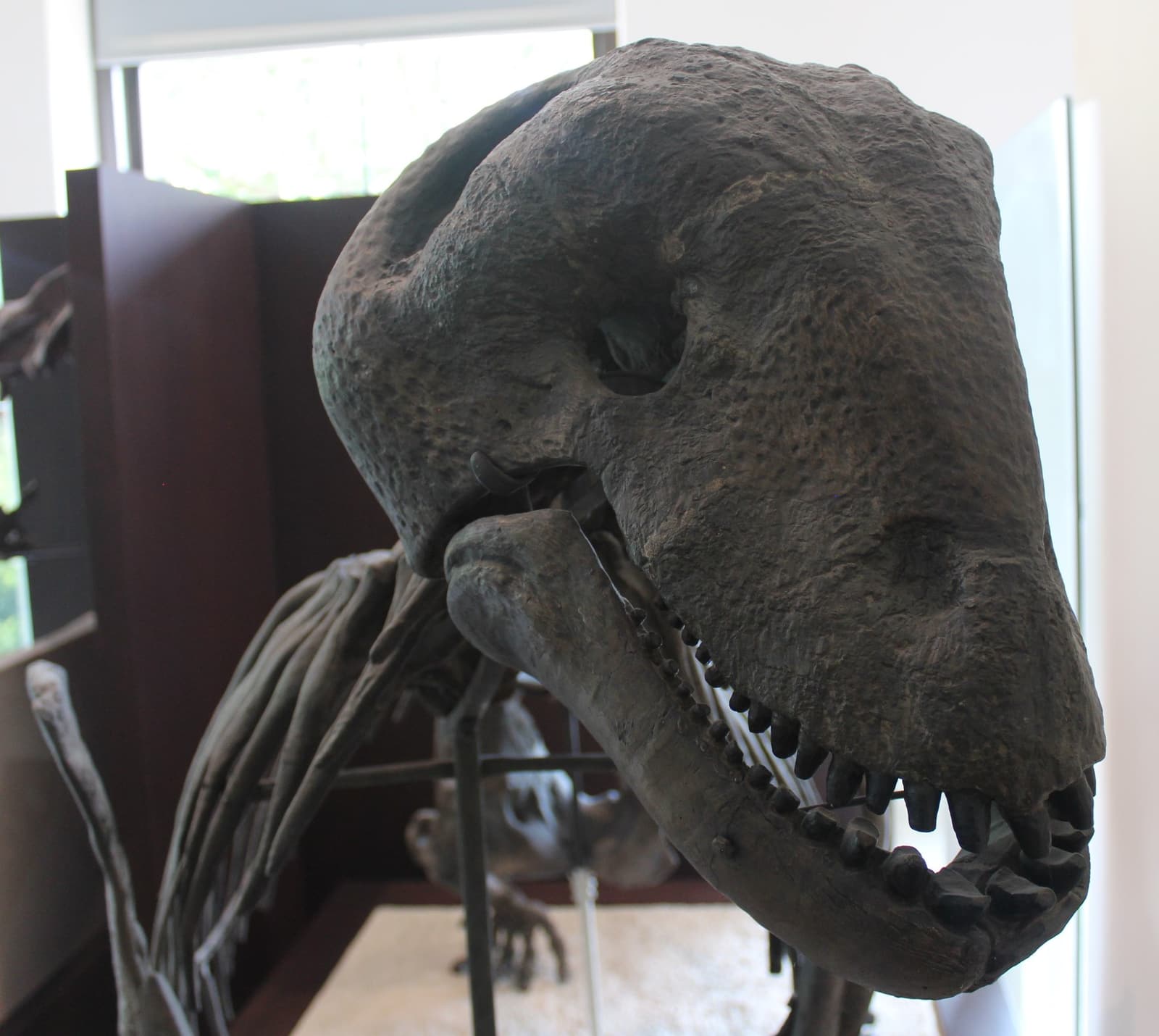
Moschops capensis looks blunt before it looks interesting: a heavy body, short face, swollen skull roof, and the posture of an animal built more for force than elegance. That first impression is useful, but only if it is slowed down. Moschops was not a dinosaur, not a mammal, and not a movie monster with a helmet. It was a tapinocephalid dinocephalian, a middle Permian therapsid from South Africa's Karoo record, on the synapsid side of amniote history.[1][4]
The reason to revisit it is not that headbutting is a fun behavior to imagine. The reason is that Moschops shows how paleontology turns behavior into anatomy. Nobody watched two dinocephalians collide. The argument has to pass through bone: the cranial roof, the arches supporting it, the position of the neck joint, the size of the endocast, the expected non-neural tissue around the brain, and the body mass that would have made any collision expensive.[2][3][4]
That makes Moschops a strong anatomy-and-method case. It asks a better question than "did this animal ram things?" The better question is: what kind of skull would make head-to-head contact plausible, and where does the evidence stop?
Image context: the cover uses a real Wikimedia Commons photograph of the AMNH display specimen AMNH 5552.[5] It fits this article because the skull is the argument. The thick roof and deep rear of the head make the animal's public silhouette less important than the structural problem preserved in bone.
The skeleton made the animal legible before the behavior was settled
William King Gregory's 1926 AMNH monograph remains a useful starting point because it treated Moschops as a whole skeleton rather than as a skull curiosity.[1] The mounted animal was reconstructed from Permian material collected in South Africa and held at the American Museum of Natural History, where the skull and postcranial skeleton made a broad, low, heavily built body visible at museum scale.[1][5]
That whole-body view matters. A thick skull does not act alone. A skull used in combat has to be supported by a neck, shoulders, forelimbs, and trunk capable of absorbing and redirecting force. Gregory's description tied the head to the rest of the animal: a large therapsid skeleton with sturdy limbs, a massive shoulder region, and a short, strong cranial front end.[1] Even before later studies formalized the headbutting hypothesis, the specimen made one thing clear: Moschops was not a delicate browser carrying an oversized ornament. It was a heavy terrestrial herbivore whose skull sat inside a load-bearing body.
This is the first boundary. The photograph is dramatic, but the fossil is not a behavior recording. It is a structure. Paleontology has to infer behavior only after asking whether the structure could take the forces being proposed.
The headbutting hypothesis is architectural, not theatrical
Herbert Barghusen's 1975 review is the classic source for turning dinocephalian headbutting into an anatomical hypothesis.[2] His argument did not rest on one swollen bone. It treated several cranial features together: a strong dorsal head shield, supporting arches, a neck joint positioned so blows would create less harmful torque, and a reoriented head suitable for contact against the upper skull.[2]
That combination is why Moschops and related tapinocephalids remain more interesting than a simple "bone-headed reptile" label. A thick skull roof by itself could be display, growth, pathology, or lineage habit. A thick skull roof connected to force-supporting architecture is a stronger signal. Barghusen's model read the skull as a ramming instrument modified from a non-mammalian synapsid plan, not as a copy of a modern bovid or sheep skull.[2]
That last distinction matters. Living headbutting mammals often use horns, keratin, sinuses, and cranial shapes that Moschops did not have. The point is not that Moschops fought like a bighorn sheep in Permian costume. The point is that different skull plans can converge on forceful contact while solving the engineering problem differently.[2]
The best version of the hypothesis is therefore narrow: many tapinocephalid skulls look mechanically compatible with pushing or ramming, and Moschops belongs in that conversation. The evidence supports combat as a serious functional interpretation. It does not give us a mating season, a ritual choreography, or a guarantee that every thickened skull belonged to the same behavioral script.
Scanning moved the argument inside the skull
The 2017 synchrotron study by Benoit, Manger, Norton, Fernandez, and Rubidge pushed the problem inward.[3] Working on a tapinocephalid skull then treated as Moschops capensis, the authors reconstructed the endocast and argued that the cranial cavity did not simply preserve a brain-shaped void. Instead, it appeared to include space for substantial non-neural tissue, plausibly protective tissue around the brain during head impacts.[3]
That is a useful methodological shift. A thick skull roof tells us about the outside of the force system. The endocast asks what happened to the vulnerable tissue inside. If headbutting was intense enough to matter, the braincase should not be interpreted as if every cubic centimeter were brain. Protective membranes, venous spaces, or other soft tissues can occupy volume and change what the endocast means.[3][4]
The authors also discussed sensory and behavioral implications, including the possibility that headbutting was tied to complex social behavior.[3] That is plausible, but it is exactly where discipline is needed. Social inference from a skull is not direct. The stronger claim is that the internal anatomy is compatible with a brain protected from impact and that this fits the broader headbutting model. The weaker claim would be to write a full social life from a scanned cavity.
This is why Moschops is such a good fossil for method. The anatomy invites behavior, but it also keeps behavior on a leash.
Body mass changes the scale of the collision
The 2024 Palaeontologia Electronica study by Benoit and Midzuk added another control: body and endocast estimates using digital 3D sculpting.[4] Their broader dinocephalian study treated Moschops as one of several taxa for which brain size, body mass, and non-neural endocranial tissue could be revisited. The important result for this article is not a single heroic number. It is the way the study reframed Moschops as a roughly 400-kilogram-scale animal in its sampled reconstruction, not as a casually inflated giant.[4]
That matters because impact behavior depends on mass. A skull-to-skull shove between small animals is not the same mechanical problem as contact between animals weighing several hundred kilograms. At that size, the head, neck, and torso must all work together. The 2024 paper also argued that a notable share of the dinocephalian endocast volume may have been non-neural tissue, with Moschops among the taxa for which protective or non-brain filling remains relevant to interpretation.[4]
Here again, the point is not to make the behavior more spectacular. It is to make it harder to overstate. If Moschops was a several-hundred-kilogram herbivore with a thickened skull and an endocast partly occupied by non-neural tissue, then headbutting becomes anatomically coherent. But coherence is not a camera. It tells us that a behavior fits the equipment; it does not tell us how often it happened, whether it was lethal, or how much of the animal's life revolved around it.
The safest reading is stronger than the cartoon
The cartoon version of Moschops is a dome-headed Permian brute. The scientific version is better. It is a herbivorous tapinocephalid therapsid whose skull roof, cranial supports, neck-joint geometry, internal cranial space, and body scale line up well enough to make head-to-head combat a serious hypothesis.[1][2][3][4]
The limits are part of the profile. Moschops does not prove that every dinocephalian with pachyostosis rammed rivals. It does not prove a modern mammal-style dominance system. It does not let us treat the endocast as either all brain or all cushion without argument. And it should not be folded into dinosaur imagery just because it looks ancient and heavy.
Read closely, the animal is more precise than that. Moschops matters because it turns a behavior people want to imagine into a chain of anatomical tests. The skull is thick, but thickness is only the opening clue. The real story is how bone, soft-tissue inference, mass, and mechanical plausibility combine to make an extinct animal's behavior arguable without pretending it is fully visible.
Sources
- Robert Broom and William K. Gregory, The skeleton of Moschops capensis Broom, a dinocephalian reptile from the Permian of South Africa, Bulletin of the AMNH, vol. 56, article 3 (1926), via Biodiversity Heritage Library.
- Herbert R. Barghusen, "A review of fighting adaptations in dinocephalians (Reptilia, Therapsida)," Paleobiology 1, no. 3 (1975).
- Julien Benoit, Paul R. Manger, Luke Norton, Vincent Fernandez, and Bruce S. Rubidge, "Synchrotron scanning reveals the palaeoneurology of the head-butting Moschops capensis (Therapsida, Dinocephalia)," PeerJ 5:e3496 (2017), PubMed record.
- Julien Benoit and A. J. Midzuk, "Estimating the endocranial volume and body mass of Anteosaurus, Jonkeria, and Moschops (Dinocephalia, Therapsida) using 3D sculpting," Palaeontologia Electronica 27(2):a39 (2024).
- Wikimedia Commons, "File:Moschops skull AMNH.jpg" - photographic source for the article image.