For years, Quetzalcoatlus has been treated as a trivia endpoint: “the biggest flying animal ever.” That headline is catchy, but it hides the harder and more useful question.
The scientific value of Quetzalcoatlus is not only maximal wingspan. It is the way this taxon sits inside a late azhdarchid lineage that appears to have scaled body size upward while preserving flight through a different mechanical package than modern birds.
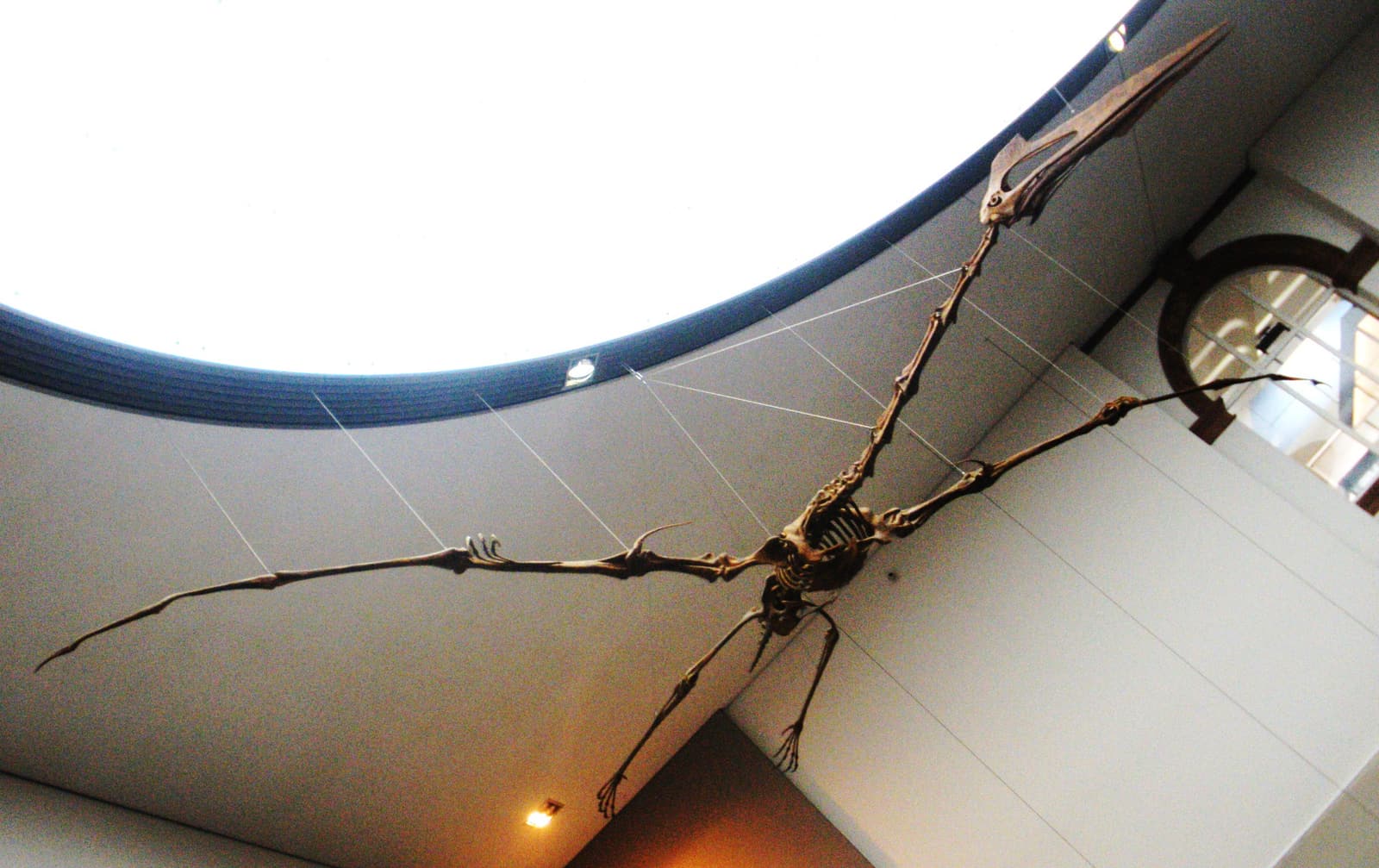
Image context: the cover image shows a mounted Quetzalcoatlus skeleton at Senckenberg Museum and is used here as direct anatomical context for neck proportions, forelimb dominance, and giant-azhdarchid silhouette.
1) Stratigraphic and taxonomic anchors that hold up
The genus comes from Late Cretaceous Texas material, centered on Big Bend localities in and around the Javelina Formation, with a Maastrichtian age window near 68–66 Ma.[1][2][3] The historical record is unusually important here because discovery, curation, and species assignment stretched across decades.
The 2021 Journal of Vertebrate Paleontology memoir series materially tightened this foundation by organizing specimen provenance and taxonomy at publication scale, including formal treatment of Q. lawsoni alongside Q. northropi.[2][3] That does not eliminate all disagreement, but it narrows the argument from “what do we even have?” to “what do these remains imply functionally?”
In practical terms, this is a better starting point than many iconic taxa: clearer specimen bookkeeping, explicit locality structure, and named disagreement lines.
2) Why azhdarchid gigantism is a lineage story, not a one-off monster
A common reading mistake is to isolate Quetzalcoatlus as a freak outlier. The broader azhdarchid record points to a lineage trend where extremely elongated necks, long limbs, and relatively reduced pedal specializations are coupled with strong terrestrial competence.[3][4][5]
That morphology supports a “ground-active giant flier” interpretation more naturally than older shoreline skimmer analogies. For giant azhdarchids, the working model has shifted toward terrestrial stalking in open settings, with feeding and movement ecology built around reach, stride, and visual scanning rather than continuous aquatic skimming.[4][6]
The key methodological point is that lineage context reduces overfitting. If one taxon appears strange in isolation but coherent within a clade-level pattern, the clade signal deserves priority.
3) Flight envelope: what is robust, what remains model-sensitive
Three claims are relatively robust across the literature:
- Giant azhdarchids were still capable of powered flight at very large sizes.[5][6]
- Launch mechanics were likely forelimb-dominant and quadrupedal, unlike bird-style bipedal launch assumptions.[6]
- Size estimates for Q. northropi remain bounded but not singular, with modern discussions often clustering near roughly 10–11 m wingspan, while historical estimates span much wider intervals.[1][6]
Where uncertainty remains high is not “could it ever leave the ground,” but performance boundaries inside different atmospheric and loading conditions: acceleration margin, climb profile, and sustained maneuvering at giant scale.
This is where model assumptions matter disproportionately. Small changes in soft-tissue mass distribution, wing membrane geometry, and body-mass reconstruction can shift inferred performance classes.
4) The real inferential trap: scaling certainty faster than evidence
Because Quetzalcoatlus is culturally famous, each new graphic reconstruction is often read as a final biomechanical verdict. That is exactly backwards.
The evidence hierarchy should run like this:
- Specimen-level anatomy (hardest anchor)
- Clade-level comparative pattern (next-best stabilizer)
- Functional model output (strong but assumption-loaded)
- Behavioral lifestyle claims (highest uncertainty)
In this stack, a beautiful simulation is not invalid. It is conditional. The conclusion quality depends on how transparently the assumptions are disclosed and stress-tested.
5) What changed in 2026-level reading discipline
If you read giant-pterosaur headlines today, the highest-value upgrade is to stop asking “largest ever, yes or no?” and start asking “which layer of the evidence stack has actually improved?”
For Quetzalcoatlus, the biggest gains in recent decades are taxonomic and morphological organization, not a single magical performance number. That is still major progress because it constrains the model space.
The lineage takeaway is clear: azhdarchids demonstrate that late pterosaur evolution explored an upper body-size regime where terrestrial efficiency and flight capability could coexist, but with narrow performance margins that remain sensitive to reconstruction choices.
That balance, rather than one headline wingspan, is the durable scientific result.
Sources
- Lawson (1975), Science: “Pterosaur from the Latest Cretaceous of West Texas: Discovery of the largest flying creature.”
- Brown, Sagebiel & Andres (2021), Journal of Vertebrate Paleontology: “The discovery, local distribution, and curation of the giant azhdarchid pterosaurs from Big Bend National Park.”
- Andres & Langston Jr. (2021), Journal of Vertebrate Paleontology: “Morphology and taxonomy of Quetzalcoatlus Lawson 1975 (Pterodactyloidea: Azhdarchoidea).”
- Padian, Cunningham, Langston Jr. & Conway (2021), Journal of Vertebrate Paleontology: “Functional morphology of Quetzalcoatlus Lawson 1975 (Pterodactyloidea: Azhdarchoidea).”
- Andres (2021), Journal of Vertebrate Paleontology: “Phylogenetic systematics of Quetzalcoatlus Lawson 1975 (Pterodactyloidea:Azhdarchoidea).”
- Witton, Habib & Laudet (2010), PLOS ONE: “On the size and flight diversity of giant pterosaurs, the use of birds as pterosaur analogues and comments on pterosaur flightlessness.”
- Wikimedia Commons image file page (lead image provenance)