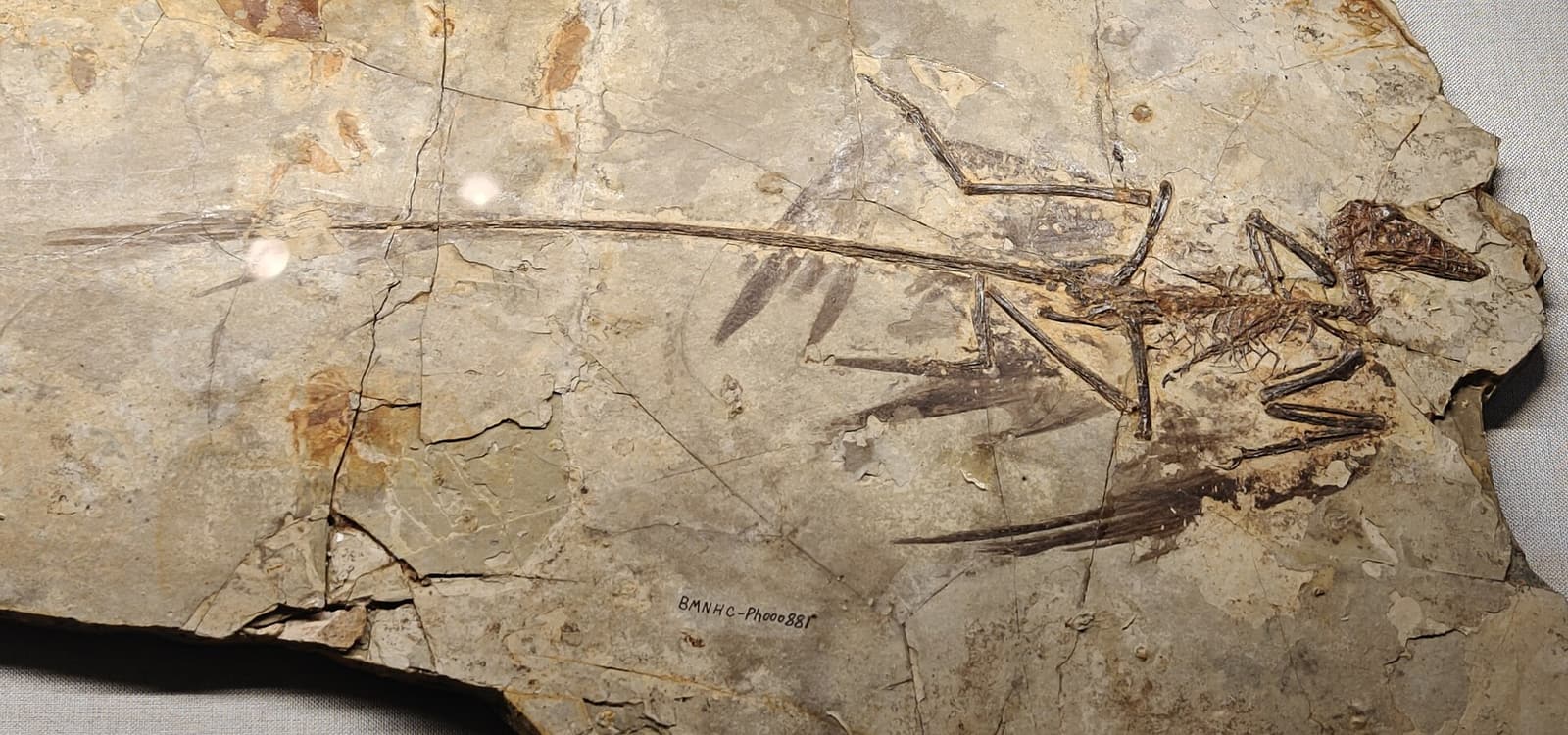
Microraptor changed the flight debate because it did more than add another feathered dinosaur to the Jehol record. The Liaoning slabs preserved a whole aerodynamic layout: forelimbs, hindlimbs, and tail all carrying long feathers that had to be interpreted together.[1][2]
That shift matters. Once the legs enter the picture as lifting surfaces rather than decorative fringe, the question stops being “did small theropods have feathers?” and becomes “what kind of planform did early paravians actually fly or glide with?”[1][4][5]
Image context: the cover image shows the BMNHC Ph000881 Microraptor specimen and is used here as the direct visual anchor for hindlimb feathering, tail vanes, and the body-wide surface geometry discussed in this article.
1) Why this fossil changed the question
The 2002 American Museum Novitates paper on new Microraptor zhaoianus material helped establish the animal as a small dromaeosaurid from northeastern China.[2] The 2003 Nature paper then sharpened the argument dramatically by describing Microraptor gui as a four-winged dinosaur, with pennaceous feathers on both forelimbs and hindlimbs.[1]
That sequence is easy to flatten into a headline about “first four-winged dinosaur,” but the deeper change was methodological. After 2003, any origin-of-flight model that kept its attention only on the arms was working around the fossil rather than through it.[1]
2) What the slab preserves, in deep-time terms
These fossils come from the Early Cretaceous Jehol world of Liaoning, roughly 120 million years ago, where fine-grained preservation repeatedly captured feathers as anatomical data rather than atmospheric decoration.[1][2][3]
For Microraptor, the crucial preserved cluster is not a single dramatic feather. It is the repeated combination of:
- long forelimb feathers,
- long hindlimb feathers,
- a feathered tail with clear aerodynamic consequence,
- and an articulated small-bodied paravian skeleton that lets those surfaces be read as one mechanical package.[1][2][3]
By 2014, additional specimen work strengthened the case that this was not a one-off taphonomic illusion created by one spectacular slab. New material from western Liaoning gave the genus a broader anatomical footing and made the hindlimb-wing question harder to dismiss as preparation noise.[3]
3) The real visual shock: the legs become part of the wing argument
When readers look at a Microraptor fossil, the immediate temptation is to treat the hindlimb feathers as a flourish around a basically bird-like body. The fossil pushes in the opposite direction.
The hindlimb feathers matter because they force the eye to read the animal as a distributed surface rather than a two-wing prototype. In that reading, the tail is not a mere ornament either; it becomes part of the stability and control problem.[1][4][5]
This is why Microraptor remains so important in flight-origin discussions. It drags the debate out of symbol and into geometry. The fossil does not hand over one perfect flight recipe, but it does make a narrow claim unavoidable: early feathered flight surfaces were being assembled across the body, not only on the arms.[1][4]
4) Where the fossil stops and the models begin
The hard evidence is strongest at the level of preserved anatomy. The slabs show extensive feathering and a body arrangement that invites aerodynamic interpretation.[1][2][3]
The next layer is experimental and model-based. A 2013 Nature Communications study reported that Microraptor could achieve effective glides without requiring a fully modern bird wing, and that low-elevation, high-lift gliding fits the reconstructed animal better than a fantasy of sleek high-speed efficiency.[4] A 2014 physical-model study then emphasized stability and control, showing that posture and surface arrangement change handling qualities even when the animal remains recognizably aerodynamic.[5]
That is the right evidence order for a close reading:
- the fossil establishes surface distribution,
- aerodynamic models test what those surfaces can do under stated assumptions,
- behavior and lifestyle claims come last and stay conditional.[1][4][5]
5) What this close reading supports, and what it leaves open
High-confidence supports:
- Microraptor preserved a body-wide feather arrangement that made hindlimb wings a scientific problem, not a reconstruction flourish.[1][2][3]
- The fossil record here shifted the origin-of-flight debate from feather presence alone toward planform, stability, and control.[1][4][5]
- The strongest enduring inference is gliding or aerial competence under constrained conditions, not a fully settled picture of one exact flight style.[1][4][5]
Boundaries that stay open:
- Exact launch mode, maneuver envelope, and habitual posture remain model-sensitive.[4][5]
- Species-level sorting within Microraptor material has a more complex history than the popular image of one perfect specimen suggests.[2][3]
- A spectacular fossil can narrow the debate sharply while still leaving room for disagreement about ecology, tree use, and performance ceiling.[4][5]
6) Why Microraptor still reads as modern paleontology
Microraptor is a good reminder that major fossils often matter because they rearrange questions rather than because they settle them. The Liaoning slabs forced paleontology to treat hindlimb feathers, tail vanes, and small-body aerodynamics as one connected problem.
That is the durable result. The fossil made early flight harder to tell as a clean ladder from ground runner to modern bird, and easier to read as an experiment in distributed surfaces, partial control solutions, and evolutionary designs that later lineages would simplify, discard, or refine.[1][4][5]
Sources
- Xu et al. (2003), Nature: "Four-winged dinosaurs from China."
- Hwang et al. (2002), American Museum Novitates: "New Specimens of Microraptor zhaoianus (Theropoda: Dromaeosauridae) from Northeastern China."
- Pei et al. (2014), American Museum Novitates: "A New Specimen of Microraptor (Theropoda: Dromaeosauridae) from the Lower Cretaceous of Western Liaoning, China."
- Dyke et al. (2013), Nature Communications: "Aerodynamic performance of the feathered dinosaur Microraptor and the evolution of feathered flight."
- Evangelista et al. (2014), PLOS ONE: "Aerodynamic Characteristics of a Feathered Dinosaur Measured Using Physical Models: Effects of Form on Static Stability and Control Effectiveness."
- Wikimedia Commons file page for the BMNHC Ph000881 specimen photograph.