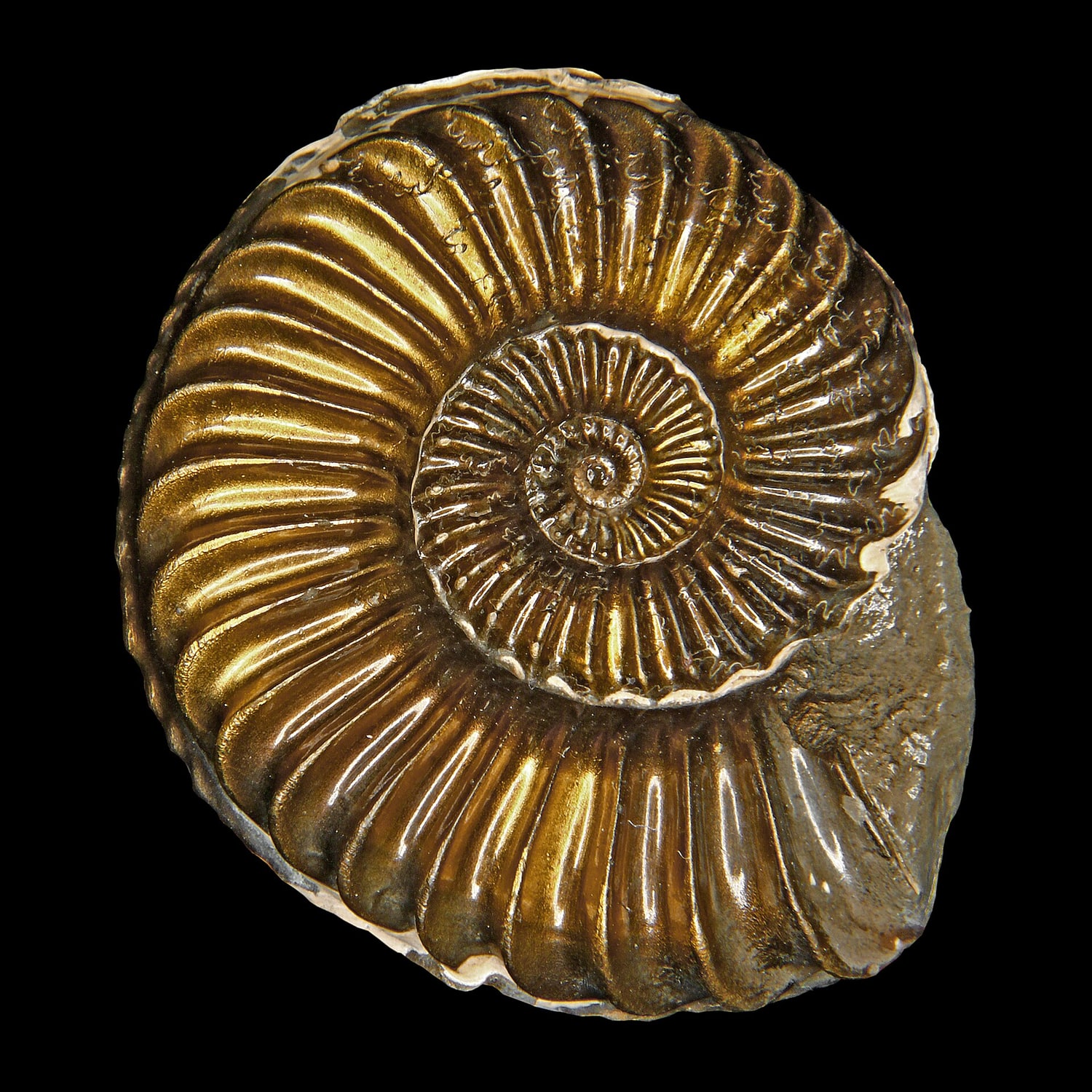

The ammonite above is a photographed fossil, not a reconstruction: a pyritic Pleuroceras solare specimen from Bavaria.[6] Its gold-colored spiral looks more durable than bone. That appearance is exactly why pyrite decay feels so perverse. Iron sulfide can help carry an organism's form through burial, yet the same mineral may become unstable after excavation. A fossil can finish one journey through deep time and begin a much faster episode of chemical weathering inside a drawer.
The change is environmental. Pyrite formed or persisted in one set of buried conditions; collection brings oxygen, water vapor, temperature cycles, handling, packaging, and neighboring materials into the story. “Fossilized” therefore does not mean chemically finished. A specimen remains matter, and matter keeps responding to its surroundings.[3][4][5]
The Canadian Museum of Nature's Pyrite Disease: Keeping Fool's Gold Challenges Museums is only 1 minute 52 seconds long, but it gives this hidden collection problem a useful visual sequence: bright pyrite, damaged material, and the dry enclosures used to slow further change.[1][2] The museum published the film on its official channel alongside a written account from its mineralogy collection. Watch it once for the contrast between shine and powder; then use the annotations below to separate metaphor from mechanism.
0:00–0:30 | A metallic shine is not a stability test
The opening plays on pyrite's old “fool's gold” reputation.[1][2] For a collections viewer, the more important deception is not confusing pyrite with gold. It is confusing brightness with permanence. A clean metallic surface says what light is doing now; it does not reveal grain size, hidden fractures, organic carbon, earlier exposure, or oxidation beginning below the visible face.[3][4]
That distinction matters especially for fossils. Pyrite can occur as obvious crystals, as a replacement of biological structures, or as fine grains dispersed through a shale matrix. The most vulnerable material may be microcrystalline or framboidal rather than a handsome cube that advertises its mineralogy.[4] A curator cannot safely classify risk from color alone. Geological unit, mineral texture, matrix, collection history, and present condition all belong in the diagnosis.
The lead photograph should be read with the same restraint. It shows a real pyritized ammonite, but no photograph by itself proves that decay is active.[6] Warning signs come from change: a formerly bright area dulling, cracks opening, pale or gray powder appearing, crystals growing between layers, or a label and box beginning to show acid damage.[2][3][4] Monitoring is comparison over time, not a verdict delivered by one attractive surface.
0:30–1:12 | “Disease” names a reaction, not an infection
The middle of the film introduces the cracking and discoloration that give pyrite decay its disease-like name.[1][2] The metaphor is memorable but chemically imprecise. In ordinary museum conditions, the central process is oxidation: pyrite meets oxygen and water, producing sulfuric acid and hydrated iron sulfates. Those secondary solids occupy more volume, absorb moisture, and grow through pores and fractures. Expansion converts a molecular reaction into mechanical damage.[3][4]
The reaction can spread harm without being contagious in the biological sense. Acidic products can attack paper labels, cardboard boxes, carbonate matrix, and nearby vulnerable objects. Shared humid air can expose several specimens to the same trigger. Powder and reaction products can also move within a tray.[2][3] Isolation is therefore sensible, but the cause is not a microbe jumping from fossil to fossil. Calling it “disease” should prompt quarantine-like care without obscuring the chemistry.
Research on fossil-bearing shale shows why the visible result is not always just iron sulfate dust. In the Late Carboniferous Xiaheyan insect beds, investigators linked pyrite oxidation to the release of sulfate and to gypsum growth where calcium was available. The expanding crystals could fragment the rock and obscure fine anatomical detail.[5] This is a crucial paleontological loss: even if the broad outline survives, the characters needed to identify a wing vein, joint, or soft-tissue boundary may be overwritten by later mineral growth.
1:12–1:52 | The closing container is part of the specimen's future
The film ends with prevention: lower humidity and dry, impermeable storage.[1][2] The Canadian Conservation Institute gives a deliberately cautious public guideline, describing pyrite as particularly vulnerable above 50% relative humidity and recommending tight enclosures, desiccant, and controlled microclimates for sensitive material.[3] This is not glamorous conservation. A gasket, a humidity indicator, conditioned silica gel, and a schedule of inspection may preserve more information than a dramatic treatment attempted after the surface has begun to powder.
The number should not become false certainty. Classic museum work found microcrystalline and framboidal pyrite especially susceptible at 60% relative humidity and above, while later collection evidence showed that organic-rich specimens or a damaging exposure history may require substantially drier conditions.[4] A short sensor reading is also not a storage biography. Daily and seasonal peaks, time before accession, a previous building, a leaky case, or years in an unmonitored box can matter more than today's neat display.
That is why a microclimate is more than “keeping the room dry.” A sealed enclosure reduces the specimen's contact with fluctuations; a desiccant buffers the small volume around it; monitoring reveals whether the enclosure is actually holding its target. The outer room still matters, but the box becomes a local environmental instrument.[3]
One tray shows what late detection costs
The British Geological Survey documented the frightening end state in a collection of mainly goniatite fossils from the Westphalian Coal Measures. Of 65 specimens in a wooden tray, 56 had been totally destroyed and replaced by gray reaction products; the remaining nine were extensively damaged. Scanning electron microscopy and X-ray diffraction identified oxidized pyrite and larger-volume hydrated iron sulfates.[4]
That case resists a tidy single-cause story. The authors considered geological horizon, pyrite and organic-carbon content, weathering before collection, earlier storage, and fossil microstructure. Monitoring near the affected material captured large humidity extremes elsewhere in the store, while a brief later reading inside an adjacent tray sat nearer 40%. The study explicitly warned that a week of measurements could not reconstruct the long history that produced the loss.[4]
For paleontology, the destroyed tray is not merely damaged property. It is lost repeatability. A published identification can be reconsidered only if later researchers can return to the specimen. New imaging can extract new characters only if the surface and matrix remain. Locality labels, preparation notes, and older photographs become more important when the object changes, but none is a complete substitute for the fossil itself.
Prevention is stronger than a universal cure
Historical treatments have included neutralizing chemicals, coatings, oils, and ammonia-vapor methods, with uneven outcomes. The BGS review records cases in which apparently protective coatings failed because moisture still entered while expanding products accumulated beneath the film.[4] That history argues against a do-it-yourself recipe. Once decay is active, treatment depends on the fossil's mineralogy, matrix, previous consolidants, research value, and the products already present. A trained conservator needs to decide what can be removed, stabilized, enclosed, or merely documented.
The durable lesson of the Canadian Museum of Nature film is therefore not that pyrite is a bad preservative.[1] Without mineralization, some fossils would never have reached a collection at all. The lesson is that preservation has stages. Burial can create a fossil; excavation can reset its exposure; storage can either slow the new reactions or quietly accelerate them.
Seen this way, a collections drawer is not the end of fieldwork. It is the fossil's newest environment. Humidity logs, sealed boxes, condition photographs, and regular inspection become part of paleontological method because they protect the possibility of asking tomorrow's questions of today's specimen. The rock survived its first weathering history by chance. Its second one is a curatorial choice.
Sources
- Canadian Museum of Nature, “Pyrite Disease: Keeping Fool's Gold Challenges Museums,” official YouTube video embedded above.
- Christian Capehart, “Pyrite Disease: Keeping Fool's Gold Challenges Museums,” Canadian Museum of Nature, January 9, 2019.
- Canadian Conservation Institute, “Caring for natural history collections,” preventive-conservation guidance on pyrite oxidation, relative humidity, enclosures, and desiccants.
- E. S. Hodgkinson and S. Martin, Curation History and Mineralisation of Highly Degraded Pyrite Fossil Collection, British Geological Survey Internal Report IR/04/037, 2004.
- Giliane P. Odin, Véronique Rouchon, Olivier Béthoux, and Dong Ren, “Gypsum growth induced by pyrite oxidation jeopardises the conservation of fossil specimens: an example from the Xiaheyan entomofauna,” Palaeogeography, Palaeoclimatology, Palaeoecology 507 (2018).
- Llez (H. Zell), “File:Pleuroceras solare, Little Switzerland, Bavaria, Germany.jpg,” Wikimedia Commons source page for the photographed pyritic ammonite used as the lead image.