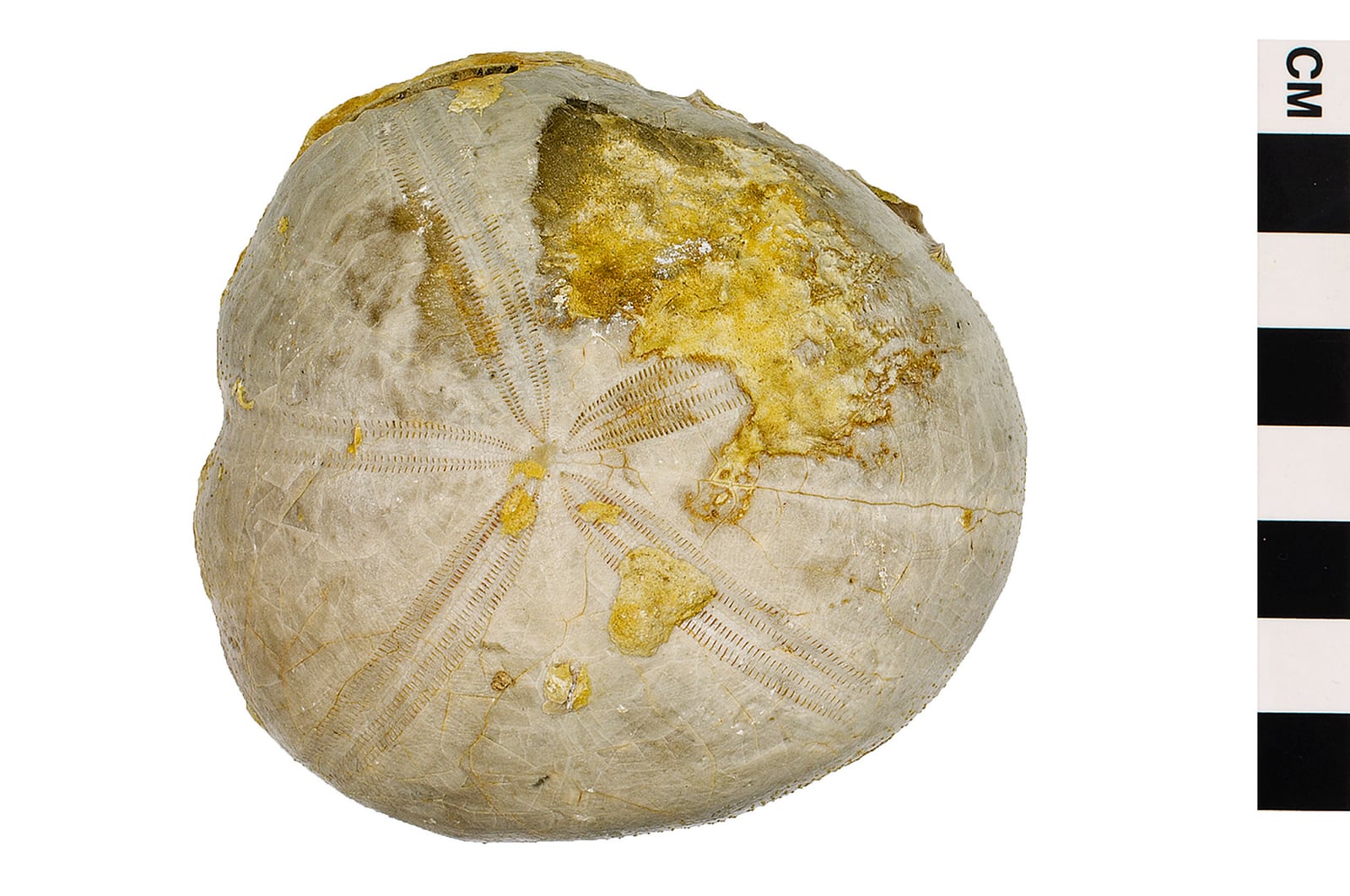
The fossil looks as if two geometries have been pressed into the same shell. Five pore-studded petals radiate across its upper surface, unmistakably echoing a sea urchin’s star. Yet the outline is not a circle. A notch cuts into one end, the opposite end tapers, and the whole test—the rigid case made from interlocking calcite plates—points in a direction.
This is the evolutionary trick of the irregular echinoids, the lineage that includes heart urchins, sand dollars and sea biscuits. They did not discard the five-part construction inherited from other echinoderms. They overlaid it with a front and a back. Beginning in the Early Jurassic, that reorganization opened a new way of living in soft sediment: moving forward, swallowing the seabed and, in many later branches, disappearing beneath its surface.[1][2]
The familiar shorthand says that a round, radial urchin became a bilateral burrower. The fossils tell a more interesting story. Direction appeared as a bundle of changes that did not arrive all at once. The anus moved, the mouth shifted, spines multiplied and shrank, tube feet specialized, jaws changed or vanished, and the test became lower or longer in different branches. Burrowing was not a switch thrown by a single mutation. It was an ecological project assembled inside an older five-rayed plan.
A body with no preferred heading
On a typical globular sea urchin, the mouth sits at the center of the underside and the anus opens within the apical system at the summit. Five ambulacra—paired columns of plates pierced for tube feet—alternate with five interambulacra around the test. Such an animal can graze and turn without committing its skeleton to one permanent leading edge.
“Regular urchin” is useful visual language, not the name of one natural evolutionary group. Irregularia, by contrast, is supported as a single lineage. Its members retain basic five-part radiality while adding secondary bilateral symmetry. In the most obvious external change, the periproct, the plated region surrounding the anus, leaves the apical system and shifts toward what becomes the rear.[1][3]
That relocation matters, but it is not a sufficient origin story. A 2007 phylogenetic analysis compared 39 characters across Jurassic irregular echinoids and concluded that periproct position alone was a poor defining character. Related “regular” forms had evolved eccentric anal openings independently, while early members of Irregularia were better recognized through a combination that included the architecture of the feeding apparatus and unusually dense fields of small tubercles and spines.[1]
In other words, the rear did not begin with one wandering opening. It emerged from correlated asymmetries. Once an animal repeatedly travels through sediment in one direction, the leading and trailing ends face different problems. Food must enter at the front or below. Waste must leave without fouling feeding and respiratory surfaces. Spines must grip and shift grains. Tube feet that collect food need not do the same job as those that exchange gases. The old fivefold scaffold remained, but its five sectors no longer carried identical assignments.[3][4]
The Jurassic redesign came in pieces
The irregular-echinoid body-fossil record opens in the Early Jurassic, after the end-Permian crisis had reduced echinoid diversity and the surviving crown lineage radiated into Mesozoic seas. A time-calibrated study of echinoid diversification found an early pulse associated with the origin of irregular forms and later pulses within their major subclades. That pattern fits adaptive radiation, but it does not mean a finished heart urchin appeared at the first occurrence.[2]
Early forms remained comparatively close to the surface and retained a substantial jaw apparatus known as Aristotle’s lantern. Across later lineages, the mouth migrated forward, the anus moved farther back, and the test became elongated or flattened. Small, closely set spines formed a mobile felt over the body, better suited to pushing against grains and moving sediment than the sparse, long spines of an exposed urchin. Tube-foot fields near the mouth became more elaborate for collecting particles.[1][3][4]
More derived sediment swallowers reduced and eventually lost the lantern. That was not degeneration; it changed the intake system. Instead of bringing a rigid set of teeth to each food item, specialized tube feet could pass organic-rich particles toward a smaller forward mouth. In heart urchins, enlarged plates on the underside formed a plastron that helped support directed movement through the substrate, while petal-like ambulacra on the upper surface carried respiratory tube feet.[4]
No single sequence applies to every irregular branch. Sand dollars later flattened into high-energy, shallow-water specialists; heart urchins became plough-shaped infaunal deposit feeders; holasteroids explored other surface and deep-sea designs. The lineage is united by descent, not by one depth of burial or one silhouette. Modern irregulars therefore help interpret fossil structures, but a living deep burrower cannot simply be projected backward onto every Jurassic test.[1][3]
Moving the exit did not create the burrow
It is tempting to tell the whole transition from the anus. Moving waste away from the apical reproductive openings and upper respiratory tube feet makes functional sense for an animal ingesting sediment. A posterior exit also avoids carrying a full digestive tract back toward the center of a compact body. These are plausible benefits, not direct observations of the selection pressures acting on the first irregular echinoids.[4][5]
Developmental evidence adds an important boundary. The five ambulacral growth zones of an echinoid test are modules, each associated with an ocular plate near the apex. Studies of living and fossil forms show that displacement of the periproct follows a consistent route relative to those modules, and lesser eccentricity evolved several times outside Irregularia. This suggests that the body already contained a developmentally available direction in which the opening could move. Irregular echinoids pushed that latent asymmetry farther and earlier during growth.[5]
Constraint is not the opposite of adaptation. The soft seabed rewarded a functional front and back; inherited development limited how that direction could be built. Evolution worked with the plate-producing zones already present. The result was not a bilateral animal pasted onto a radial one, but a directional use of radial parts.
That distinction also explains why the star remains so visible in a heart urchin fossil. Ambulacra III leads at the front, while the paired ambulacra on either side can become petal-shaped and functionally differentiated. The rays still record the construction plan. Their unequal shapes and jobs record the new ecology.
A trail can test what a shell implies
Body fossils preserve the hardware of burrowing: test profile, spine attachment sites, pore fields, mouth and anus positions. Trace fossils can preserve the work.
The winding structures grouped under Scolicia occur from the Jurassic onward as meandering, meniscate backfilled burrows; Subphyllochorda has been treated as one preservational expression. Associated Cardioichnus records the animal at rest. Experiments with living spatangoids support the interpretation that these structures record an irregular echinoid ploughing through sediment, processing it and packing material behind the body.[6]
The match is powerful but not universal. A groove is not automatically a heart urchin, and an isolated irregular echinoid does not prove deep burial. Strong attribution depends on the trace’s internal structure, age, dimensions and anatomical fit. Where those lines converge, the burrow supplies evidence that a streamlined test only suggests: a persistent forward direction and a conveyor-belt relationship with sediment.[6]
This is why “bilateral” should not be treated as a shape word alone. The front-back axis became behaviorally real. It organized locomotion, feeding, ventilation and waste removal around travel through a medium that resists movement from every side.
The five-rayed flower survived underground
The photographed Micraster is a Late Cretaceous heart urchin, far younger and more specialized than the first Jurassic irregulars. Its value is not that it freezes the transition at its beginning. It shows what the lineage could build once the changes cohered.
The heart-like outline marks a leading notch and a trailing end. The petal pattern preserves the ancestral five-part logic. The small surface tubercles once anchored a dense coat of spines; the bare fossil has lost that moving layer. Mouth, anus, tube feet and spines did different work in life, even though the same plated test supported them all.[4][7]
Seen this way, the origin of irregular echinoids is not a march from symmetry to asymmetry. It is a redistribution of symmetry. Five growth zones continued making the body, but an ecological axis began telling those zones where they were and what they should do. Later lineages refined different answers—heart, disc, lamp, vase—without escaping the underlying echinoid grammar.
A round urchin can face anywhere. A heart urchin carries its next direction in its skeleton. Evolution did not erase the star; it taught the star to move forward.
Sources
- Thomas Saucède, Rich Mooi and Bruno David, “Phylogeny and origin of Jurassic irregular echinoids (Echinodermata: Echinoidea),” Geological Magazine 144 (2007)—character-based test of the lineage’s origin and defining anatomy.
- Simon Boivin et al., “Diversification rates indicate an early role of adaptive radiations at the origin of modern echinoid fauna,” PLOS ONE 13 (2018)—time-calibrated analysis of Jurassic and later echinoid radiations.
- World Register of Marine Species, World Echinoidea Database—current classification and overview of radiality, bilateral symmetry, spines and the principal living irregular groups.
- Porter M. Kier, “Evolutionary Trends and Their Functional Significance in the Post-Paleozoic Echinoids,” Journal of Paleontology Memoir 5 (1974)—synthesis of test, spine, tube-foot, feeding and burrowing changes.
- Thomas Saucède, Bruno David and Rich Mooi, “The evolutionary origin and maintenance of the echinoderm body plan,” Comptes Rendus Palevol 2 (2003)—developmental and fossil account of periproct displacement and secondary bilateral symmetry.
- Zain Belaústegui et al., “Echinoderm ichnology: bioturbation, bioerosion and related processes,” Journal of Paleontology 91 (2017)—review of Scolicia, associated resting traces and experimental attribution to burrowing spatangoids.
- Smithsonian National Museum of Natural History, “Fossil Heart Urchin: Micraster elegans,” Q?rius collection record—identity, Cretaceous age, Texas provenance, dimensions and image record for the photographed specimen.