

Pterosaurs survive in popular memory as animals that somehow never settle into one convincing shape. They are often flattened into a vague hybrid: part bird, part bat, part dinosaur brand icon. That blur makes them look less coherent than they really are. The most useful correction is to put three facts back into the same frame. First, the wing was built around a drastically elongated finger rather than a bird-like arm alone.[1][4] Second, the body had to work on the ground as well as in the air, which is why forelimbs and launch mechanics matter so much.[1][2][5][6] Third, the fossil record is unusually patchy because pterosaur bones were fragile and many species lived away from the settings where skeletons fossilize well.[3][7]
That is why a video collection works especially well for this topic. The first clip from the American Museum of Natural History restores the basic body plan: wing finger, quadrupedal stance, powered flight, and extreme size diversity.[1] The second, a Royal Tyrrell Museum speaker-series lecture by Michael Habib, shifts attention from silhouette to mechanics and asks how giant pterosaurs actually got airborne without being badly modeled as oversized birds.[2][6] The third AMNH clip narrows the problem again by explaining why pterosaur fossils so often arrive incomplete, forcing paleontologists to assemble anatomy from scattered evidence rather than from one miraculous full skeleton.[3][7] Watched together, the videos make one larger point: pterosaurs look implausible mainly when one of those three layers gets stripped away.
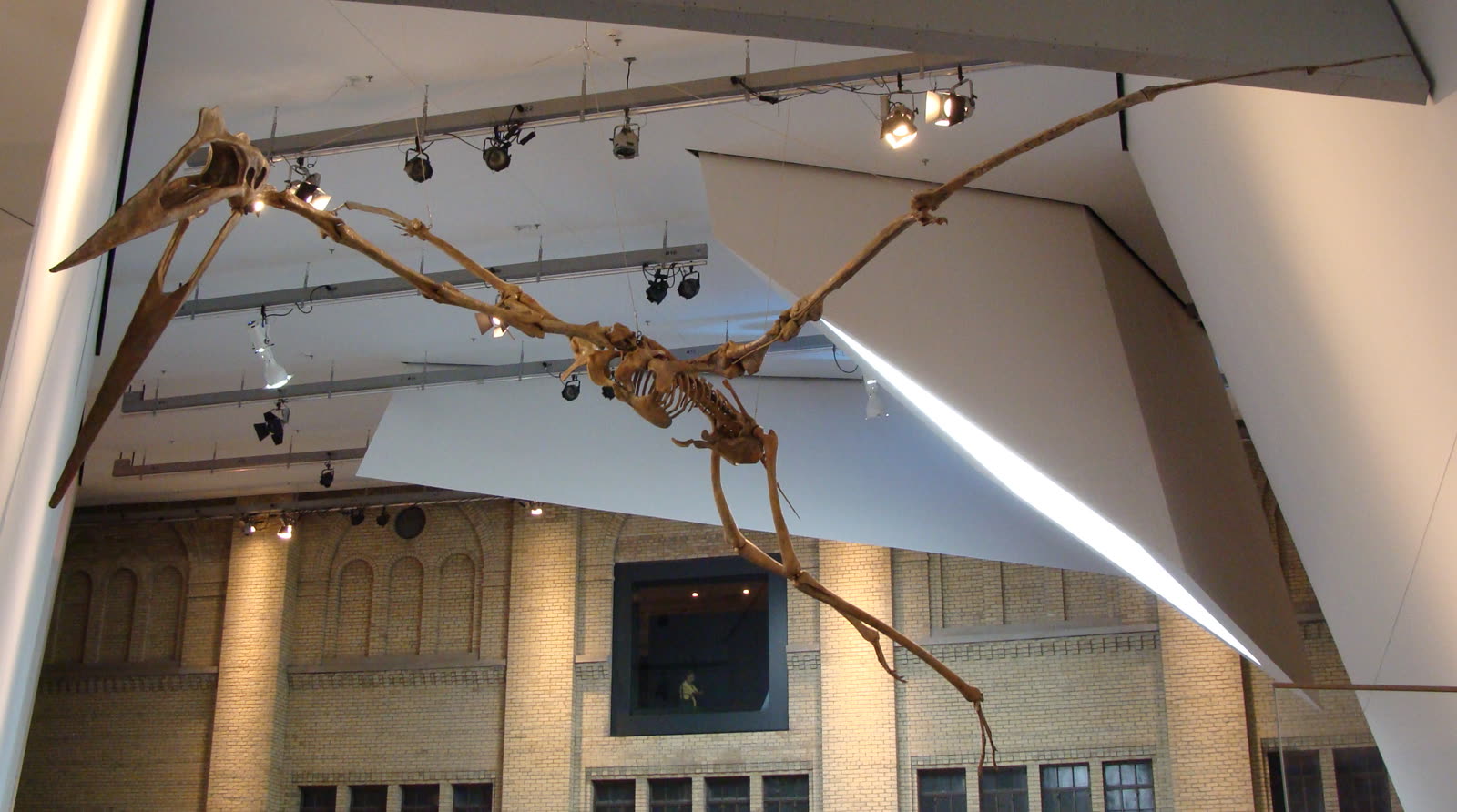
Image context: the cover uses a real photograph of a Quetzalcoatlus mount at the Royal Ontario Museum from Wikimedia Commons. It suits this article because the central claim is anatomical and physical, not decorative. A museum body in space makes the scale problem, the forelimb problem, and the balance problem visible at once.[8]
Video 1: the AMNH intro works because it restores the real body plan before it tries to amaze you
The short AMNH exhibition video is a strong opening because it does not begin with mythic scale by itself.[1] It begins with structure. The museum's own description says pterosaurs "flew with their fingers" and "walked on their wings," which is a compact way of forcing the viewer to abandon the wrong comparison class.[1] If you look at a pterosaur as if it were simply a reptile trying to imitate a seabird, the entire skeleton feels awkward. If you look at it as a flying reptile whose wing depends on an extreme hand modification and whose stance on land is already part of the flight system, the awkwardness starts turning into design logic.
That matters because pterosaurs were not a narrow experiment in one size band.[1][4] The same AMNH framing emphasizes that some species were tiny while others reached giant scale, and the NHM overview similarly presents them as the first vertebrates to achieve powered flight, with anatomical solutions distinct from birds and bats.[1][4] The point is not simply that pterosaurs flew. The point is that they built flight with a different kit. A membrane wing, a spectacularly modified fourth finger, and a body comfortable on all fours produce a flight lineage that should not be read through bird expectations.
This first video therefore does the most important conceptual cleaning in the collection. It tells the viewer what to notice before size and spectacle take over: the hand, the forelimbs, the ground posture, and the fact that walking and flying are entangled rather than separate chapters.[1][4] Once those features are back in view, the famous weirdness of pterosaurs starts feeling less like fantasy and more like a structurally consistent answer to a difficult engineering problem.
The clip also does something quietly useful for later sections. By foregrounding rare fossils and exhibition mounts together, it suggests that every confident pterosaur image already rests on curation, comparison, and reconstruction.[1] That prepares the viewer for the harder question that follows: if this body plan scaled up to giants such as azhdarchids, what exactly powered takeoff?
Video 2: the Habib lecture shifts the problem from romance to launch mechanics
Michael Habib's Royal Tyrrell lecture is the hinge of the whole collection because it refuses the laziest version of giant-pterosaur wonder.[2] The hard question is not whether giant pterosaurs looked dramatic on posters. The hard question is whether their anatomy can be modeled as a mechanically coherent flying system at large size. That is exactly the territory Habib and Mark Witton addressed in their PLOS ONE paper on giant pterosaur size and flight diversity, which argued that bird and pterosaur wing structure, gross anatomy, and launch kinematics are too different to be treated as interchangeable.[6]
That sounds technical, but the implication is easy to follow. Many claims that giant pterosaurs must have been flightless came from forcing bird assumptions onto a non-bird skeleton.[6] Once forelimb-powered quadrupedal launch enters the picture, the body stops looking like a failed oversized stork and starts behaving like a different machine. The same paper argues that giant pterosaurs retained powered-flight capability and that some older size estimates overshot the best-supported upper range, with wingspans of about 10 to 11 meters and masses around 200 to 250 kilograms presented as more defensible maxima for known forms.[6]
This is also where azhdarchids become more interesting on the ground than in the sky alone. Witton and Naish's earlier reappraisal of azhdarchid functional morphology argued against treating them as permanently skim-feeding or helplessly aerial creatures, and instead emphasized long-limbed terrestrial competence and ecology that made land use central to their lives.[5] In that light, Habib's focus on launch and ecology belongs together. A giant pterosaur had to be believable at rest, in stride, in launch, and in flight. If any one phase breaks, the reconstruction collapses.
That is why this middle video changes the emotional register of the collection. It moves pterosaurs away from poster language and back toward biomechanics.[2][5][6] Giant forms stop reading as unbelievable only after the forelimbs are allowed to do the work their anatomy suggests. The ground comes back in, and with it, plausibility.
Video 3: fossil rarity explains why pterosaurs keep getting reconstructed from edges and gaps
The last AMNH clip is only a little over a minute long, but it earns its place because it explains a public-facing problem that museum mounts can otherwise hide too well.[3] The description states the issue cleanly: few pterosaurs lived close to the places where fossils tend to form, their delicate bones preserved poorly, and paleontologists often have to combine information from multiple fossils or infer missing details from related taxa.[3] Once that is said directly, the persistent sense that pterosaurs are "hard to picture" stops looking like failure of the science and starts looking like a predictable consequence of the record.
The NHM's 2025 coverage of newly reported early pterosaurs pushes the same logic deeper in time. It notes that one reason early pterosaur fossils may be scarce is ecological and geographic: some of these animals may have spent more of their time inland, far from the depositional settings where skeletons are more likely to fossilize and later be found.[7] That matters because rarity is not just a museum inconvenience. It shapes the kinds of questions paleontologists can answer cleanly. A lineage with thin-walled bones and poor depositional luck will always require more comparative inference than one represented by repeated, articulated skeletons.
Seen after the first two videos, this preservation lesson does not weaken pterosaur science. It sharpens it. It tells you why confidence has to be distributed unevenly across the body plan.[3][7] Some elements are supported directly. Others rest on repeated comparison, scaling arguments, trackways, or better-known relatives.[5][6][7] The resulting picture is still coherent, but it is coherent in the way paleontology usually is: through layered evidence rather than through total completeness.
That is the right note to end on, because it disciplines the imagination without flattening it. Pterosaurs remain strange. The difference is that their strangeness now has a record-based explanation instead of a merely visual one.
What the three videos reveal together
Watched in sequence, these videos turn pterosaurs from a vague spectacle into an evidence structure. The first restores the basic body plan and reminds the viewer that the hand, the forelimbs, and quadrupedal stance are central rather than incidental.[1][4] The second shows that giant size only becomes tractable when launch mechanics and terrestrial competence are treated as core parts of the animal's design, not as afterthoughts once flight has already been assumed.[2][5][6] The third explains why this entire lineage keeps arriving through fragmentary fossils, composited reconstructions, and arguments that must stay honest about what is directly preserved and what is inferred.[3][7]
That combined view is more satisfying than the usual "look how weird this thing was" treatment. Pterosaurs stop looking impossible once the ground comes back in, and they stop looking arbitrary once fossil bias comes in beside it. Their anatomy still feels alien by modern standards, but it no longer feels incoherent. The wing finger, the forelimb launch, and the holes in the record all point in the same direction. These animals were real, mechanically specific solutions to vertebrate flight, and the best way to respect that specificity is to read them through structure, scaling, and preservation at the same time.[1][2][3][4][5][6][7]
Sources
- American Museum of Natural History, "Pterosaurs: Flight in the Age of Dinosaurs," YouTube video.
- Royal Tyrrell Museum of Palaeontology, "Air Giants: Launch, Flight, and Ecology of Cretaceous Pterosaurs," speaker-series YouTube video.
- American Museum of Natural History, "Why Are Pterosaur Fossils So Rare?," YouTube video.
- Natural History Museum, "Pterosaurs: The truth about these flying dinosaurs."
- Mark P. Witton and Darren Naish, "A reappraisal of azhdarchid pterosaur functional morphology and paleoecology," PLOS ONE 3(5), 2008.
- Mark P. Witton and Michael B. Habib, "On the Size and Flight Diversity of Giant Pterosaurs, the Use of Birds as Pterosaur Analogues and Comments on Pterosaur Flightlessness," PLOS ONE 5(11), 2010.
- Natural History Museum, "Early pterosaur fossils are hard to find, but we might now know why" (June 2025).
- Wikimedia Commons, "File:QuetzalcoatlusROM.JPG."