
North American oviraptorosaurs are easy to recognize in broad outline and surprisingly hard to count with any confidence. They have the familiar ingredients that make feathered theropods instantly legible to museum audiences: beaks, long hind limbs, bird-like bodies, and a reputation for being strange cousins on the dinosaur-bird line.[1][3] The trouble starts once paleontologists ask a stricter question. If one specimen is much smaller than another, are they looking at two species, or at two growth stages of one species? Jade Simon's April 14, 2022 Royal Tyrrell Museum lecture is valuable because it shifts the problem away from silhouette and toward maturity.[1]
That shift still matters after the lecture. The 2014 description of Anzu wyliei gave North America its first large, reasonably complete late Maastrichtian caenagnathid and turned the group from scattered scraps into a more coherent anatomical problem.[3] But that was never the end of the story. A January 24, 2024 PLOS ONE paper on a smaller Hell Creek hind limb used osteohistology and morphology to argue that the specimen was not a juvenile Anzu at all, but a distinct smaller-bodied adult species, with the broader implication that Hell Creek may have held three caenagnathid species rather than one obvious giant.[4] Simon's lecture sits neatly between those two moments: after the record becomes good enough to compare, and before histology starts revising what the comparison means.
That is why this video works best as an annotated viewing rather than as a simple talk recommendation. Simon is not merely introducing a charmingly odd dinosaur group.[1][2] She is showing why species counts near the end of the Cretaceous depend on bone tissue, growth stage, and the timing of older taxonomic decisions. Watch the lecture that way and the central paleontological claim becomes clear: hidden diversity is not only a matter of finding more fossils. It is also a matter of aging the fossils already in hand correctly.[1][4]
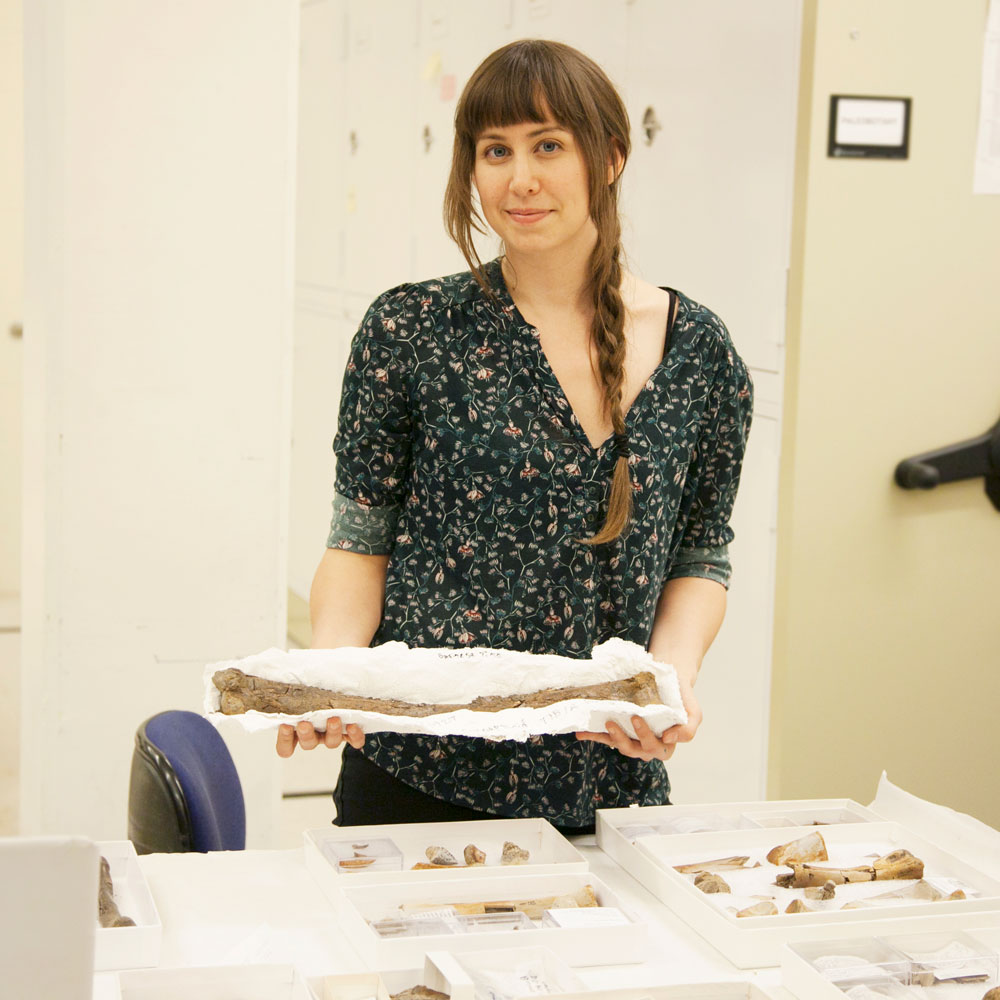
Image context: the cover photograph comes from the Burke Museum page on Simon's research and shows her holding a large oviraptorosaur tibia from the Hell Creek Formation of Montana. It fits this piece because the article's argument lives at exactly that scale: one leg bone can carry body-size clues, maturity clues, and eventually taxonomic consequences.[2]
Around 10:30, the lecture shows why better skeletons changed the question before they answered it
One of Simon's strongest early moves is to walk through the relatively recent North American specimens that made the group worth rethinking in the first place.[1] Around the ten-minute mark, she highlights Apatoraptor at the Royal Tyrrell Museum and Anzu wyliei at Carnegie as unusually informative because they preserve associated parts of the body instead of isolated scraps.[1] That matters for a group whose anatomy was long reconstructed from jaws here, feet there, and little else. The 2014 Anzu paper made the same point in more formal language: the three partial skeletons together preserved much of the body and gave caenagnathids a level of osteological resolution they had largely lacked in North America.[3]
The practical consequence is easy to miss. More complete fossils do not simply add confidence to an existing species list. They change the kinds of questions paleontologists can ask. Once limbs, pelvis, jaws, and vertebrae can be compared in the same animal, the argument shifts from "did this group exist here?" to "how many body plans are actually represented, and which differences are taxonomic rather than developmental?" Simon's lecture is excellent on that transitional moment because it treats completeness as analytical leverage, not as spectacle.[1][3]
Around 12:50 to 18:40, bone histology becomes the tool that separates size from age
The heart of the talk arrives when Simon explains paleohistology, or osteohistology, as the study of fossil bone tissue under the microscope.[1] She walks through the basic workflow clearly: take a long bone such as a femur or tibia, cut a section through the shaft, mount it, thin it until light can pass through, and then read the microstructure for vascularity, remodeling, and growth lines.[1] That section matters because it turns age from guesswork into a defensible line of evidence.
The Burke Museum profile of Simon's research gives the same logic in fieldwork terms. Her project asks how large North American oviraptorosaurs became, how quickly they grew, and how their hind limbs changed through growth; microscopic examination of bones is the route to distinguishing juvenile, young adult, and mature adult stages.[2] In the lecture, Simon pushes one step further and explains why this is not a niche methodological preference. External bone texture and fusion can help, but histology has become the more definitive way to decide whether a specimen was young or mature when it died.[1]
That maturity call is where species counts stop being a visual exercise. A small skeleton does not automatically mean a small species. It may instead be an immature representative of a larger taxon. Without histology, paleontologists can mistake growth series for diversity, or compress real diversity into one oversized species by assuming every smaller specimen is juvenile. The microscope enters the room precisely because size alone cannot carry that burden.[1][2][4]
Around 22:10 to 24:30, the apparent diversity map turns into a maturity audit
Simon then narrows the frame to the latest Cretaceous formations in Montana and Alberta and lays out the puzzle cleanly.[1] In her diagram, Dinosaur Park appears to hold three named caenagnathid species, Horseshoe Canyon two, and Hell Creek just one, Anzu.[1] Read casually, that pattern suggests a straightforward late decline in diversity. Read through the histological lens she has just built, the pattern becomes unstable. Were all of those named taxa actually mature adults when they were described, or were some smaller-bodied forms still growing?[1]
This is the best part of the lecture because it shows how taxonomy acquires a time stamp. Many of these animals were named before histology became routine for this problem, so the species list partly records the methods available when those decisions were made.[1] Simon's dissertation question, as she frames it here, is therefore less about adding dramatic new fossils than about revisiting the maturity status of the fossils already carrying species names.[1] That is a classic paleontological move: the record changes not only through discovery, but through better reading.
Around 34:30, the lecture clarifies that hidden diversity can move in two directions
A weaker article would stop with the idea that histology collapses species lists by exposing juveniles. Simon's lecture is better than that because it keeps the outcome open.[1] In her discussion of a Horseshoe Canyon specimen, she notes that the histology does not support a mature adult reading and raises the possibility that an apparently distinct taxon may instead represent a younger stage of a larger animal.[1] That is one direction the method can take: fewer defensible species after maturity is checked.
But the later Hell Creek paper shows the opposite direction just as clearly. Atkins-Weltman and colleagues describe a smaller caenagnathid hind limb, analyze its bone tissue, and conclude that it represents a new smaller-bodied adult species rather than a juvenile Anzu.[4] They go further, suggesting that three distinct caenagnathid species may have coexisted in Hell Creek.[4] That result is the perfect postscript to Simon's lecture because it confirms her larger point. Histology does not exist to reduce diversity or inflate it. It exists to stop body size from doing taxonomic work by itself.
That is the lesson worth carrying away from this video. North American oviraptorosaurs remain fragmentary, and their family tree near the end of the Cretaceous will keep shifting as new bones appear.[1][3][4] Yet the deeper correction is already in place. These animals get harder to count once the microscope enters the room because counting them honestly requires more than measuring how big the fossils look in a drawer or a gallery. Bone growth, maturity, and anatomy have to be read together. Once they are, hidden diversity stops being a slogan and becomes a method.[1][2][4]
Sources
- Royal Tyrrell Museum of Palaeontology, "Oviraptorosaurs – The Growth and Hidden Diversity of North America's Mysterious Bird-like Dinosaurs," YouTube lecture, published April 21, 2022.
- Burke Museum, "Growing pains of the oviraptorosaur" (Jade Simon on North American oviraptorosaur growth, hind limbs, and bone microstructure).
- Tyler R. Lyson et al., "A New Large-Bodied Oviraptorosaurian Theropod Dinosaur from the Latest Cretaceous of Western North America," PLOS ONE, published March 19, 2014.
- Kyle L. Atkins-Weltman et al., "A new oviraptorosaur (Dinosauria: Theropoda) from the end-Maastrichtian Hell Creek Formation of North America," PLOS ONE, published January 24, 2024.