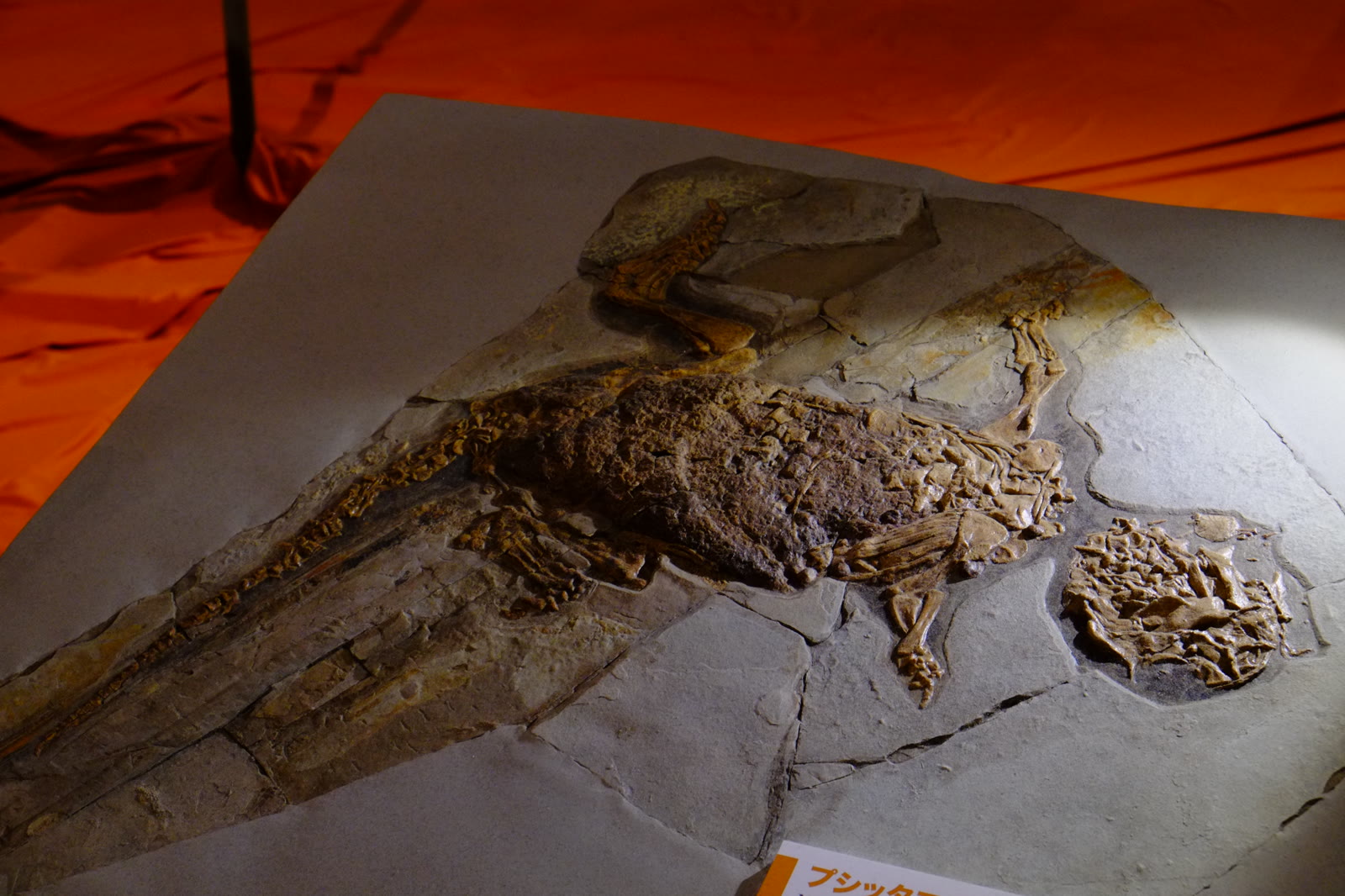
Most dinosaur fossils ask the reader to work from bone outward. The Frankfurt Psittacosaurus specimen, SMF R 4970, reverses that order. It preserves so much of the body's outer surface that the first useful question is no longer "What species is this?" but "Which parts of the animal are we seeing directly, and which parts are being reconstructed from those traces?"[1][3][4]
That distinction matters because this fossil has accumulated a reputation as a miracle specimen, the sort of slab that seems to settle everything at once. It does not. What it actually offers is better than that: several different kinds of evidence stacked on one body, each with its own confidence level. The tail bristles and regional scale patterns are direct preserved anatomy.[1][3] The countershaded body pattern is a strong inference from preserved pigment residues, but still an inference.[2] The cloaca is directly preserved, while its internal anatomy is reconstructed by comparison with living reptiles.[3] The umbilical scar is a developmental trace whose importance comes from where it sits on the body and how long it seems to have persisted.[4]
That is why SMF R 4970 deserves a close reading. It is not a single spectacular fact. It is a map of how paleontology moves from preserved surface to biological interpretation without pretending every step has the same strength.[1][2][3][4]
Image context: the cover uses a real specimen photograph from Wikimedia Commons. It fits this article because the body outline, abdominal region, and tail plume all remain visible at once, which lets the reader keep returning to the fossil itself instead of drifting into generic dinosaur illustration.[5]
Start with what the slab gives you directly
Mayr and colleagues' original 2002 description already made clear why this specimen stood apart.[1] SMF R 4970 is a largely complete Psittacosaurus skeleton preserved from the ventral side, with extensive integument still draped over the body.[1] The exact collecting locality is unknown, though the authors judged the specimen most likely to have come from the Yixian Formation of Liaoning Province in the Early Cretaceous Jehol biota.[1] That provenance uncertainty should remain in view, but it does not erase the anatomical value of the slab itself.
The 2022 Communications Biology re-study sharpened that value by showing just how regionally organized the skin is.[3] The shoulder carries large truncated-cone feature scales, the tail bears rows of quadrangular scales, the feet preserve reticulate scale textures, and the head even keeps the keratinous jugal horn.[3] That last point is especially striking: SMF R 4970 is described there as the only dinosaur known to preserve that horn covering, while also remaining the only dinosaur reported to preserve both an umbilical scar and a cloaca.[3]
The tail bristles belong in this "direct evidence" category too, but they need careful framing. Mayr et al. described about one hundred long bristle-like structures restricted to the dorsal surface of the proximal third of the tail.[1] They interpreted them as epidermal structures anchored deeply in the skin, perhaps used in display, while also warning that there was no convincing evidence at that stage for direct homology with the very different integumentary filaments known in theropods.[1] That caution still matters. The fossil clearly preserves a tail plume. What that plume means in broader dinosaur integument evolution remains a separate argument.
So the first lesson from the Frankfurt specimen is material, not metaphorical. The fossil does not merely say that Psittacosaurus had "skin." It shows that different parts of the body carried different external architectures, and that at least some ornamental structures were localized rather than spread across the animal.[1][3]
The color claim is strong, but it is still one step removed from the slab
The most famous interpretive leap made from SMF R 4970 is the 2016 countershading study by Vinther and colleagues.[2] Their paper did not treat the fossil as a literal color photograph. Instead, it started from preserved organic residues and melanosome-shaped structures, mapped those patterns onto a volumetrically reconstructed body, and then compared the resulting distribution to predicted optimal countershading under open versus closed light environments.[2]
That workflow makes the paper persuasive precisely because it is not casual. The authors did not simply notice a dark back and pale belly and declare the case closed. They tested how the preserved pattern would function on a three-dimensional animal under different lighting regimes, then argued that the best match was a relatively closed habitat such as forest canopy cover.[2]
Still, this remains a modeled ecological inference, not a direct window onto every color decision on the living animal. The specimen gives preserved patterning and pigment traces; the habitat argument comes from how those traces perform inside a reconstruction.[2] The distinction is important because SMF R 4970 is often summarized as "the dinosaur whose color we know." The more exact claim is better: it is one of the rare dinosaurs for which preserved pigmentation supports a defensible whole-body camouflage model.[2][3]
That difference is the difference between spectacle and evidence. A specimen can tell us a great deal about appearance without collapsing the gap between fossil residue and living animal.
The cloaca is the anatomical surprise, and its limits are part of the story
The cloacal region of SMF R 4970 is one of the fossil's most important surprises because it preserves anatomy that is almost never available in non-avian dinosaurs.[3] Re-examined under laser-stimulated fluorescence, the vent is longitudinal, a condition Bell and colleagues argued is shared only with crocodylians among living tetrapods.[3] The same study describes a V-shaped convergence of the darkly pigmented lateral lips and a bulbous dorsal lobe.[3]
Those are direct observations from the preserved external structure. The next step, however, is comparative inference: if the external vent resembles crocodylians, then the authors argue the internal cloacal anatomy may have been crocodylian-like as well, including a single ventrally positioned copulatory organ.[3] That inference is reasonable, but it should stay labeled as inference. The fossil gives us an external opening and its morphology. It does not hand us the soft tissue interior in full.
That is exactly why the specimen is so useful for teaching evidence boundaries. The external anatomy is unusually secure. The reproductive reconstruction is plausible because it is tied to living analogues. The two claims are related, but they are not identical in certainty.[3]
The umbilical scar turns the fossil into a life-history specimen
If the cloaca expands the anatomical map, the umbilical scar changes the life-history story. In 2022, Bell and colleagues described an elongate ventral midline structure delimited by paired abdominal scales and identified it as the oldest preserved umbilical scar known in an amniote.[4] On their reading, the structure extends for roughly 13 centimeters, or about 14% of the specimen's snout-vent length.[4]
That matters for two reasons. First, the scar is not being inferred from vague midline texture. The paper argues that its scale arrangement is distinct, regular, and unlike the wrinkling or folding seen elsewhere on the specimen.[4] Second, the individual appears to have been near sexual maturity, which means the scar had persisted far longer than the brief post-hatching umbilical marks seen in most birds and many reptiles today.[4]
In other words, the Frankfurt Psittacosaurus is not only a rare soft-tissue fossil. It is also a developmental fossil. The slab preserves a trace of early embryonic attachment that remained visible into later life.[4] That widens the specimen's importance beyond appearance and display. It links the fossil directly to growth and ontogeny.
Why this one fossil keeps mattering
SMF R 4970 remains valuable because each of its headline features teaches a different rule for reading exceptional preservation. Tail bristles and regional scale types show what the body surface can preserve directly.[1][3] Countershading shows how far a careful model can travel from pigment residues without becoming pure fantasy.[2] The cloaca shows how comparative anatomy becomes strongest when the external morphology is unusually well fixed.[3] The umbilical scar shows that developmental traces can survive in deep time and still be legible on their own terms.[4]
That is the real lesson of the Frankfurt specimen. A great fossil does not flatten all evidence into one undifferentiated marvel. It lets the reader sort direct preservation, comparative inference, and ecological modeling into a clear hierarchy. SMF R 4970 does that better than almost any dinosaur soft-tissue specimen we have.
Sources
- Gerald Mayr, D. Stefan Peters, Gerhard Plodowski, and Olaf Vogel, "Bristle-like integumentary structures at the tail of the horned dinosaur Psittacosaurus." Naturwissenschaften (2002).
- Jakob Vinther et al., "3D Camouflage in an Ornithischian Dinosaur." Current Biology 26, no. 18 (2016).
- Phil R. Bell et al., "The exquisitely preserved integument of Psittacosaurus and the scaly skin of ceratopsian dinosaurs." Communications Biology 5 (2022).
- Phil R. Bell et al., "Oldest preserved umbilical scar reveals dinosaurs had 'belly buttons'." BMC Biology 20 (2022).
- Wikimedia Commons file page for the specimen photograph used as the lead image.