Pteridinium simplex looks like a fossil that should be easy to file away. It has repeated ridges, an elongate body, and the soft, modular look that makes many Ediacaran organisms seem halfway between plant, animal, and pattern. That first glance is exactly the problem. The stronger reading starts by refusing to flatten it into one label. Pteridinium matters because its body is a three-dimensional structure caught in a sedimentary argument: three vanes, a central seam, a possible canoe-like cavity, partial burial, current exposure, and a long afterlife of being moved, twisted, and preserved in sand.[1][2][3]
The latest reconstructions make the fossil less decorative and more physical. Darroch and colleagues describe Pteridinium simplex as an erniettomorph known especially from late Ediacaran successions in Namibia, South Australia, and Russia. The organism is trifoliate: three vanes joined at a central seam. In the common Namibian reconstruction, two lateral vanes curve and join at the ends, creating an elongate canoe-like form, while a third vane rises through the middle and divides the cavity.[1] That geometry is not a minor visual trait. It is the whole interpretive engine.
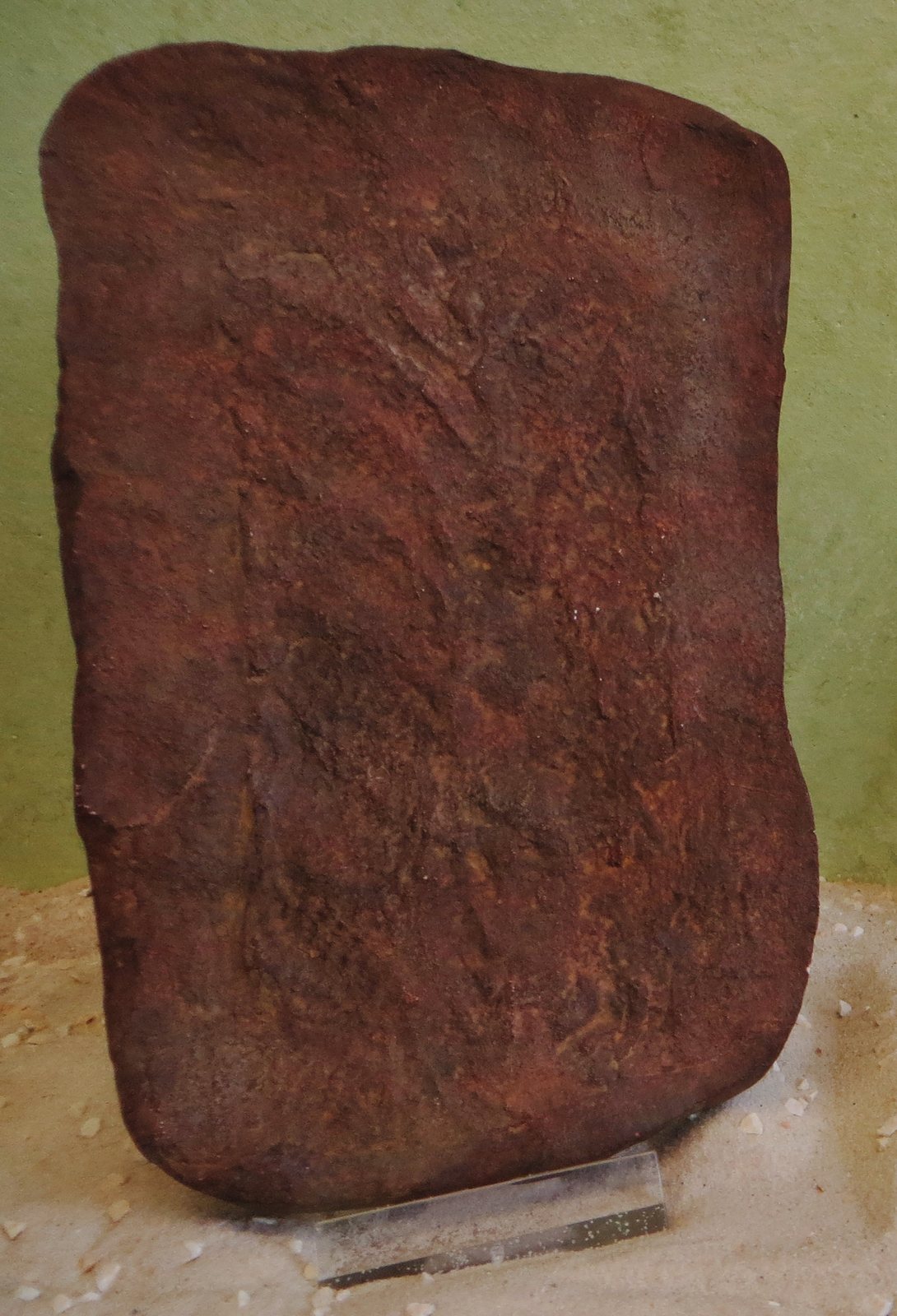
The body is not a flat frond
The easiest mistake is to treat Pteridinium as a pressed decorative frond, as though the fossil were mainly a surface. The three-vane architecture pushes against that. The important question is not simply what pattern the ridges make, but how those ridges were arranged in space. A vane can guide water, stiffen a body, define a cavity, or create drag. Once the organism is restored as a body with depth, its anatomy becomes less like a fossil logo and more like a small engineered object on the seafloor.
That is why the central seam deserves attention. Erniettomorphs are built from repeated tubular modules, often arranged with glide symmetry rather than true bilateral symmetry.[1] To a modern eye trained on heads, tails, left-right symmetry, and limbs, that body plan feels evasive. But evasion is not emptiness. The repeated modules are the structure. Pteridinium is telling us that late Ediacaran organisms could be macroscopic, modular, and ecologically consequential without looking like any familiar animal blueprint.
The age and setting sharpen the point. Farm Swartpunt material in southern Namibia comes from latest Ediacaran sediments of the Nama Group, with nearby ash-bed dates around the last few million years before the Cambrian boundary.[1] That placement matters because Pteridinium sits in a world where large soft-bodied organisms, early trace makers, tubular forms, and the first harder-bodied ecological experiments are all crowding the same historical threshold.[1][4] It is not a prelude in the weak sense. It is part of the final Ediacaran experiment in how bodies used the seafloor.
Preservation is a warning, not a nuisance
The fossil record of Pteridinium is unusually instructive because preservation keeps interrupting any easy life story. The 2014 microCT work summarized by DigiMorph begins from that difficulty: Pteridinium simplex is often preserved as three-dimensional casts and molds in coarse quartzites, and specimens can be transported, distorted, and embedded in gutter fills or channel deposits.[3] Those are not side notes. They define the evidence.
MicroCT helped because it let researchers trace individual specimens and vanes through the rock, digitally restoring three-dimensional morphology that would be difficult to read from exposed surfaces alone.[3] The result was not a single sensational reveal. It was a set of constraints. The study found evidence for a flexible integument that could bend, fold, twist, stretch, and tear, but did not find support for the vane identity changes or penetrative growth that had been used to argue for a fully buried lifestyle.[3] In plain terms: the body was flexible and three-dimensional, but that does not make it an organism growing entirely inside sediment.
This is the kind of boundary paleontology needs. A fossil can be distorted without becoming useless. A body can be partly buried without being fully infaunal. A vane can be hard to follow without licensing any reconstruction that feels clever. Pteridinium becomes scientifically stronger when those constraints stay visible.
The 2024 Nama Group reassessment adds another caution. Runnegar, Gehling, Jensen, and Saltzman argue that few, if any, of the soft-bodied Ediacaran organisms they studied were preserved in life orientation in their original habitats, and that unmineralized tubular fossils commonly appear transported or toppled by water motion.[4] They even reinterpret some comb and rake structures on bed bases as bump-and-drag marks, most probably made by erniettomorph vanes such as those of Pteridinium.[4] That does not erase the animal. It moves attention from idealized life pose to the physical path from living body to preserved mark.
Current makes the shape legible
The most productive recent interpretation treats Pteridinium as a current-facing organism. Darroch and colleagues combine field observations, sedimentology, museum material, and computational fluid dynamics to argue for a semi-infaunal life habit in aggregated communities, with the long axis often perpendicular to prevailing current direction.[1] This is the moment the three-vaned body stops being merely strange. It becomes a flow device.
The CFD result is conceptually simple and powerful. In the model that best fit their fossil data, water moving over and around the body produced recirculation inside the central cavity and wake structures behind the organism.[1] In a perpendicular orientation, flow is deflected by the leading edge and raised central vane, creating low-velocity zones where suspended particles could plausibly settle.[1] That is a bounded feeding hypothesis, not a fantasy of behavior. The fossil does not preserve a meal. It preserves a body geometry that can be tested against water movement.
This interpretation also explains why orientation matters. If a body lives partly in the sediment and partly in the water column, it does not need to chase prey or move like a later animal to participate in the food web. It can make shape do work. Current provides the motion; the body changes the current; particles become available in the cavity. Read this way, Pteridinium belongs to a broader late Ediacaran shift toward benthic suspension-feeding strategies, alongside other erniettomorphs such as Ernietta.[1]
The population-level piece is just as important. Darroch and colleagues modeled multiple individuals because their field data suggested a gregarious life habit.[1] That choice keeps the fossil from becoming a lonely curiosity. A patch of Pteridinium bodies could have changed near-bottom flow differently from one isolated organism, with wakes, turbulence, and recirculation zones forming around and between individuals.[1] The ecology is therefore spatial. Placement on the seafloor becomes part of the organism's function.
The best answer stays partial
The temptation is to turn Pteridinium into a solved animal. That would be a mistake. Its exact affinity remains difficult; its body plan has no clean living analogue; and later reassessments of Nama fossils warn that transport, toppling, and bed-base tool marks can complicate life-position claims.[1][3][4] The secure conclusion is narrower and better. Pteridinium simplex was a modular late Ediacaran organism with a three-vane body, likely living at or partly within the sediment-water boundary, and its best current interpretation makes ecology depend on how that body interacted with moving water.[1][3]
That is enough to make the fossil important. It shows that before Cambrian animals made the seafloor busier with burrows, shells, limbs, and more familiar predator-prey tools, late Ediacaran organisms were already testing body architecture against environmental physics. Pteridinium does not need to become a direct ancestor, a plantlike frond, or a tidy member of a modern animal group to matter. Its value is stranger and more precise: three vanes made a current problem visible in stone.
Sources
- Simon A. F. Darroch, Brandt M. Gibson, Maggie Syversen, Imran A. Rahman, Rachel A. Racicot, Frances S. Dunn, Susana Gutarra, Eberhard Schindler, Achim Wehrmann, and Marc Laflamme, "The life and times of Pteridinium simplex," Paleobiology 48, no. 4 (2022).
- Mike Meyer, David A. Elliott, James D. Schiffbauer, Walter D. M. Hall, Karl H. Hoffmann, Gabrielle Schneider, Patricia Vickers-Rich, and Shuhai Xiao, "Taphonomy of the Ediacaran fossil Pteridinium simplex preserved three-dimensionally in mass flow deposits, Nama group, Namibia," Journal of Paleontology 88, no. 2 (2014), Monash University record.
- DigiMorph, University of Texas High-Resolution X-ray CT Facility, "Pteridinium simplex, Ediacaran Fossil," supplemental CT imagery and abstract for the 2014 microCT study.
- Bruce Runnegar, James G. Gehling, Sören Jensen, and Matthew R. Saltzman, "Ediacaran paleobiology and biostratigraphy of the Nama Group, Namibia, with emphasis on the erniettomorphs, tubular and trace fossils, and a new sponge, Arimasia germsi n. gen. n. sp.," Journal of Paleontology 98, Memoir 94 (2024).
- Wikimedia Commons, "File:Pteridinium simplex 5644.jpg," source page for the real photographed fossil used as the article image.