
The easiest way to flatten Homo floresiensis is to treat it as a curiosity: the small ancient human from Flores, quickly nicknamed the "hobbit," filed away as one of paleoanthropology's stranger side characters. Nature Video's short film is useful because it pushes against that habit. It begins with the famous Liang Bua discovery, then moves east across Flores to Mata Menge, where much older and even smaller fragments make the story harder and more interesting.[1][4]
The video is not long, but it stages the core problem well. Homo floresiensis is not just a small body. It is a question about how long a hominin lineage could live on an island, how quickly body size might shift under island conditions, and how much ancestry can be read from teeth and jaw fragments when the rest of the skeleton is missing. The Smithsonian's Human Origins Program frames the same uncertainty directly: researchers still debate whether the lineage came from Homo erectus, from a more primitive early Homo population, or from some branch not yet well sampled in Asia.[2]
That is why the nickname is less helpful than the geography. Flores was not a scaled-down stage set. It was an island system with limited large mammals, repeated volcanic and sedimentary histories, and cave deposits that had to be re-dated before the disappearance of H. floresiensis could be discussed responsibly. The Natural History Museum's overview keeps the basic public facts in view: the species is known from Flores, the Liang Bua skeleton was strikingly small, and Indonesia's volcanic setting shaped the archaeological landscape.[3]
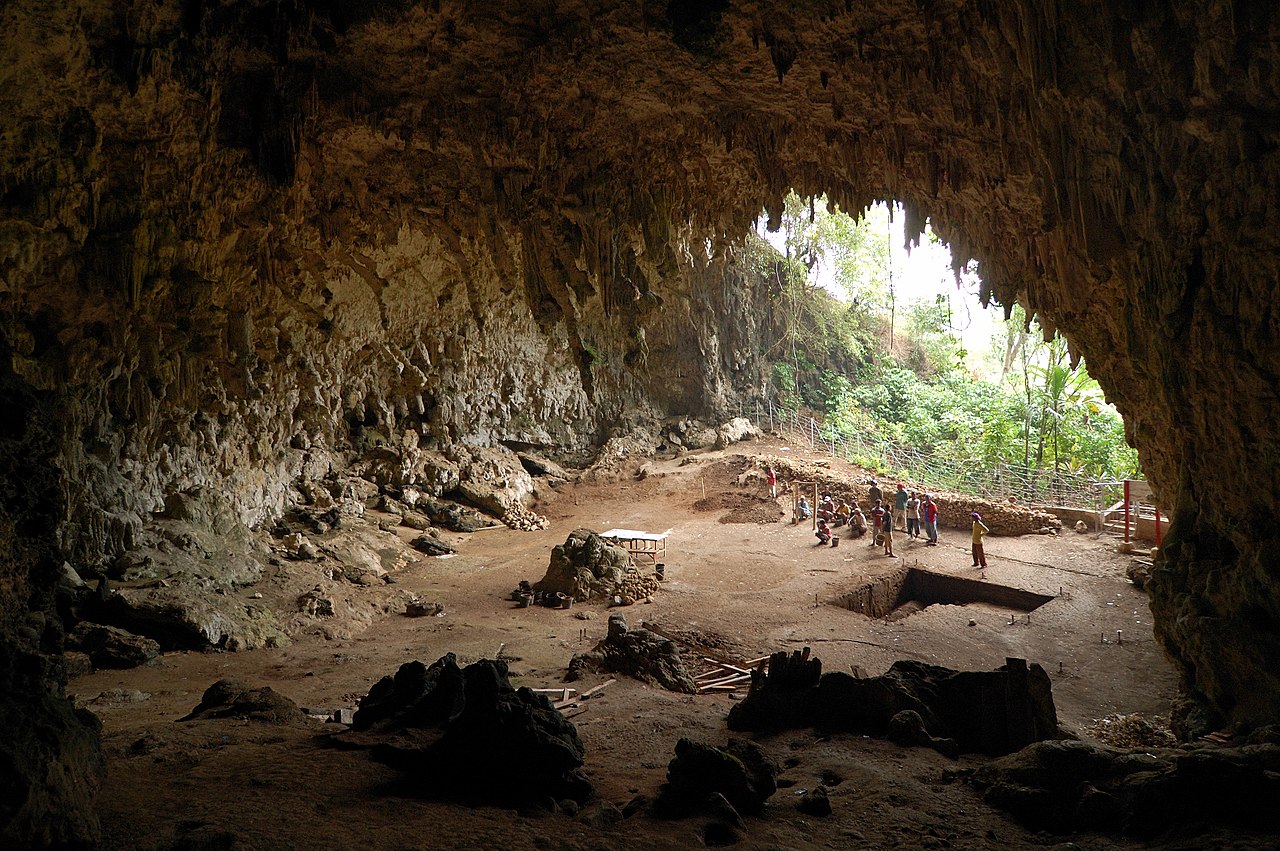
Image context: the lead image is a real photograph of Liang Bua cave, not a reconstruction or diagram. It fits the article because the cave is the evidentiary anchor for the younger fossils and the revised chronology discussed below.[5][7]
Watch the tooth before the skeleton
The most important visual move in the video is its attention to smallness at the level of evidence. A viewer might expect the film to dwell on the famous LB1 skeleton from Liang Bua. Instead, it spends its energy on fragments from Mata Menge: a small mandible and teeth from an earlier Middle Pleistocene context.[1][4] That shift matters. Once the older fossils enter the frame, H. floresiensis stops looking like a late, isolated oddity and starts looking like the end of a longer Flores experiment.
The 2016 Nature paper by van den Bergh and colleagues described hominin fossils from Mata Menge that were similar in key respects to H. floresiensis but came from a much older site in the So'a Basin.[4] The companion dating and context paper placed those fossils in an early Middle Pleistocene setting and emphasized the association with simple stone artifacts and the Flores island fauna.[5] Together, those papers changed the question. Instead of asking only why a tiny human existed at Liang Bua late in the Pleistocene, researchers had to ask why a tiny-bodied hominin signal was already present hundreds of thousands of years earlier on the same island.
This is where the video is strongest as a teaching object. Teeth and jaw pieces are not emotionally satisfying in the way a near-complete skeleton is. They do not give a visitor the same immediate sense of face, height, posture, and vulnerability. But they are enough to force a deeper chronology. If the Mata Menge material belongs near the ancestry of H. floresiensis, then small body size was not a late cave accident. It was part of a durable island lineage.
Island dwarfing is a mechanism, not a slogan
Around the middle of the video, the island-dwarfing idea becomes tempting.[1] On islands, large animals can become smaller when food, territory, predator pressure, and reproductive strategies change. Flores is famous partly because this rule seems to have reached a hominin. But the article should keep the mechanism disciplined. "Island dwarfing" is not a magic word that explains every detail by itself. It is a hypothesis about selective pressures acting over generations, and the fossil record has to show when the shift happened and which lineage was shifting.
The 2024 Nature Communications paper sharpens that point by adding more Mata Menge evidence, including an exceptionally small adult humerus fragment and additional dental material.[6] Its central implication is not just that the Flores hominins were small. It is that small body size appears early in the Flores sequence, making long-term insular adaptation more plausible than a very late, rapid shrinkage event near Liang Bua.[6] That does not settle ancestry. It narrows the space in which ancestry arguments have to work.
This boundary matters because H. floresiensis has often been pulled between two easy stories. One story makes it a miniaturized Homo erectus descendant. Another sees it as retaining traits from a more primitive early Homo source. The Smithsonian summary is careful because the evidence remains incomplete.[2] The video also benefits from that caution. It presents Mata Menge as a clue, not as the last word. A small jaw can make one evolutionary route more attractive without proving the entire route.
The cave dates changed the drama
The other detail to watch for is less cinematic: chronology. The popular shock of H. floresiensis originally depended partly on the idea that it survived very recently, perhaps close enough in time to make coexistence with modern humans feel almost immediate. The 2016 revised stratigraphy paper changed that picture. Sutikna and colleagues concluded that skeletal remains of H. floresiensis at Liang Bua date to about 100,000 to 60,000 years ago, while stone artifacts attributed to the taxon continue to around 50,000 years ago.[5]
That revision does not make the story less dramatic. It makes it cleaner. The disappearance of H. floresiensis now sits closer to a broader island turnover problem: what happened on Flores around the time the hominin fossils, associated fauna, and tool traditions change? The evidence does not require a simple scene of direct conflict with Homo sapiens. It asks for a sequence involving environmental change, resource pressure, volcanic landscape history, possible modern-human arrival, and the limits of a lineage already adapted to a narrow island world.[3][5]
This is why the video's older-fossil focus is so important. Without Mata Menge, the Liang Bua story can feel like a late surprise. With Mata Menge, the surprise becomes endurance. The lineage, or something close to it, may have been part of Flores for far longer than the famous cave skeleton alone suggested.[4][6]
What the film leaves open
The film gives a viewer the right frame, but the written evidence has to keep the interpretation honest. It cannot show every stratigraphic layer, every dating method, or every anatomical comparison behind the claims. The Nature papers do that work: one set revises Liang Bua's timing, another establishes the older Mata Menge context, and the 2024 study adds body-size evidence from a tiny adult limb bone.[4][5][6]
The practical takeaway is that Homo floresiensis is most interesting when the nickname falls away. The animal was human, but not a miniature version of us. It was small, but not merely cute or bizarre. It belonged to a Flores record in which geography, body size, tools, teeth, cave deposits, and extinction timing all have to be read together. The video works because it turns viewers away from a single skeleton and toward a larger island question: how much evolutionary history can a small place hold, and how much of that history can survive in fragments no bigger than a tooth?
Sources
- nature video, "Hobbit histories: the origins of Homo floresiensis," YouTube video.
- Smithsonian Human Origins Program, "Homo floresiensis" (species overview and summary of unresolved ancestry hypotheses).
- Natural History Museum, London, "Homo floresiensis: the real-life 'hobbit'?" (public overview of the Flores finds, context, and interpretation).
- Gerrit D. van den Bergh et al., "Homo floresiensis-like fossils from the early Middle Pleistocene of Flores," Nature 534 (2016).
- Thomas Sutikna et al., "Revised stratigraphy and chronology for Homo floresiensis at Liang Bua in Indonesia," Nature 532 (2016).
- Yousuke Kaifu et al., "Early evolution of small body size in Homo floresiensis," Nature Communications 15 (2024).
- Wikimedia Commons, "File:Homo floresiensis cave.jpg" (Rosino's 2007 photograph of Liang Bua cave, used as the article image).