Doedicurus clavicaudatus is often introduced as a giant armadillo with a clubbed tail, which is true as shorthand and weak as anatomy.[1][2] The species profile becomes sharper once the shell stops doing all the conceptual work. Doedicurus matters because several extreme features converge in one animal: a rigid dorsal carapace, a caudal tube specialized into a true striking instrument, a skull and dentition associated with bulk feeding in open environments, and a phylogenetic position that no longer sits outside armadillos as some older reconstructions implied.[1][2][3][4]
That combination is what keeps the genus scientifically interesting. The 2023 comparative cranial study on Pleistocene glyptodonts treats Doedicurus as one of four major late genera and notes body-mass estimates in the roughly 1,400 to 2,000 kilogram range.[2] The animal was huge, but size is only the first layer. What makes the profile memorable is how late and specialized the whole body became. The tail was not an afterthought appended to a shell. The head was not a generic grazing head tucked under armor. Each end of the body became more particular as glyptodont evolution pushed toward the Pleistocene extreme represented by Doedicurus.[2][4]
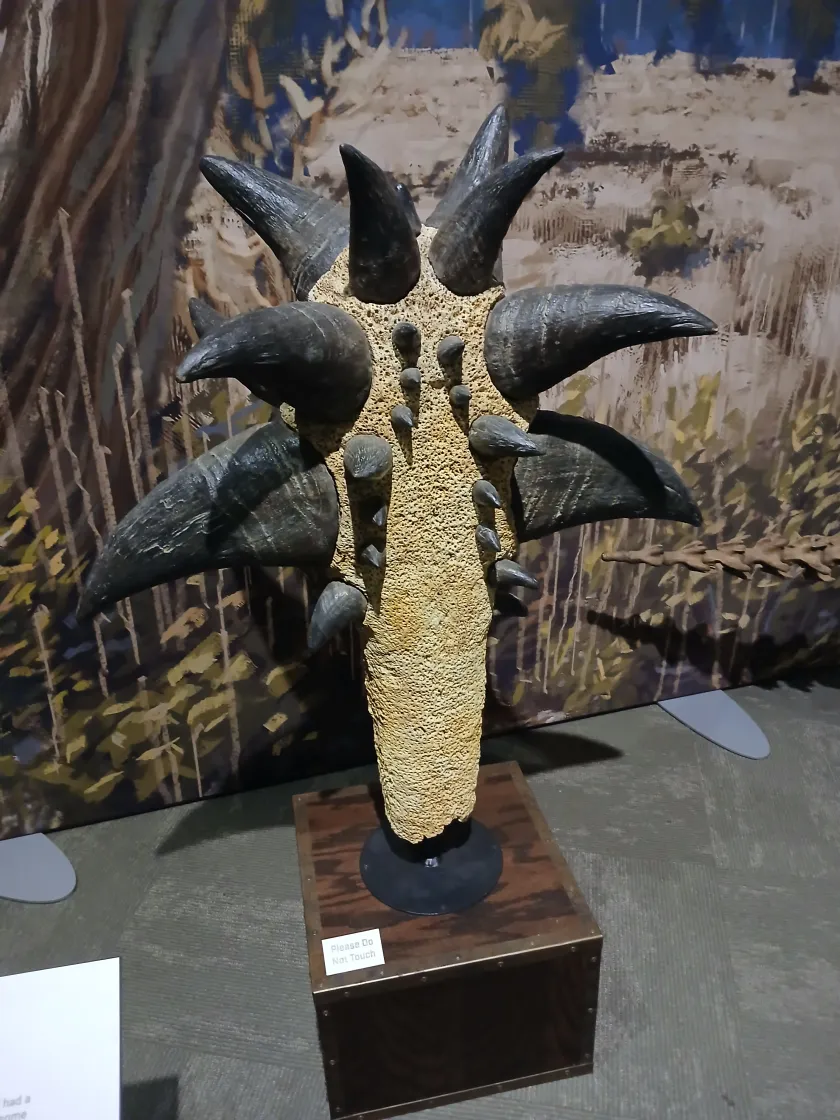
Image context: the cover uses a real museum photograph of a Doedicurus tail club from Wikimedia Commons. It belongs here because the article turns on the tail before it turns on the carapace. The widened bony tube makes the species read less like a slow armored dome and more like an herbivore carrying a dedicated impact structure at the back of the body.[5]
1) The tail is the center of the profile
If the name Doedicurus keeps showing up in popular books, the tail is the main reason. The 2024 paper on new doedicurine remains describes the Doedicurus caudal tube as an extreme end point, widened distally into a kind of club with large lateral figures where corneal spine-like structures were inserted.[4] That is a precise way of saying the back end of the animal was not merely armored. It was remodeled into something closer to a purpose-built weapon.
The older biomechanics paper by Vizcaíno and Fariña gives that morphology a mechanical read.[3] Their analysis of glyptodont tail clubs applies the idea of a center of percussion, the "sweet spot" familiar from bats and rackets, to the tail of Doedicurus. The important result is not a cinematic claim that every blow shattered bone on contact. It is that the club's geometry makes sense as a force-delivery system that could concentrate impact while reducing the reaction forces transmitted back through the tail base.[3] In other words, the structure behaves like an implement, not just an ornament.
That matters because it changes the species from "large armored herbivore" into a more specific ecological and behavioral design. A rigid shell can already do defensive work. A massive tail club suggests something beyond passive endurance.[3][4] The safe reading is agonistic use, whether against predators, rivals, or both.[3] The evidence does not let us choreograph every encounter. It does let us say that the tail was overbuilt for a world in which impact mattered.
2) The head says bulk feeding, not generic tank-like browsing
The front of the animal is almost as distinctive as the back. The 2023 cranial and endocranial study emphasizes that Pleistocene glyptodonts developed unusually derived skulls, with Doedicurus and Panochthus sharing some large-bodied cranial features while still occupying their own positions inside late glyptodont diversity.[2] The paper also links wide muzzles and high hypsodonty to bulk feeding in open environments, and specifically places Doedicurus among the open-environment bulk feeders rather than among narrower-muzzled, more selective feeders.[2]
That is a better entry point than the older habit of describing every glyptodont as a shell on legs. A broad muzzle matters because it changes how the head met the landscape.[2] It suggests an animal taking in large amounts of vegetation rather than carefully selecting scattered leaves. The skull becomes a grazing instrument, and the shell becomes part of a body committed to massive, low, sustained feeding in open country.[2]
This also helps explain why the species profile has to move beyond size. Very large herbivores often become legible only when the mouth and the environment are placed back into the same sentence. In Doedicurus, the broad rostrum, high-crowned dentition, and great mass belong together.[2] The animal was not simply protected. It was built to process a lot of abrasive plant matter while carrying a body plan that made escape less important than staying defended and staying fed.
3) The DNA result changed the lineage story
For a long time, glyptodonts could be described as relatives of armadillos that had wandered very far from the living forms. The 2016 mitogenomic paper moved the argument onto firmer ground by recovering Doedicurus from ancient DNA and placing glyptodonts deeply inside the armadillo crown group, as a distinct subfamily within Chlamyphoridae.[1] The paper specifically placed the glyptodont line as sister to the clade formed by fairy armadillos and tolypeutines, rather than as some remote armored offshoot that split away near the base of cingulate history.[1]
That repositioning is one of the best reasons to keep Doedicurus in view. The species looks so anatomically distant from a living armadillo that the evolutionary bridge can feel abstract. The DNA result makes the bridge harder to ignore.[1] It also sharpens the scale of the transformation. Delsuc and colleagues estimated a small-bodied ancestor for the glyptodont-plus-armadillo branch, implying a spectacular increase in body mass along the glyptodont line.[1] The shell did not mark isolation from the armadillo story. It marked one of the most extreme experiments inside it.
This does not shrink Doedicurus into a familiar animal. It does the opposite. Once the lineage position is clear, the species becomes a lesson in how far one branch of armored xenarthrans could travel while remaining inside the same broader family history.[1][2] The giant shell, the heavy skull, and the hammer tail become derived armadillo traits carried to a Pleistocene extreme.
4) The right boundaries make the animal stronger, not smaller
A useful species profile has to stop before it becomes myth. The evidence supports a giant late Pleistocene glyptodont with a specialized striking tail, a broad muzzle suited to bulk feeding in open environments, and a lineage nested within armadillos.[1][2][3][4] It does not support a full behavioral screenplay. We do not know the exact frequency of tail use in combat, the complete diet in every habitat, or the entire social structure of the animal's last populations.
Those boundaries improve the species rather than thinning it out. Doedicurus stays memorable because multiple lines of evidence point in compatible directions. The tail club says force.[3][4] The skull says heavy feeding in open landscapes.[2] The DNA says that this huge armored herbivore was not outside the armadillo story after all.[1] Put together, those claims produce a cleaner picture than the old cartoon of a walking dome with a spiked club attached.
That is enough to keep the species alive in the mind on better terms. Doedicurus deserves attention because it shows what a lineage can do when armor, feeding mechanics, and weaponized anatomy all intensify in the same body. The result is not a generic Ice Age tank. It is a very late, very specialized glyptodont that makes evolution look both more continuous and more extravagant at once.
Sources
- Frédéric Delsuc, Graham J. Slater, Fernanda M. Kramarz, and colleagues, "The phylogenetic affinities of the extinct glyptodonts." Current Biology 26, no. 4 (2016).
- Zoé M. Christen, Marcelo R. Sánchez-Villagra, and colleagues, "Cranial and endocranial comparative anatomy of the Pleistocene glyptodonts from the Santiago Roth Collection." Swiss Journal of Palaeontology 142, article 1 (2023).
- Sergio F. Vizcaíno, Richard A. Fariña, and colleagues, "The sweet spot of a biological hammer: the centre of percussion of glyptodont (Mammalia: Xenarthra) tail clubs." Proceedings of the Royal Society B 276, no. 1670 (2009).
- Andrés D. Zurita, Daniel Perea, Juan C. Fernicola, and colleagues, "New remains of Doedicurini (Cingulata, Glyptodontidae) from the latest Pliocene/earliest Pleistocene of the Pampean Region (Argentina) shed light on the morphological evolution of the caudal tube." Journal of South American Earth Sciences 132 (2024).
- Wikimedia Commons file page for the lead image, "File:Doedicurus tail club.webp".