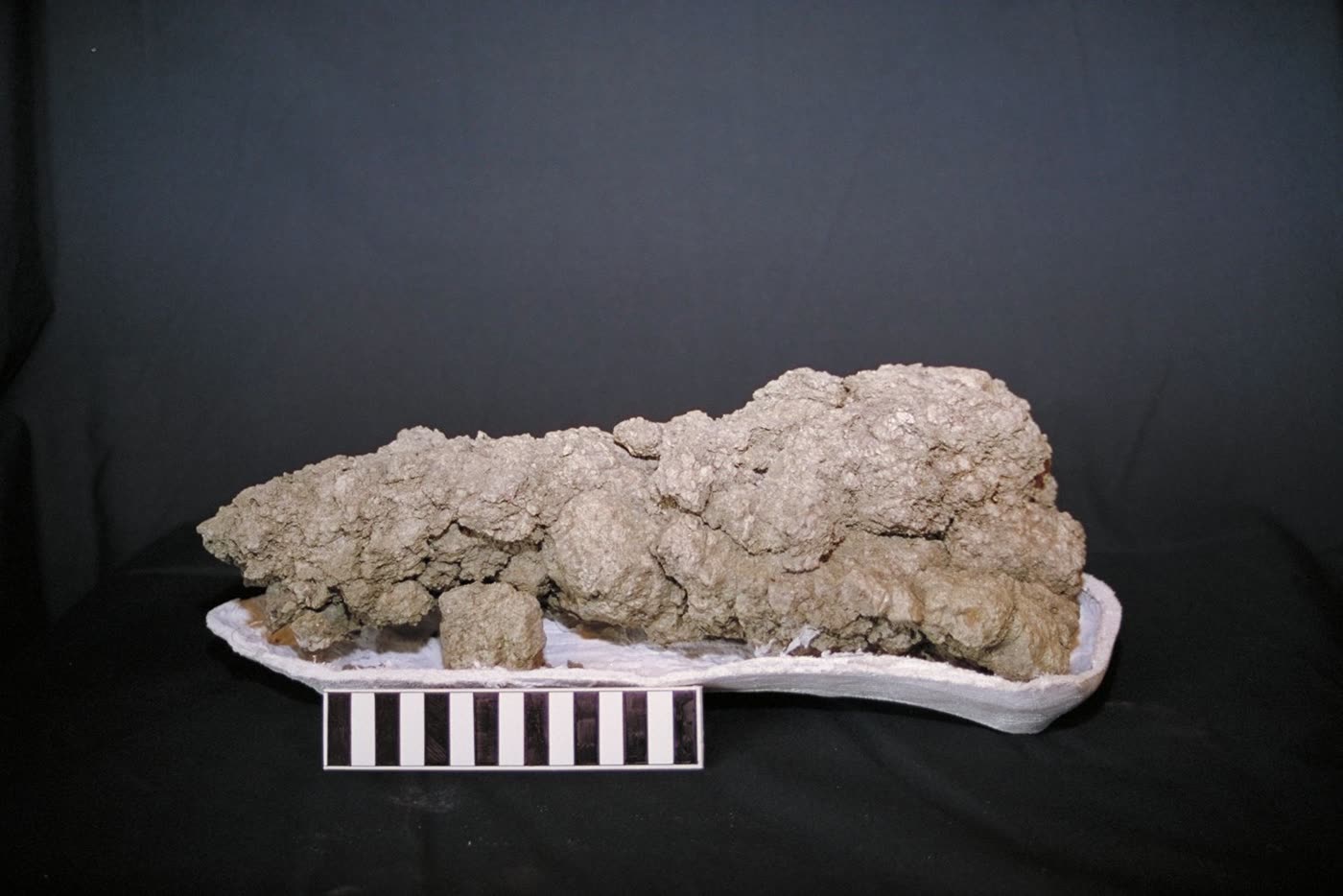
Coprolites attract lazy headlines because they sound like direct access to a vanished meal. In one sense, that attraction is earned. A body fossil tells you what an organism was. A coprolite can tell you what passed through it, what resisted digestion, and sometimes what kind of ecosystem was feeding the animal in the first place.[1][5] Few fossils feel closer to behavior.
The problem is that coprolites are direct evidence only after several harsh filters. Digestion destroys soft tissue and reduces prey into an uneven residue. Burial can distort the original shape. Transport and mineral replacement can make feces look like any other stone until thin section, chemistry, or embedded fragments clarify what the object is.[1][5] That is why coprolites are best read as digested evidence, not as perfect replay.
Image context: the lead photograph shows a mineralized theropod coprolite with light bone fragments visible inside the dark mass. It works for this article because coprolite interpretation starts exactly there, with inclusions and texture. The object is valuable not because it is "dinosaur poop" in the abstract, but because chopped bone survives inside it and turns waste into dietary evidence.[2][6]
1) Why coprolites matter more than their reputation suggests
Coprolites belong to the wider category of bromalites, fossilized remains tied to feeding and digestion rather than to skeleton alone.[1] That matters because feeding traces answer questions body fossils often leave open. Teeth can suggest a diet. Gut contents can do it more directly, but they are rare and usually tied to a single spectacular specimen. Coprolites sit in between. They are common enough to sample repeatedly, yet intimate enough to preserve actual remains of what was eaten.[1][5]
That intimacy gives them unusual paleobiological leverage. Bone fragments, fish scales, insect cuticle, plant tissues, pollen, spores, parasites, and biomolecules can all survive in coprolites under the right conditions.[1][4] Each category carries a different kind of signal. Hard fragments can identify prey classes. Pollen or spores can place the meal inside a broader habitat. Lipid biomarkers can preserve trophic information even when visible inclusions are scarce.[1][4]
This is why Karen Chin and the CU Museum stress ecosystem reading rather than novelty reading. Even when the exact producer is uncertain, a coprolite can still preserve information about who was being eaten, which materials survived digestion, and what kinds of interactions structured the local food web.[5]
2) The first boundary is always producer assignment
Readers often assume that once a paleontologist recognizes an object as a coprolite, the next step is simply naming the animal that produced it. In practice, that is usually the weakest link in the chain.[1] Feces are trace fossils. They are linked to behavior, not attached to the body of the defecator.
Shape alone rarely settles the problem. Digestion, dehydration, trampling, current transport, and mineralization can all alter the original form.[1] A spiral coprolite may hint at a producer with a spiral intestinal valve, but many specimens preserve no such signature. More often, attribution has to be built from a bundle of partial clues:
- specimen size,
- inclusions such as bone or plant matter,
- local fauna from the same horizon,
- depositional setting,
- and any chemical or microscopic signal that narrows trophic level.[1][3][4]
The CU Museum's Jurassic carnivore coprolite is a good example of that method. The museum notes that the specimen is packed with fragmented bone and was likely produced by a large carnivorous dinosaur, probably an allosaurid, yet the identity remains a reasoned inference rather than a one-to-one certainty.[5] That restraint is not a weakness in the method. It is the method working properly.
3) What a famous theropod coprolite actually proved
The strongest classic case is Chin and colleagues' 1998 paper on a large Late Cretaceous theropod coprolite from Saskatchewan.[2] The specimen mattered because it contained a remarkably heavy bone load. Chin's team estimated that roughly 30% to 50% of its volume consisted of cancellous bone fragments, many of them angular rather than fully rounded by prolonged transport.[2] That moved the discussion beyond generic carnivory.
Large theropods were already known to eat other animals. The coprolite sharpened the claim to feeding style. Bone-rich feces implied repeated consumption of skeletal tissue and strong enough oral processing to reduce bone into dense, passable debris.[2] In other words, this was evidence for habitual bone-crushing or bone-heavy feeding, not merely for flesh stripping.
Just as important is what the paper did not claim. It did not present the coprolite as a perfect taxonomic fingerprint. The attribution to a large tyrannosaur-grade theropod rested on context: specimen size, local fauna, and the lack of better alternatives in the depositional setting.[2] That distinction is worth preserving because it shows how coprolites become powerful. They are usually strongest on diet, somewhat weaker on producer identity, and strongest of all when both arguments are kept on separate rails.
4) From one meal to a food web
Coprolites become more interesting when they accumulate as a dataset instead of as a museum oddity. Martin Qvarnström and colleagues showed this in Late Triassic material from Poland, where densely packed beetle remains inside coprolites opened a route into the diet of a dinosauriform traditionally read in a different ecological light.[3] The argument did not depend on a skeleton attached to the feces. It depended on repeated association: similar coprolites, repeated insect content, and a local fauna whose likely producer could be narrowed by size and abundance.[3]
That kind of repeated sampling changes the scale of inference. A single coprolite can reveal a meal. A population of coprolites can reveal selectivity, seasonality, prey availability, and trophic structure.[1][3] Once many specimens point in the same direction, paleontology can move from "what passed through one gut" to "what this environment kept making available to consumers."
The Mazon Creek study by Tripp and colleagues pushes the method even further.[4] Their Carboniferous coprolites were too ambiguous morphologically to yield a clean dietary story from shape alone. Chemistry did the work instead. Cholesteroids made up 86% to 99% of total steranes in the sampled coprolites, and the authors also identified coprostanol and related signals consistent with a carnivorous producer.[4] That matters because it expands the toolkit. When visible inclusions are sparse or too altered, biomolecular traces can still recover trophic information.
This is the real methodological lesson. Coprolites should not be trapped inside one kind of analysis. Their value grows when anatomy, microscopy, sedimentology, and geochemistry are allowed to cross-check one another.[1][4][5]
5) How to read a coprolite without overclaiming
The best reading rule is a sequence, not a verdict.
First, ask whether the object is securely identified as a coprolite rather than as a concretion, regurgitate mass, or other odd sedimentary lump.[1][5]
Second, ask what kind of evidence is actually preserved: visible inclusions, thin-section microstructure, biomolecules, pollen, parasites, or simply overall form.[1][4]
Third, separate the diet claim from the producer claim. A coprolite may strongly demonstrate carnivory, durophagy, insectivory, or plant consumption while leaving the exact defecator uncertain.[1][2][3]
Fourth, ask whether the specimen stands alone or belongs to a repeated assemblage. Scale changes confidence. One spectacular coprolite can transform interpretation, but a field of related specimens can transform paleoecology.[1][3][5]
Coprolites therefore matter for a precise reason. They are among the few fossils that preserve an organism after appetite has already acted on the world. That makes them messy. It also makes them rare evidence of interaction rather than anatomy alone. Read carefully, they do not merely tell us that an extinct animal existed. They show what it processed, what its environment offered, and how much of an ecosystem can survive the trip through a gut.[1][2][4][5]
Sources
- Jingyi Yang, Martin Qvarnström, Grzegorz Niedzwiedzki, and Per E. Ahlberg (2022), Frontiers in Ecology and Evolution: "A review of vertebrate coprolites and the history of their classification."
- Karen Chin, Timothy T. Tokaryk, Gregory M. Erickson, and Lewis C. Calk (1998), Nature: "A king-sized theropod coprolite."
- Martin Qvarnström et al. (2019), Royal Society Open Science: "Beetle-bearing coprolites possibly reveal the diet of a Late Triassic dinosauriform."
- Madison Tripp et al. (2022), Biology: "Fossil Biomarkers and Biosignatures Preserved in Coprolites Reveal Carnivorous Diets in the Carboniferous Mazon Creek Ecosystem."
- University of Colorado Boulder Museum of Natural History, "Coprolites" (collection note on bone-filled dinosaur coprolites and producer uncertainty).
- Wikimedia Commons file page for the theropod coprolite photograph used as the lead image.