Prototaxites is usually introduced with the sentence that made it famous: before forests were tall, a giant fungus stood over Devonian landscapes. That sentence is useful because it gives the fossil scale. It is also too settled. The better 2026 reading is more interesting: Prototaxites was a huge, columnar, heterotrophic organism in early terrestrial ecosystems, but the exact lineage has become harder, not easier, to name.[1][2][4]
That is why the fossil deserves an anatomy-and-method reading rather than a prehistoric oddity profile. The public image is a telephone-pole mushroom. The scientific problem is a stack of evidence that does not all point with the same force: trunk-like form, interwoven tube anatomy, carbon-isotope values inconsistent with ordinary photosynthetic plants, modern analogue work suggesting microbial carbon sources, and a new chemical comparison that challenges the fungal assignment itself.[1][2][3][4]
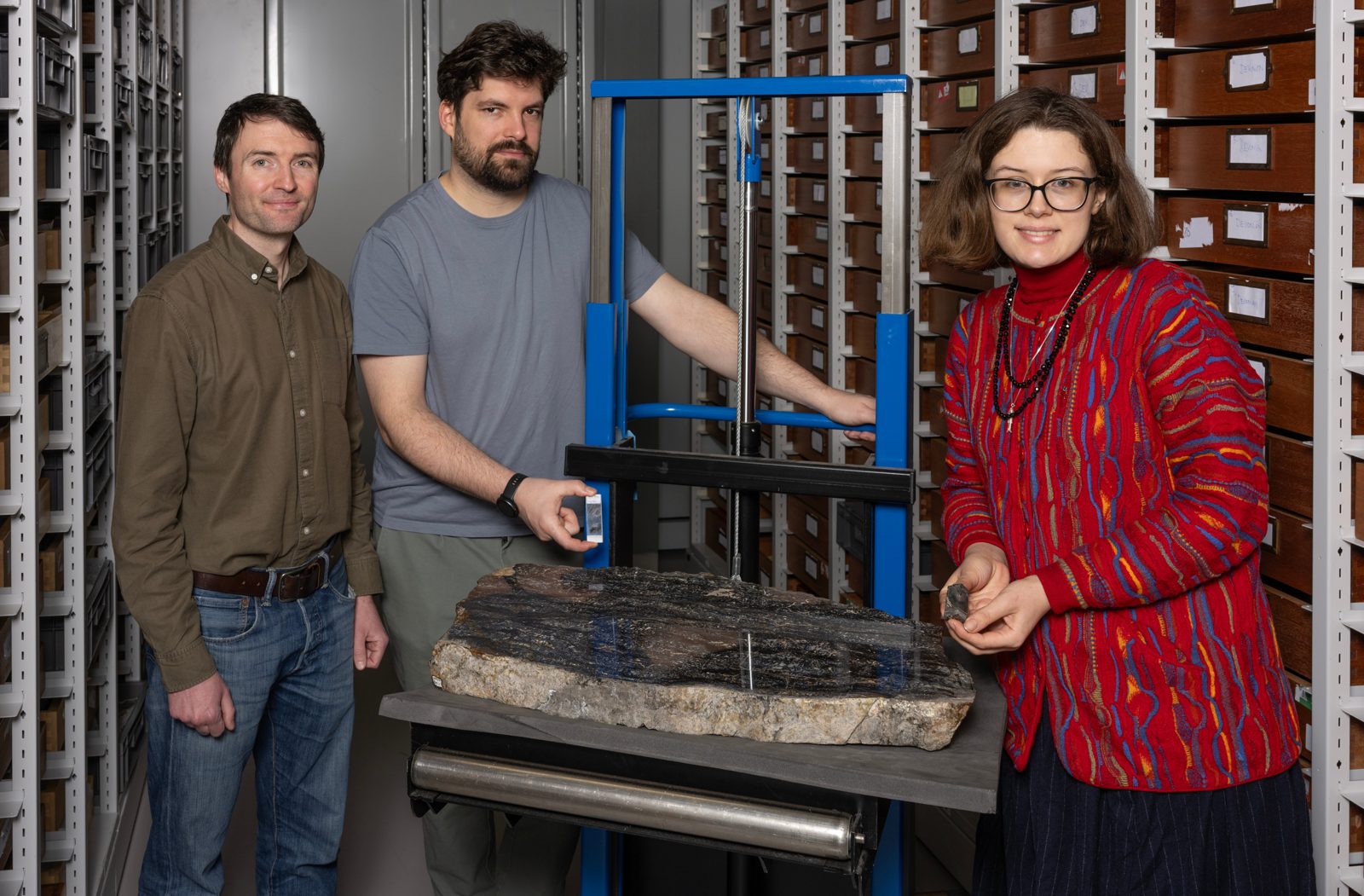
The safest starting point is the object. Prototaxites fossils are not leafy plants, woody trees, or ordinary mushroom caps. They are columnar bodies known from Silurian and Devonian terrestrial deposits, with some forms reaching tree-like size before vascular plants had built true forests.[2][4] A photographed research-collection scene around Prototaxites is valuable for exactly that reason: it shows the organism as handled evidence, not as a finished life scene. Its scientific force begins with fossil material, scale, and fabric.[5]
The old fungus case was not casual
The fungal interpretation did not win attention simply because Prototaxites looked strange. Francis Hueber's 2001 reassessment made a detailed anatomical case after a long history in which the fossil had been treated as rotted wood, alga, or other plant-like material.[1] Hueber argued that the genus was built from several interacting tube types comparable to hyphae and interpreted the organism as a gigantic, perennial fungal sporophore with saprobic nutrition.[1]
That mattered because it gave the column a living architecture. If the fossil was an interwoven mass of tube systems, then it was not a failed tree or a random roll of plant debris. It was a body built by repeated filament-like structures. The fungal label gave paleontologists a way to connect form, growth, and nutrition in one organism.[1]
But a method deep dive has to separate "good hypothesis" from "finished answer." Hueber's model was strong because it tried to explain the internal fabric, not just the outline. It was still an affinity claim based on preserved anatomy that lacks many modern fungal features we would love to see directly: reproductive structures tied cleanly to the big columns, unambiguous biochemical markers, and a living comparison that does not require major modification.[1][4]
Isotopes made the plant reading weaker
The next major support for the fungus-like reading came from carbon isotopes. Boyce and colleagues argued in 2007 that Prototaxites showed carbon-isotope patterns unlike co-occurring vascular plants and more consistent with heterotrophy than with a straightforward photosynthetic organism.[2] That result did not prove "mushroom" in a simple way. It did something narrower and more important: it made the old plant or alga readings harder to defend as default explanations.[2]
Heterotrophy changes the landscape story. A photosynthetic column would be making its own carbon from the atmosphere. A heterotrophic column has to obtain organic carbon from somewhere else. In the sparse early Devonian land world, that "somewhere else" becomes a real ecological problem. What was available in enough quantity to build such large bodies before dense forests and thick leaf litter dominated land surfaces?
Hobbie and Boyce's 2010 analogue study sharpened that question by comparing modern saprotrophic fungi and carbon sources. Their work supported the idea that aquatic-derived photosynthetic material, such as microbial or algal material from ephemeral wet settings, could help explain the isotope range seen in Prototaxites.[3] That is a more disciplined picture than "giant fungus eating trees." It points toward a Devonian landscape where microbial mats, floodplain water bodies, sparse plants, and decomposing organic matter all matter to the organism's carbon budget.[3]
This is the strongest part of the older interpretation, and it should not be thrown away casually. The isotope evidence still makes a purely photosynthetic Prototaxites difficult. The fossil looks like a heterotroph, or at least an organism whose carbon economy was not that of a normal land plant.[2][3][4]
The 2026 challenge is chemical and structural
The newer problem is that "heterotrophic" and "fungus" are not the same word. Loron, Cooper, McMahon, Jordan, and colleagues reopened the classification problem in a 2026 Science Advances study of Prototaxites taiti from the Rhynie chert.[4] Their central claim is not that the organism was secretly a plant. It is that the Rhynie material is chemically distinct from contemporaneous fungi and structurally distinct from known fungi, pushing the authors toward an extinct eukaryotic lineage as the better current assignment.[4]
The scope matters. The paper focuses on P. taiti, a Rhynie chert species preserved in an exceptionally informative early land ecosystem. It does not let a reader declare every Prototaxites specimen solved in one stroke. But it does strike at the foundation of the easy public label. If a well-preserved member of the genus lacks the expected fungal chemical fingerprint while showing tube organization outside known fungal patterns, then "giant fungus" has to become a hypothesis under pressure rather than a settled museum caption.[4]
That change is scientifically healthy. It does not make the older isotope work useless. It rearranges the evidence stack. Carbon isotopes still argue against a simple plant-like autotroph.[2][3] Tube anatomy still explains why the fossil has long invited fungal comparison.[1] The new molecular and structural work says that resemblance may not equal membership in Fungi.[4] The result is not less knowledge. It is a narrower claim space.
The strongest 2026 profile is bounded
So what can be said with confidence? Prototaxites was a large columnar organism of Silurian-Devonian terrestrial ecosystems, built from internal tube fabrics and important enough to stand above many early land plants in both physical scale and ecological visibility.[1][2][4][5] It was probably heterotrophic rather than a conventional photosynthetic plant, based on carbon-isotope evidence and analogue work.[2][3] It played some role in early terrestrial carbon cycling, whether as a fungus, a fungus-like organism, or a now-extinct eukaryotic experiment.[3][4]
What should be said more carefully? The word "fungus" is no longer the safest final label. It remains historically important and still explains why the fossil became a landmark in early land-life debates.[1][2][3] But after the 2026 Rhynie chert study, the better formulation is that Prototaxites is a giant heterotrophic organism whose affinity is unresolved between a difficult fungal interpretation and an extinct eukaryotic lineage.[4]
That boundary is the reason the fossil still feels modern. Paleontology is not only a science of naming old things. It is a science of deciding which names the evidence can carry. Prototaxites was once too big to fit the early land world people imagined. Then it became a giant fungus because anatomy and isotopes made that label useful. Now the label is cracking because better chemical and structural comparisons have raised the evidentiary bar.
The fossil is sharper after that crack. It no longer has to be a mushroom-shaped spectacle to matter. It matters because it preserves a large terrestrial body plan from a time when land ecosystems were still assembling their basic economies: who made carbon, who consumed it, who decomposed it, and which extinct experiments left no living descendant to make the labels easy.
Sources
- Francis M. Hueber, "Rotted wood-alga-fungus: the history and life of Prototaxites Dawson 1859," Review of Palaeobotany and Palynology 116 (2001).
- C. Kevin Boyce, Carol L. Hotton, Marilyn L. Fogel, Robert M. Hazen, Andrew H. Knoll, and Francis M. Hueber, "Devonian landscape heterogeneity recorded by a giant fungus," Geology 35, no. 5 (2007).
- Erik A. Hobbie and C. Kevin Boyce, "Carbon sources for the Palaeozoic giant fungus Prototaxites inferred from modern analogues," Proceedings of the Royal Society B 277 (2010).
- Corentin C. Loron, Laura M. Cooper, Sean McMahon, Sean F. Jordan, and colleagues, "Prototaxites fossils are structurally and chemically distinct from extinct and extant Fungi," Science Advances 12, no. 4 (2026).
- Neil Hanna / PA via The Independent, photo of researchers at the National Museums Collection Centre with Prototaxites sample fossils (article image source), January 2026.