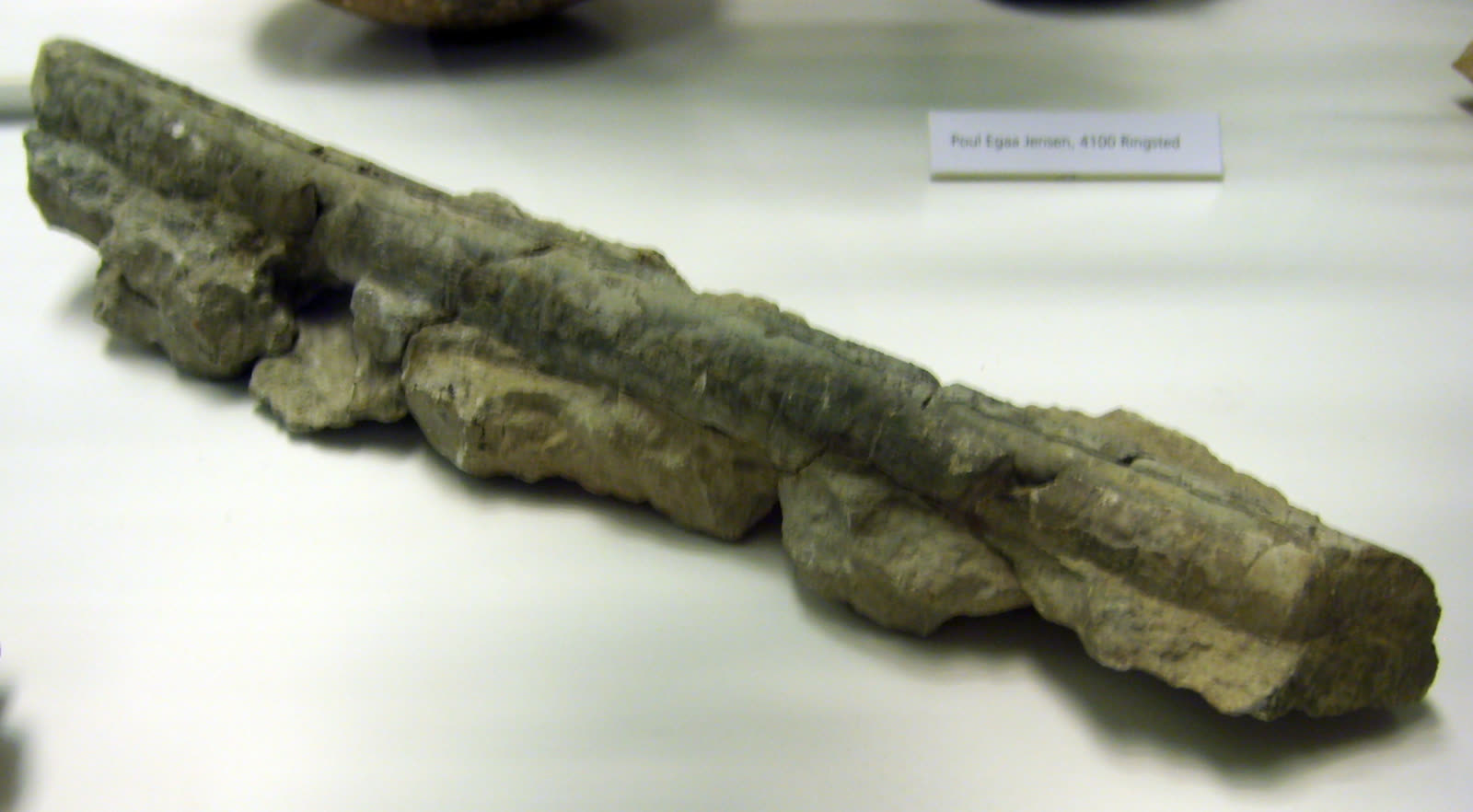
Endoceras looks simple at first because the shell does one obvious thing: it runs straight. That is also the trap. A long Ordovician cone can become a prehistoric spear in the imagination, a giant "orthocone" treated as if straightness alone explained the animal. The better profile begins inside the shell, with the siphuncle, the endocones, and the problem of keeping a large shelled cephalopod oriented in water.
The Digital Atlas of Ordovician Life places Endoceras in Mollusca, Cephalopoda, Endocerida, and Endoceratidae, with the genus attributed to Hall in 1847 and a geologic range from the Middle to Late Ordovician.[1] Its summary ecology is nektobenthic carnivore: an animal connected to swimming and the water column, but not safely imagined as a modern squid with a stone pipe on its back.[1] The fossil evidence is mostly shell architecture. Behavior has to be inferred from that architecture, from comparable cephalopods, and from the sedimentary settings in which related shells appear.
That boundary matters because Endoceras is sometimes inflated into a record-book monster. Some specimens and relatives were very large, and the Atlas page for Endoceras proteiforme describes Cincinnatian material that could reach roughly 10 to 15 feet in length, with a circular section, shallow chambers, and a large submarginal siphon.[2] But size is not the most interesting fact. The most interesting fact is that such size had to be managed by a shell system: chambers, septa, siphuncle, mineral deposits, and a body chamber carrying the living animal at one end.
The shell is a control problem
The Atlas diagnosis is concise: large, straight conchs; transverse sutures; a large ventral holochoanitic siphuncle; subcircular endocones; and a thin endosiphuncular tube.[1] Those are not decorative details. They are the mechanical language of a cephalopod shell. The conch gives the animal its long external form. The septa divide the rear part of the shell into chambers. The siphuncle runs through that chambered region as the tissue-linked system by which cephalopods regulate fluid and gas relationships inside the shell.
In Endoceras, the siphuncle is not a tiny central thread. It is large and pushed toward the ventral side of the conch.[1][2] In hand sample, that is one of the features that separates endocerids from a generic straight nautiloid slab in a fossil shop or museum drawer. The animal's public silhouette may be the cone, but the internal tube is where the profile becomes specific.
The endocones are just as important. These nested mineral deposits formed inside the siphuncle toward the shell apex. They are often explained as ballast, helping counterbalance the living body chamber at the opposite end. That is a reasonable functional inference, but it should be kept as inference rather than treated as direct behavior preserved in stone. The fossil preserves shell parts and deposits. From those parts, paleontologists model orientation, buoyancy, and possible swimming posture.
The siphuncle is evidence, but not a magic key
A 1997 study of Ordovician endocerid siphuncular structure by Harry Mutvei is useful because it moves the discussion from outline to microstructure.[3] Mutvei studied exceptionally preserved endocerid shells from Early and Middle Ordovician limestones of northern Estonia and found that the septal neck contained three structurally different aragonite layers, while the connecting ring continued one of those layers.[3] The paper also argued that some reported structural differentiations in the connecting ring were likely diagenetic artifacts, not original anatomy.[3]
That is the kind of caution Endoceras needs. Fossils do not merely preserve evidence; they also alter it. A shell can recrystallize, break, deform, or lose crucial context. A feature that looks taxonomically decisive may partly record mineral history after burial. Mutvei's warning about endocone variation is especially relevant: endosiphuncular deposits can vary within species, so their shape should be used carefully in generic and species diagnosis.[3]
This does not make the siphuncle less important. It makes it more interesting. The large siphuncle is the reason Endoceras is not just "a straight shell." It is also the reason the animal resists easy reconstruction. The same structure that helps identify the group also has a preservation and variation problem attached to it. A good species profile has to carry both truths at once.
An Ordovician predator in a changing sea
The Ordovician context gives Endoceras its ecological weight. Kröger, Servais, and Zhang reconstructed the early rise of pelagic cephalopods and argued that Ordovician cephalopods became part of increasingly complex open-water food chains as nutrient and phytoplankton availability expanded.[4] Their broader study is not a biography of Endoceras, but it frames why large shelled cephalopods matter: they were part of a marine world in which swimming predators and vertical migrants were becoming more important.[4]
The details also prevent overstatement. In Middle Ordovician offshore settings, their compilation found orthocerids most common, with large orthoconic endocerids present in many collections, while shallow settings showed a different mix of cephalopod groups.[4] That pattern supports a world with multiple straight-shelled cephalopod strategies, not one universal "orthocone lifestyle." A straight shell could belong to different lineages and ecologies. Shape is a starting point, not a conclusion.
For Endoceras, "nektobenthic carnivore" is a useful but bounded phrase.[1] It suggests an animal moving in relation to the water column and seafloor, probably using its shell system for buoyancy control while feeding as a predator. It does not tell us exact prey choice, cruising speed, mating behavior, or whether every species held the same posture. Those details require more evidence than the shell alone provides.
Why the fossil photograph is enough
The cover image is a photographed Endoceras fossil from Stevns, Denmark, associated with the Zoologisk Museum.[5] It is not a living reconstruction, a diagram, or a fantasy scene. That restraint is an advantage. The fossil shows the evidence paleontologists actually start from: a long conical shell, chambering, and the physical presence of a Paleozoic cephalopod body plan after soft tissues have vanished.
It also helps keep the animal honest. A dramatic reconstruction might fill the Ordovician water with tentacles, prey, posture, and color. Some of that would be plausible by comparison with cephalopods, but plausibility is not preservation. The shell tells us the animal was a large straight-shelled cephalopod with a distinctive siphuncular system. The rest has to be layered carefully: living cephalopod comparison, functional morphology, sedimentary occurrence, and caution about diagenesis.
That is why Endoceras is stronger as a buoyancy story than as a monster story. The straight shell is not boring. It is a long problem in physics and growth. Each septum marked another chamber. The siphuncle crossed those chambers. The endocones changed the distribution of mass inside the shell. The living animal had to carry all of that through an Ordovician sea.
The cone was not the animal
The cleanest way to remember Endoceras is to stop treating the cone as the whole creature. The cone is the durable part. The animal was the living cephalopod using that cone: regulating buoyancy, occupying the body chamber, orienting itself around a long external shell, and participating in marine ecosystems that were becoming more complex through the Ordovician.[1][4]
That profile is less flashy than the biggest possible length estimate, but it is more scientific. Endoceras proteiforme can still be impressive at 10 to 15 feet.[2] The genus can still stand for the scale reached by early Paleozoic cephalopods. But the real lesson is internal: a large ventral siphuncle, nested deposits, chambered shell, and uncertain soft body turn a straight fossil into a problem of balance, preservation, and inference. Endoceras matters because the straight shell does not explain itself.
Sources
- Digital Atlas of Ordovician Life, "Endoceras" - classification, geologic range, paleoecology, and hand-sample identification features.
- Digital Atlas of Ordovician Life, "Endoceras proteiforme" - Cincinnatian occurrence notes and published descriptions of size, chambers, and submarginal siphon.
- Harry Mutvei, "Siphuncular structure in Ordovician endocerid cephalopods," Acta Palaeontologica Polonica 42, no. 3 (1997).
- Björn Kröger, Thomas Servais, and Yunbai Zhang, "The Origin and Initial Rise of Pelagic Cephalopods in the Ordovician," PLOS ONE 4, no. 9 (2009).
- Wikimedia Commons, "File:Endoceras.jpg" - source page for the real fossil photograph from Stevns, Denmark used as the article image.