Messel is easy to remember through mascot fossils. Readers may arrive through the tiny horses, the bats, the crocodiles, or the perfectly articulated mammals that make the middle Eocene feel suddenly close.[1][2] Those fossils deserve their fame, but the site becomes clearer when the order of explanation is reversed. Messel matters first because it is a preservation system. The whole point of the quarry is that a volcanic lake, bituminous oil shale, and unusually stable bottom-water conditions kept turning ordinary deaths into unusually complete evidence.[1][4]
That shift in emphasis is what makes Messel still feel fresh in 2026. Hessisches Landesmuseum Darmstadt describes the fossil site as an abandoned oil-shale open-cast quarry northeast of Darmstadt, with oil shale deposited at the bottom of a volcanic lake during the middle Eocene, about 48 million years ago.[1] The newer biodiversity review tightens that geological frame: the fossil-bearing oil shale of the Middle Messel Formation represents the stable meromictic phase of a maar lake that formed around 48.06 million years ago and persisted until at least 47.22 million years ago.[4] Once those conditions come first, the spectacular fossils stop looking like miracles and start looking like the output of a specific lake history.
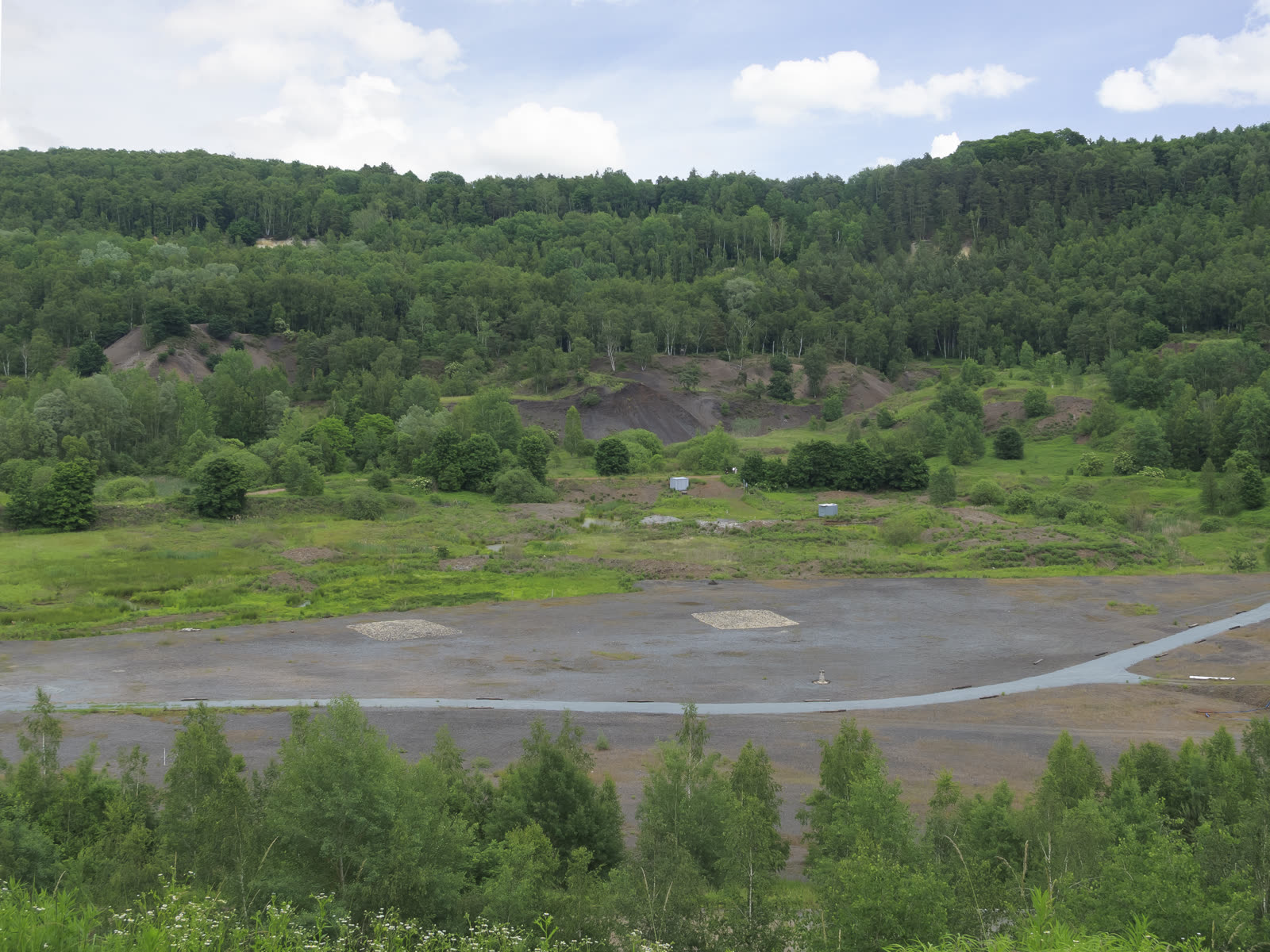
Image context: the cover uses a real Wikimedia Commons photograph of the Messel Pit basin. It belongs here because the article's main claim is geological before it is zoological. The stepped quarry walls and enclosed basin make the site readable as a former lake system whose shape and sedimentary setting controlled what could be preserved at all.[6]
The site is strongest when the lake comes before the mammals
UNESCO's site description still gives the cleanest public statement of why Messel holds its place. It calls Messel the richest site in the world for understanding the Eocene living environment and stresses that the fossils range from fully articulated skeletons to the stomach contents of animals from that period.[2] That breadth matters because it changes the unit of interpretation. A normal fossil locality may give you a few charismatic animals and a rough environmental guess. Messel gives you bodies, diets, vegetation, insects, fishes, reptiles, birds, and mammals in one tightly constrained setting.[1][2][4]
That is also why the horses should not dominate the narrative. HLMD notes that Messel preserves plant fossils with intact flowers and fruits, insects still showing iridescent colours, frogs and frog spawn, tortoises, lizards, crocodiles, snakes, birds ranging from hummingbird-scale forms to much larger specimens, and a wide range of mammals.[1] The biodiversity review pushes the same point in more formal language by treating Messel as a lake within a paratropical forest near the end of the Early Eocene Climate Optimum.[4] In other words, Messel is not a cabinet of isolated celebrities. It is a lake-centered ecosystem sample.
Why the shale kept whole bodies and not just scraps
The preservation logic begins with water-column stability and ends in the sediment. The 2024 review describes the fossil-bearing interval as the stable meromictic phase of the lake.[4] That word matters. Meromixis means the water body was not fully mixing top to bottom on an ordinary cycle, so the lower water column could stay chemically and ecologically distinct from the surface layer.[4] For a fossil site, that kind of stratification is a gift. It reduces disturbance at the bottom, limits scavenging and bioturbation, and gives carcasses a better chance of reaching the sediment without being disassembled beyond use.
The oil shale matters for the same reason. HLMD emphasizes that Messel specimens often retain microscopic details including skin structures, hair, feathers, and stomach content, a claim that only makes sense if the sedimentary environment is holding far more than bone.[1] The quarry's famous "oil shale" is therefore not a background rock label. It is part of the mechanism. Finely laminated bituminous sediment records low-energy deposition on the lake floor, and that low-energy floor is where Messel's information density begins.[1][4]
This is the main field lesson. When a site preserves articulated skeletons and soft-tissue traces across many groups, the first serious question is not "Which fossil is cutest?" It is "What in the basin kept post-mortem destruction from winning?" Messel keeps answering that question with the same package: enclosed volcanic-lake geometry, long-lived stratification, and organic-rich lake-bottom sediment.[1][4]
The real reset is soft-tissue and life-history evidence
The site's strongest argument arrives when preservation crosses from outline into biology. UNESCO highlights stomach contents.[2] HLMD highlights skin, hair, and feathers.[1] The famous pregnant Eurohippus messelensis paper shows why those claims are more than brochure language. The PLOS ONE study describes a fetus preserved in close to its original intrauterine position and notes that black soft-tissue shadows at Messel are not direct tissue survival in the ordinary sense, but a by-product of bacterial metabolism after the carcass reached the lake bottom.[5]
That is a decisive point because it keeps the site from being treated as pure visual luck. Messel did not simply "freeze" animals. Biological remains entered a chemical and microbial regime that could translate anatomy into durable fossil films, mineral crusts, and articulated associations before the usual processes of breakup erased them.[5] Once that is understood, a Messel fossil no longer feels like a particularly photogenic skeleton. It becomes a record of how death, sinking, chemistry, microbes, and sediment interacted in one basin.
The payoff is broader than one horse paper. A site that can preserve fetal remains, stomach contents, hair, feather traces, and fine insect detail is a site that lets paleontology work on ecology, life history, and behavior with a tighter leash than most terrestrial localities allow.[1][2][5] You are no longer reconstructing an Eocene forest from a handful of teeth and a climate proxy alone. You are reconstructing it from bodies that still carry part of their last meal and, sometimes, part of their last developmental stage.
What Messel still does not give for free
That richness does not remove all boundaries. The 2024 biodiversity review notes that the fossiliferous oil shales represent the stable deep-lake phase and that species richness estimates are still shaped by collection history and uneven sampling across repositories.[4] A site can be extraordinary and still incomplete. Messel is a deep-lake archive, not a perfect replay of every shoreline process, every seasonal pulse, or every habitat within the surrounding forest.[4]
That boundary is useful because it keeps the praise exact. Messel does not matter because it solved all Eocene paleontology. It matters because it solved a particular part of it unusually well: how to preserve a middle Eocene lake-centered ecosystem with enough anatomical fidelity that whole-food-web and whole-life-history questions become answerable at all.[1][2][4][5]
Why the site still holds
The strongest summary is therefore a geological one with biological consequences. Messel is valuable because a maar lake became a long-running preservation machine.[1][4] The fossils are dazzling, but the true subject is the system that kept them legible: stratified water, quiet bottom conditions, bituminous shale, and a chemistry-microbe sequence capable of carrying bodies past the normal threshold of destruction.[1][4][5]
That is why the site still deserves field-report treatment in 2026. The quarry continues to matter less as a parade of adorable Eocene mammals than as a discipline check on how paleontology should read exceptional sites. Start with the basin. Then the shale. Then the chemistry. Only after that should the horses, bats, snakes, and stomachs step onto the page.
Sources
- Hessisches Landesmuseum Darmstadt, "Messel Pit Fossil Site" - site overview covering the quarry, middle Eocene oil shale, and the range of preserved plants, insects, vertebrates, skin, hair, feathers, and stomach contents.
- UNESCO World Heritage Centre, "Messel Pit Fossil Site" - official description emphasizing Messel's value for the Eocene living environment and fossils ranging from articulated skeletons to stomach contents.
- Senckenberg Nature Research, "UNESCO-World Heritage Messel Pit" - institutional overview of the site's preservation history and Senckenberg's stewardship role.
- K. D. Rose et al., "The biodiversity of the Eocene Messel Pit," Palaeobiodiversity and Palaeoenvironments (2024) - open-access synthesis describing Messel as the stable meromictic phase of a maar lake within a paratropical forest.
- Jens Lorenz Franzen, Christine Aurich, and Jörg Habersetzer, "Description of a Well Preserved Fetus of the European Eocene Equoid Eurohippus messelensis," PLOS ONE (2015) - evidence for fetal preservation and Messel's soft-tissue mineralization pathway.
- Wikimedia Commons file page for the Messel Pit quarry photograph used as the article image.