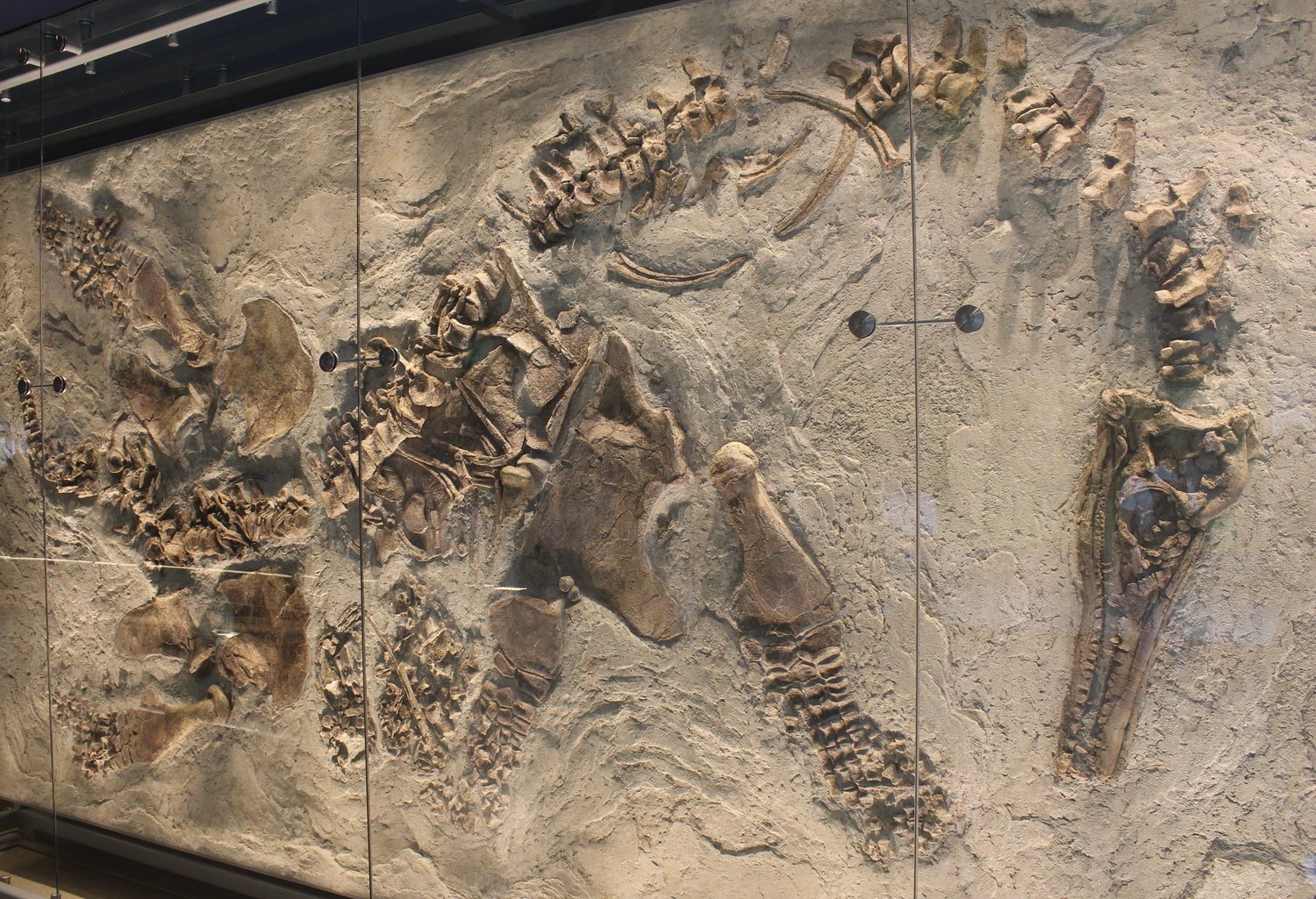
Two bones from a tiny pelvis are stuck to the inside of a grown plesiosaur’s shoulder. They are an awkward pair to picture. In a living animal the hip sits a long way behind the shoulder, and on the museum mount the little skeleton has mostly fallen apart. Yet that patch of contact survived excavation on a Kansas ranch, a journey to Los Angeles and the assembly of a four-flippered reptile nearly five metres long. Much of the case for calling the animal pregnant rests on which face of the shoulder those bones touched. [1]
What held together in the jackets
Charles Bonner found the skeleton in Logan County in 1987, near the base of the Pierre Shale. About 78 million years earlier, during the Late Cretaceous, seawater covered this part of Kansas. Bonner brought the fossil out in twelve protective jackets. No quarry map recorded how the blocks fitted together. Anyone studying the mounted animal would have to ask which bones still occupied positions fixed by the rock and which ones a preparator had placed there. [1][3]
Three jackets held bones of both animals. In one, gypsum and sediment still bound two pieces of the little pelvis to the inward-facing surface of the adult’s right coracoid, a broad plate in the shoulder girdle. The small pelvis had kept part of its original arrangement. The other two mixed jackets held finger bones from the adult’s right front flipper among the smaller animal’s scattered remains. Those finger bones helped the team place the blocks near the shoulder. Bonner checked the reassembly. A visitor sees a whole animal at a glance, but the individual joins carry different degrees of certainty. [1]
Whose bones were inside?
A predator can die with the skeleton of its last meal still inside it. F. Robin O’Keefe and Luis Chiappe, who described the specimen in 2011, had two further clues. First, the upper arm bones in both skeletons share a distinctive curve and a row of four joint surfaces at the flipper end. Those details identify both as Polycotylus latipinnus. Second, the smaller animal’s bones were still at an embryonic stage of development. Taken together with the position of its pelvis, these features make a case for a fetus carried by the adult. The find gave researchers direct evidence that at least one kind of plesiosaur bore live young. [1]
How big would this one have grown before birth? The adult died during pregnancy, so measuring the remains could give only a starting point. O’Keefe and Chiappe estimated that a full-term young animal would have reached roughly two-fifths of its mother’s length. That prediction offered an unusual opportunity. If it held, the bones of a close relative that survived birth might record a change in growth at about the predicted size. [1][4]
Researchers sampled the Kansas fetus’s shoulder blade to see what bone laid down before birth looked like under a microscope. In the outer bone, channels that once carried blood vessels ran outward toward the surface, a sign of rapid growth. In a young South Dakota relative, Dolichorhynchops bonneri, the team found an abrupt change in tissue within the upper arm bone. They interpreted the boundary as a birth line. Its position supported a large newborn in this second species too. The comparison let a shoulder blade from an animal that died in the womb help identify where prenatal growth ended in another. [4]
One fetus accounts for the small bones in the Kansas blocks. Raising a single large offspring takes considerable investment before birth, and the researchers wondered whether mothers stayed with their young afterward, as some marine mammals do. The fossil brings us unusually close to the first half of that story. Two pieces of a hip still cling to the shoulder that sheltered them. How the pair would have swum once there was open water between them remains a question. [1][3]
Sources
- F. R. O’Keefe and L. M. Chiappe, “Viviparity and K-Selected Life History in a Mesozoic Marine Plesiosaur,” Science (2011).
- Jonathan Chen, photograph of Polycotylus with fetus, Natural History Museum of Los Angeles County (2022).
- Natural History Museum of Los Angeles County, research announcement on the pregnant plesiosaur and its young (2019).
- F. R. O’Keefe and colleagues, “Ontogeny of Polycotylid Long Bone Microanatomy and Histology.”