At the back of a young horse’s mouth, the last molar comes into service late. Its neighbors can already show wear while the new tooth barely touches its partner in the opposite jaw. One fossil mouth caught at that moment records a particular stage of growing up. At the Hagerman Horse Quarry in Idaho, paleontologists had enough mouths to ask a more intimate question. Did the mares tend to have their foals at the same time of year? [1][2]
The horses lived about 3.2 million years ago, during the Pliocene. Their bones came out of the Glenns Ferry Formation west of the town of Hagerman, where Smithsonian crews opened three fossil beds in the late 1920s and early 1930s. Some finds were complete enough to put a horse back on its feet in a museum. The loose jaws had an advantage of their own. A researcher could lay them out side by side and compare the same tooth across animals of different ages. [1][2][3]
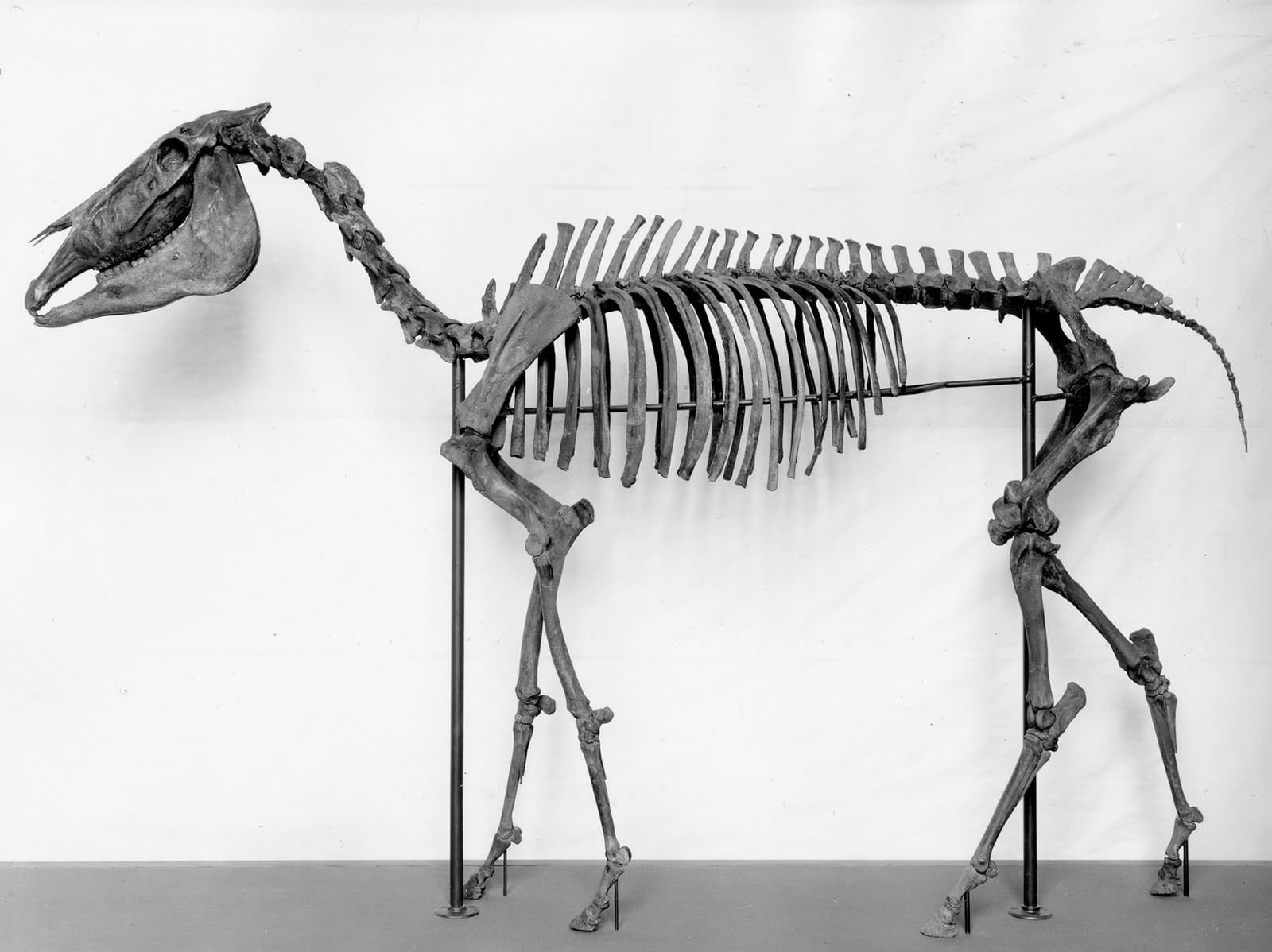
A horse with a zebra’s face
James Gidley described the Idaho animal in 1930 under the name Plesippus shoshonensis. Later researchers assigned it to Equus simplicidens, the name the park uses today. Equus also includes the living asses and zebras. Look at the Hagerman horse from ground level and each leg ends in a single hoof. Work upward to the skull and the resemblance to a living Grevy’s zebra is close enough that the park brochure depicts the Idaho animal with stripes. The illustrator had bones to guide the proportions of the head. The pattern on the hide was a choice. [1][3][4]
One Smithsonian skull, catalogued as USNM 12573, rewards a look from underneath. The incisors curve around the end of the long muzzle. Farther back, a prominent canine helped Raymond Bernor and colleagues identify the animal as an adult male. Turn the skull sideways and another feature comes into view. An opening for nerves and blood vessels sits high on the side of the face, above the space occupied by the deep crowns of the cheek teeth. Much of each grinding tooth was tucked away inside the living head. [1]
A year between groups
In 1996, paleontologist H. Gregory McDonald examined the skulls and lower jaws from Hagerman for the sequence in which teeth had emerged. Imagine two young horses with equally long jaws. One still has a tooth waiting to come in where the other already has a working tooth. The difference gives a way to put those animals in developmental order even when size alone would group them together. [2]
When McDonald sorted the Hagerman animals by dental age, some ages turned up more often than others. The peaks were spaced roughly a year apart. Think of a herd visited on a single afternoon. If mares foal throughout the year, the youngsters can span almost any age in months. If most mares foal in one season, this year’s young will be close in age, with another group about a year older and relatively few animals between. McDonald read that second pattern in the Idaho jaws. A calendar month for foaling would require a separate clue to the season in which the animals died. [2]
The same quarry has inspired two very different final scenes. McDonald considered the possibility that a herd tried to cross a swollen river. Later work proposed that horses gathered at a dwindling water hole during a drought and that a subsequent flood buried their remains. Both accounts can put animals of several ages in one patch of sediment. Water could have carried bones to their resting place even if thirst had already killed the horses. [1][2]
For a visitor looking up at the mounted skeleton, the easiest animal to picture is a lone adult standing still. The jaws recover something harder to put on display. In the gaps between dental ages there is evidence of mares giving birth within a common season, and of another crop of foals coming along a year later. [2]
Sources
- Raymond L. Bernor and colleagues, “Evolution of Early Equus in Italy, Georgia, the Indian Subcontinent, East Africa, and the Origins of African Zebras” (2019), Hagerman quarry history and Smithsonian skull description.
- H. Gregory McDonald, “Population structure of the late Pliocene (Blancan) zebra Equus simplicidens … from the Hagerman Horse Quarry, Idaho” (1996), dental ages and seasonal breeding.
- National Park Service, “The Hagerman Horse (Equus simplicidens),” specimen photographs and collection history.
- Hagerman Fossil Beds National Monument, park brochure, skull comparison and illustrated reconstruction.