Pneumodesmus newmani is famous for a claim that sounds too large for the fossil: perhaps the oldest known air-breathing land animal. The animal itself is not large. It is a small myriapod fragment from Cowie Harbour near Stonehaven, Scotland, named in 2004 from Paleozoic millipede material described by Heather M. Wilson and Lyall I. Anderson.[1] Its evidentiary weight does not come from a dramatic skeleton, a trackway across a bedding plane, or a reconstructed body posed against a forest. It comes from cuticle.
That is why Pneumodesmus is a useful fossil to read slowly. The specimen matters because openings on the body wall were interpreted as spiracles: external apertures for a tracheal breathing system.[1][2] In a living millipede, spiracles are not decorative pores. They are the hardware that lets air enter the body. If the interpretation is right, the fossil does not merely show a small arthropod near land. It shows an animal whose respiratory system had crossed a boundary. The important claim is not "it was on land because it looks like a millipede." The stronger claim is "it was breathing air because the body preserves structures that only make functional sense in air."
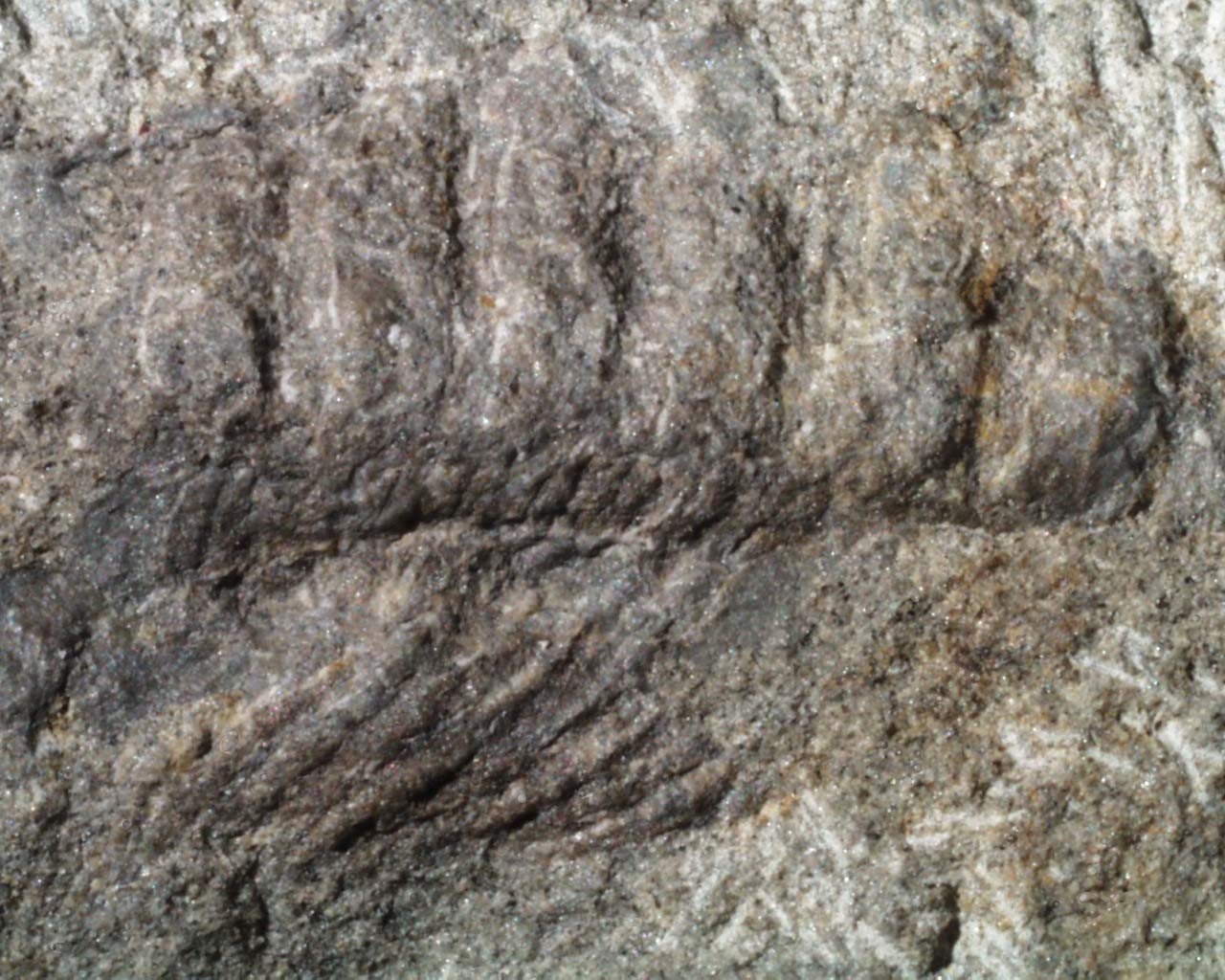
The fossil is small, but the inference is anatomical
The first mistake is to treat Pneumodesmus as a slogan about "the first land animal." That phrase is memorable, but it hides the method. Wilson and Anderson placed Pneumodesmus among archipolypodan millipedes in their 2004 treatment of Paleozoic Scottish diplopods, and later summaries continue to identify it as a myriapod/diplopod from the Stonehaven material.[1][2] The taxonomic setting matters because millipedes are not vague early land creatures. They are arthropods whose living relatives solve land life with cuticle, many legs, and air-breathing openings distributed along the body.
The spiracle claim is therefore doing most of the work. A body fossil can be terrestrial in several weaker senses: found in non-marine sediment, associated with land plants, or shaped like a lineage that later lived on land. Pneumodesmus is stronger because the external openings were read as part of gas exchange.[1][2] That moves the argument from environment to anatomy. The animal is not merely near a shoreline ecosystem; its body appears equipped for air.
That distinction also keeps the fossil from being over-romanticized. Pneumodesmus does not preserve a complete walking animal with every leg, head structure, and behavior laid out. It is fragmentary, and fragmentary fossils should not be asked to perform a full life history. What it can support is narrower and better: a small myriapod body fragment preserves features consistent with terrestrial air breathing. In paleontology, that kind of bounded claim is often more durable than a grander story.
Cowie Harbour makes the fossil a landscape problem
The second reason the specimen matters is place. The Scottish Geology Trust's GeoGuide for The Toutties describes the Cowie Harbour beds as a freshwater assemblage with fish, arthropods, and newly discovered millipedes, including Pneumodesmus newmani.[5] This is not a marine fossil accidentally recruited into a land story. It belongs to a non-marine Old Red Sandstone world of streams, floodplains, lake or marsh beds, fish, eurypterids, plant-like material, and arthropods.[4][5]
That setting makes Pneumodesmus part of a larger terrestrialization problem. Land animals did not appear into an empty stage. Early arthropods entered landscapes where plants, microbial surfaces, freshwater margins, drying events, sediment pulses, and basin structure all mattered. If a small millipede-like animal was already breathing air at Cowie Harbour, then the ecosystem around it had enough landward structure to support more than a one-off visitor.[2][5]
The GeoGuide language is deliberately site-based, and that is useful. It emphasizes the local fossil assemblage and the structural setting of the Stonehaven Group rather than turning the fossil into an isolated trophy.[5] A fossil this small needs that context. Without the bed, the basin, and the associated fauna, the specimen risks becoming an abstract "first." With them, it becomes a sign that early terrestrial ecosystems were already assembling in a particular Scottish sedimentary basin.
The age is the hard part
The strongest article on Pneumodesmus has to leave room for the age debate. The fossil has been described as Silurian in many accounts, but the Cowie Harbour beds have also been argued to be earliest Devonian. Suarez, Brookfield, Catlos, and Stockli reported U-Pb zircon constraints in 2017 and argued that the relevant Cowie Harbour Fish Bed appears lowermost Devonian, around 414 million years old, which would weaken the oldest-air-breathing-animal title if older terrestrial candidates elsewhere hold.[2]
Then the argument swung back. Wellman and colleagues published a 2023 paper arguing from spore assemblages and additional zircon data that the basal Stonehaven Group biota is late Wenlock, late Silurian, in age.[3] That interpretation keeps Pneumodesmus very early indeed and compatible with the traditional older framing. The controversy did not end there. A 2025 review by Brookfield, Catlos, and Garza argued that the late Wenlock evidence and the younger Pridoli-Lochkovian evidence come from different structural blocks, and that the strata actually bearing the millipede are better dated as Pridoli-Lochkovian rather than mid-Silurian.[4]
This is not a side detail. It changes how the fossil should be introduced. A careless version says: Pneumodesmus is the oldest land animal, full stop. A careful version says: Pneumodesmus is one of the oldest reported air-breathing land animals, and its exact place on the Silurian-Devonian timeline depends on a disputed correlation problem in fault-bounded Stonehaven strata.[2][3][4]
That cautious sentence is less catchy, but it is better paleontology. The specimen's anatomical importance does not disappear if its age is early Devonian rather than late Silurian. Spiracles still matter. A small millipede-like body still anchors air breathing in early terrestrial arthropods. What changes is the leaderboard, not the fossil's core evidence.
Why the "oldest" label can get in the way
The oldest label is attractive because it gives a reader a clean hook. It is also dangerous because it makes the fossil sound as if its value depends on staying first forever. Pneumodesmus deserves a better reason to be remembered. Its force lies in showing what kind of evidence can make land life visible: not a forest, not a footprint, not a spectacular predator, but respiratory openings in cuticle.
That matters for how terrestrialization is imagined. Animals did not conquer land in one theatrical crossing. The move required many smaller systems to become workable: surfaces that resisted drying, legs that could operate without buoyancy, mouthparts that handled land food, senses that worked in air, reproductive strategies that avoided constant immersion, and breathing systems that could exchange gases outside water. Pneumodesmus gives one of those systems a fossil address.
It also helps separate body evidence from environmental evidence. A non-marine deposit can tell us where an organism was buried. Spiracles can tell us something about how an organism functioned. Both are needed, but they are not the same claim. The Cowie Harbour context makes the fossil ecologically plausible; the spiracles make it biologically decisive.[1][5]
That is the close-reading payoff. The fossil is not important because it gives a tidy origin scene for land animals. It is important because it makes one step of the transition inspectable. On a tiny Scottish fragment, air breathing stops being an inferred destination and becomes a preserved anatomical feature. The date may continue to be argued bed by bed, zircon by zircon, and spore by spore. The small openings on the cuticle remain the reason Pneumodesmus keeps breathing in the story.
Sources
- Heather M. Wilson and Lyall I. Anderson, "Morphology and taxonomy of Paleozoic millipedes (Diplopoda: Chilognatha: Archipolypoda) from Scotland," Journal of Paleontology 78, no. 1 (2004), DOI record.
- Stephanie E. Suarez, Michael E. Brookfield, Elizabeth J. Catlos, and Daniel F. Stockli, "A U-Pb zircon age constraint on the oldest-recorded air-breathing land animal," PLOS ONE 12, no. 6 (2017).
- Charles H. Wellman, Gilda Lopes, Zoe McKellar, and Adrian Hartley, "Age of the basal 'Lower Old Red Sandstone' Stonehaven Group of Scotland: the oldest reported air-breathing land animal is Silurian (late Wenlock) in age," repository PDF of 2023 paper.
- Michael E. Brookfield, Elizabeth J. Catlos, and Hector K. Garza, "Reconciling Divergent Ages for the Oldest Recorded Air-Breathing Land Animal, the Millipede, Pneumodesmus newmani Wilson & Anderson, 2004," Fossil Studies 3, no. 2 (2025), Sciety DOI activity page.
- Scottish Geology Trust GeoGuide, "The Toutties, Aberdeenshire," site account for the Cowie Harbour beds, fossil assemblage, and Stonehaven Group context.
- Wikimedia Commons, "Pneumodesmus newmani.jpg," file page for the real holotype photomicrograph used as the article image.