Coal usually asks to be read as compression. Plant matter accumulates, burial deepens, water and volatile compounds leave, and a swamp slowly becomes a black seam. Coal balls interrupt that story. They are the awkward, stony exceptions inside the seam: carbonate-rich lumps of permineralized peat in which plant tissues can remain three-dimensional enough for paleobotanists to cut, peel, image, and compare cell by cell.[1][4]
That interruption is why coal balls are more than curiosities from old mines. They preserve the coal swamp before coal has finished simplifying it. A leaf mat, root tangle, stem fragment, sporangium, or small arthropod trace can pass from living wetland into mineral archive without being flattened into a thin carbon film. The result is a fossil format that keeps structure where normal coalification tends to keep only mass.[1]
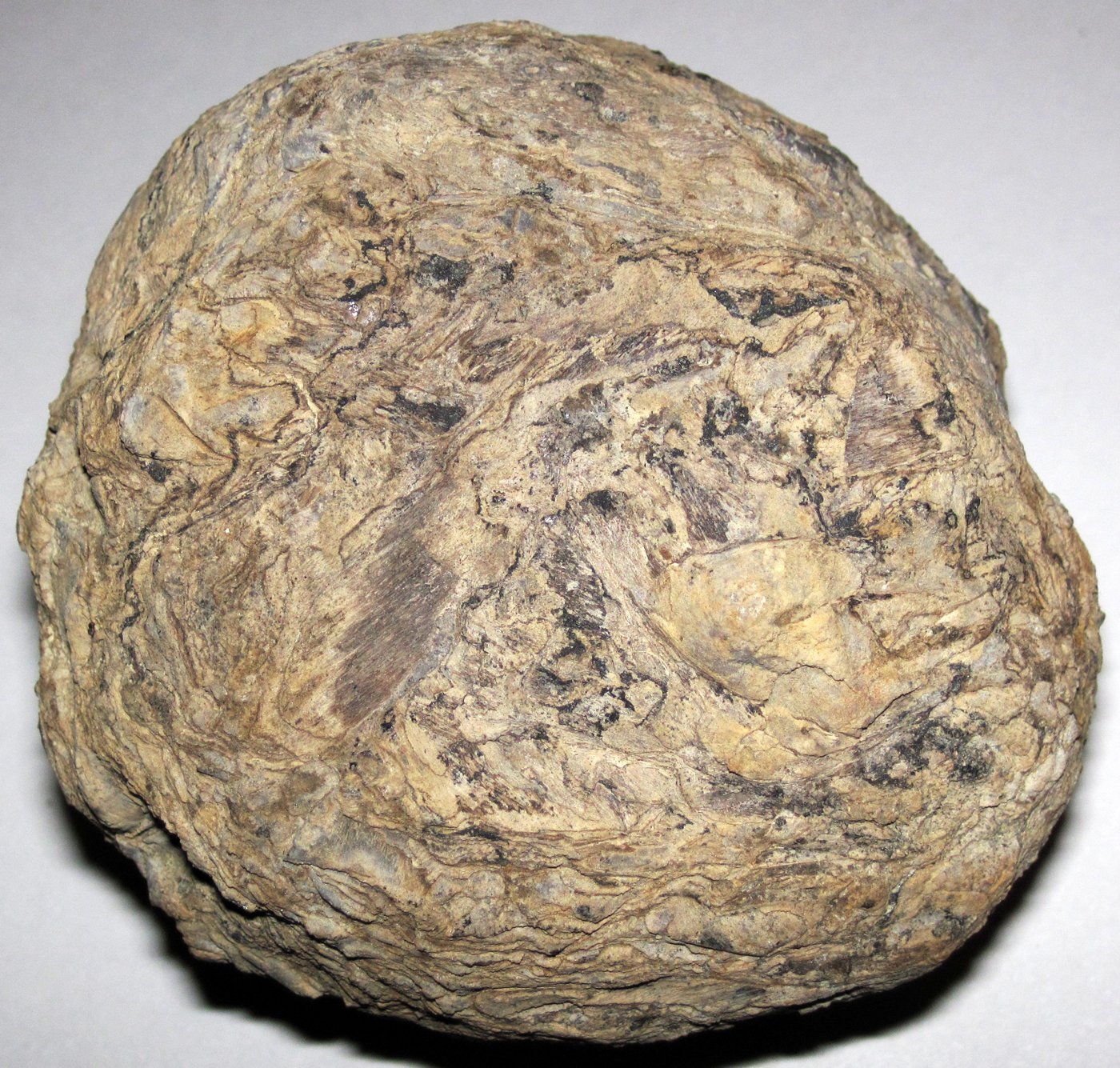
The first useful correction is that a coal ball is not a fossilized cannonball, a dinosaur egg, or a decorative mineral sphere. It is permineralized peat. Britannica's compact definition gets the basic public frame right: coal balls are petrified plant matter, often spheroidal, found in Upper Carboniferous coal seams and important for fossil information about coal-age forests.[4] The more technical literature pushes the same point harder. Lakeram, Elrick, and Punyasena describe coal balls as fossil plants preserved in permineralized peat deposits from Carboniferous tropical forests, and they center the history of how researchers physically extracted evidence from those masses.[1]
That last phrase matters: extracted evidence. Coal balls do not give themselves away at a glance. A specimen may look like an unattractive gray-brown lump until it is cut and polished. The classic cellulose acetate peel method turns that cut face into a reproducible viewing surface. Researchers etch the polished surface with acid, apply acetate, peel off a thin film, and place it under a microscope so cellular anatomy can be studied without simply grinding the fossil away.[1][5] The method is wonderfully low-drama, but its consequences are large. It can turn a dense nodule into a stack of anatomical pages.
The Archive Is Built Before Flattening Wins
Coal balls matter because they preserve a stage that the ordinary coal story tends to destroy. In a typical compressed plant fossil, outline can be excellent, but internal anatomy is often compromised. In a coal ball, carbonate minerals enter the peat early enough to fill spaces and stabilize tissues before compaction removes the architecture.[1][2] That is why paleobotanists have long used them to study roots, stems, leaves, reproductive organs, and ecological associations from Pennsylvanian wetlands.
The preservation is not perfect and should not be romanticized. A coal ball is still a selective object. It forms only under particular chemical and sedimentary conditions, and the plants captured in it are not automatically a complete census of the swamp. But the selectivity is different from the selectivity of a flattened shale impression or a loose spore sample. Coal balls can keep organs in anatomical relationship and preserve enough cell-level detail to make questions about plant growth, tissue organization, and peat-swamp ecology sharper than a silhouette alone would allow.[1]
That is why the phrase "before the coal" is useful. The coal seam records biomass, climate, basin subsidence, waterlogging, and later burial. The coal ball records a smaller, stranger event inside that process: a chemical pause in which peat becomes stone quickly enough to keep recognizable plant anatomy. One record is broad and industrially familiar. The other is small, lumpy, and scientifically intimate.
The Water Was Not a Simple Swamp Story
For a long time, the origin problem around coal balls has turned on water chemistry. If these objects are peat from coal swamps, were they mineralized mainly by freshwater moving through the mire, by marine flooding, or by a mixing zone between the two? The answer matters because it changes what a coal ball says about the landscape. A purely freshwater model keeps the archive inside the swamp. A marine or brackish model connects it to transgression, coastal flooding, and pore waters moving through a wetland at the edge of an epicontinental sea.[2][3]
The 2023 Communications Earth & Environment paper by Chrpa and colleagues is useful because it treats coal balls as geochemical evidence, not just plant cabinets. Working on Pennsylvanian material from the Midland and Illinois basins, the authors argue that echinoderm remains and early high-magnesium calcite cement point toward marine or brackish water early in coal-ball formation, followed by later low-magnesium calcite consistent with freshwater diagenesis.[2] Their conclusion is not simply "the sea made coal balls." It is more interesting: coal balls likely formed in a marine-freshwater mixing zone.[2]
That finding gives coal balls a tide line. The peat swamp is still central, but it is no longer a sealed freshwater room. Marine influence could enter the chemistry, bring carbonate conditions, move tiny marine remains into the peat, and start the mineralization that preserved the plant archive. Later freshwater alteration could overprint that first event.[2] The nodule becomes a record of environmental negotiation: swamp plants, marine ions, pore waters, early cement, later diagenesis.
USGS work on the Herrin Coal makes the same formation problem feel operational. In Franklin County, Illinois, coal balls in the Herrin Coal occurred in concentrated areas up to 4 meters thick, enough to obstruct longwall mining, and the study used carbon and oxygen isotopes, geochemistry, mineralogy, and associated materials to refine a depositional model for their formation.[3] That is an excellent reminder that coal balls are not only museum specimens. In coalfields, they were physical bodies in the seam, sometimes numerous enough to shape extraction and research access at the same time.
Peel Collections Turn Lumps Into Memory
The most underrated part of the coal-ball story is curation. A coal ball is heavy, awkward, and finite. A peel is light, viewable, teachable, and reproducible enough to become part of a research collection. Lakeram and colleagues' review emphasizes both the physical peel method and the newer problem of digital curation: how coal-ball peels and their metadata can be preserved, imaged, indexed, and made useful beyond the drawer where they currently sit.[1]
That matters because the scientific archive is not just the nodule. It is the nodule plus the cut surface, the peel, the slide, the label, the locality data, the coal bed, the stratigraphic context, the preparation history, and the image file that lets a future researcher compare tissues without redoing the destructive part of the work. Coal balls are a good antidote to the idea that paleontology is only discovery. Here, discovery is extended by preparation and kept alive by collection management.
There is also an ethical discipline hidden in the method. Cutting and peeling can reveal cell structure, but it changes the specimen. Digital imaging can widen access, but only if the image remains tied to the original object and its context. A coal-ball collection that loses locality data becomes a gallery of pretty plant cells. A well-curated collection remains a map of swamp anatomy through space and time.[1][3]
What Coal Balls Teach Best
Coal balls do not make Carboniferous forests simple. They make them inspectable. They show that ancient coal swamps were not just future fuel beds, but living wetlands with roots, stems, spores, tissues, decay pathways, water chemistry, and occasional marine interruptions. They also show that fossil evidence can be spectacular without looking spectacular. The cover image is visually modest because coal balls are visually modest until method does the work.[5]
The strongest reading keeps three scales together. At the tissue scale, coal balls preserve plant anatomy in three dimensions. At the wetland scale, they capture peat before compaction and coalification erase much of that architecture. At the basin scale, their chemistry can record marine-freshwater mixing, transgression, and diagenesis rather than a single static swamp.[1][2][3]
That is why coal balls deserve a place beside more charismatic fossils. They are not famous because they resemble a creature, carry teeth, or dramatize extinction. They matter because they slow the reader down at the exact moment when "coal swamp" risks becoming a backdrop. A coal ball says the swamp was not a background. It was a tissue-rich, chemically active, preservationally uneven place. The coal seam kept the mass. The coal ball kept the scene.
Sources
- Scott R. Lakeram, Scott Elrick, and Surangi W. Punyasena, "Review of the cellulose acetate peel method and the physical and digital curation of coal balls," Applications in Plant Sciences 11 (2023).
- Michelle E. Chrpa, Anne Raymond, William M. Lamb, and Juan-Carlos Laya, "A marine origin of coal balls in the Midland and Illinois basins, USA," Communications Earth & Environment 4 (2023).
- U.S. Geological Survey Publications Warehouse, "Formation and distribution of coal balls in the Herrin Coal (Pennsylvanian), Franklin County, Illinois Basin, USA."
- Encyclopaedia Britannica, "Coal ball" - concise definition and Carboniferous context.
- Wikimedia Commons, "File:Coal ball (Duquesne Coal, Upper Pennsylvanian; Steubenville West roadcut, Ohio, USA) 2.jpg" - source page for the real specimen photograph used as the article image.