Fuxianhuia protensa is easy to turn into a headline because the best-known claims sound almost impossible: a Cambrian arthropod with a preserved brain, optic lobes, and even traces of a cardiovascular system. That language is accurate enough to be exciting, but it is too quick. The more interesting story is methodological. Fuxianhuia matters because it forces paleontologists to ask when a dark trace inside a 520-million-year-old compression fossil should be treated as anatomy rather than stain, accident, or wishful pattern matching.[1][2][3]
The animal comes from the Chengjiang biota of Yunnan, China, one of the great Cambrian soft-bodied fossil windows. In broad outline, Fuxianhuia is a stem-group euarthropod: not a modern crab, insect, or centipede in miniature, but an early arthropod-grade body whose head, limbs, trunk plates, gut, nervous system, and possible blood vessels help constrain how the euarthropod package was assembled.[1][2][4] That distinction is important. The fossil is not valuable because it looks familiar. It is valuable because it is unfamiliar in exactly the places where arthropod origins need evidence.
The brain claim has to be reproducible
The 2012 Nature paper made the most public version of the case: exceptional preservation of the brain and optic lobes in Fuxianhuia protensa, with a protocerebrum supplied by optic lobes, traces of nested optic centers, nerves from antennae defining the deutocerebrum, and more caudal nerves indicating a tritocerebral component.[1] In plain English, the paper argued that a tripartite arthropod brain was already present in at least some early Cambrian stem arthropods.[1]
That is a major claim because arthropod heads are historical composites. In living arthropods, the brain is tied to eyes, antennae or equivalent appendages, mouth position, and segmental organization. If a Cambrian fossil preserves enough neural architecture to map those relationships, it does more than add a spectacular soft tissue record. It gives an anatomical test for hypotheses that otherwise lean heavily on living groups and developmental comparison.[1][4]
But a single dramatic fossil is always vulnerable. A compression fossil can preserve carbon films, mineral replacement, decay halos, gut contents, sediment shadows, and preparation artifacts. If the claim is "a brain," reproducibility matters as much as beauty. That is why the 2015 Current Biology paper is central to the Fuxianhuia story. It described newly discovered specimens with corresponding brain profiles, then used SEM and EDX work to show that the traces could appear as carbon films variably overlaid with pyrite.[3] The point was not that every dark patch becomes nervous tissue. The point was that repeated profiles plus geochemical testing could make a labile-tissue claim less anecdotal.[3]
Preservation is not a miracle exemption
The most useful lesson from Fuxianhuia is that exceptional preservation still needs ordinary discipline. The 2015 study argued that early diagenetic mineralization was not always essential for preserving neural tissue; in their interpretation, neural traces were initially preserved as carbonaceous film and could later be pyritized.[3] That matters because it changes how readers should evaluate Cambrian organ headlines. A fossil brain is not a miracle floating above taphonomy. It is a preservation pathway that must explain why tissue outlines survived, why they occur in anatomically plausible places, and why comparable specimens show comparable organization.
This is where Fuxianhuia becomes a method deep dive rather than a trivia item. The fossil record is not handing over soft anatomy with labels attached. Researchers have to stack evidence: position in the head, symmetry, connection to eyes and appendages, recurrence across specimens, elemental maps, and comparison with living arthropod neuroanatomy.[1][3] The strongest version of the claim is cumulative. The weakest version would be a single suggestive smudge.
The same principle applies to the cardiovascular paper published in Nature Communications in 2014. Ma and colleagues described a bilaterally symmetrical organ system interpreted as vascular anatomy, preserved primarily as carbon, including a broad dorsal vessel extending through the thorax toward the brain and branches supplying the eyes and antennae.[2] If correct, that adds another internal system to a fossil already discussed for digestive and nervous anatomy, making Fuxianhuia unusually complete for a Cambrian arthropod.[2]
The temptation is to treat that as an inventory: brain, vessels, gut, limbs. The better reading is relational. A dorsal vessel supplying anterior structures means the head is not just an external shield. It is a coordinated region where sensory, neural, circulatory, and feeding anatomy meet. That is precisely the zone arthropod evolution keeps asking us to understand.
Limbs make the body less ghostly
Internal organs are only interpretable because Fuxianhuia belongs to a broader fuxianhuiid body plan. The 2018 Nature Communications study on early Cambrian fuxianhuiids focused on limb organization and the origin of the gnathobasic protopodite, the specialized basal limb region associated with feeding in euarthropods.[4] The paper examined exceptional Xiaoshiba material and argued that fuxianhuiids occupy a key position for understanding how differentiated arthropod limbs emerged from earlier appendage architectures.[4]
That limb evidence keeps the organ story from becoming disembodied. A nervous system does not evolve in isolation. Eyes need processing centers. Antennae need neural connections. Feeding limbs need coordination around the mouth and food groove. Walking limbs, exopods, endopods, trunk plates, and anterior appendages all help define what kind of animal the internal traces belonged to.[4]
This is why Fuxianhuia should not be described as "an arthropod with a brain" as if that were the whole argument. It is an early euarthropod-grade animal in which multiple body systems can be read against each other. The brain interpretation gains plausibility when it fits the head and appendage map. The vascular interpretation gains meaning when it supplies sensory and anterior regions. The limb studies clarify why the animal matters for the origin of feeding and locomotory differentiation, not only for nervous-system history.[1][2][4]
What the photograph can and cannot show
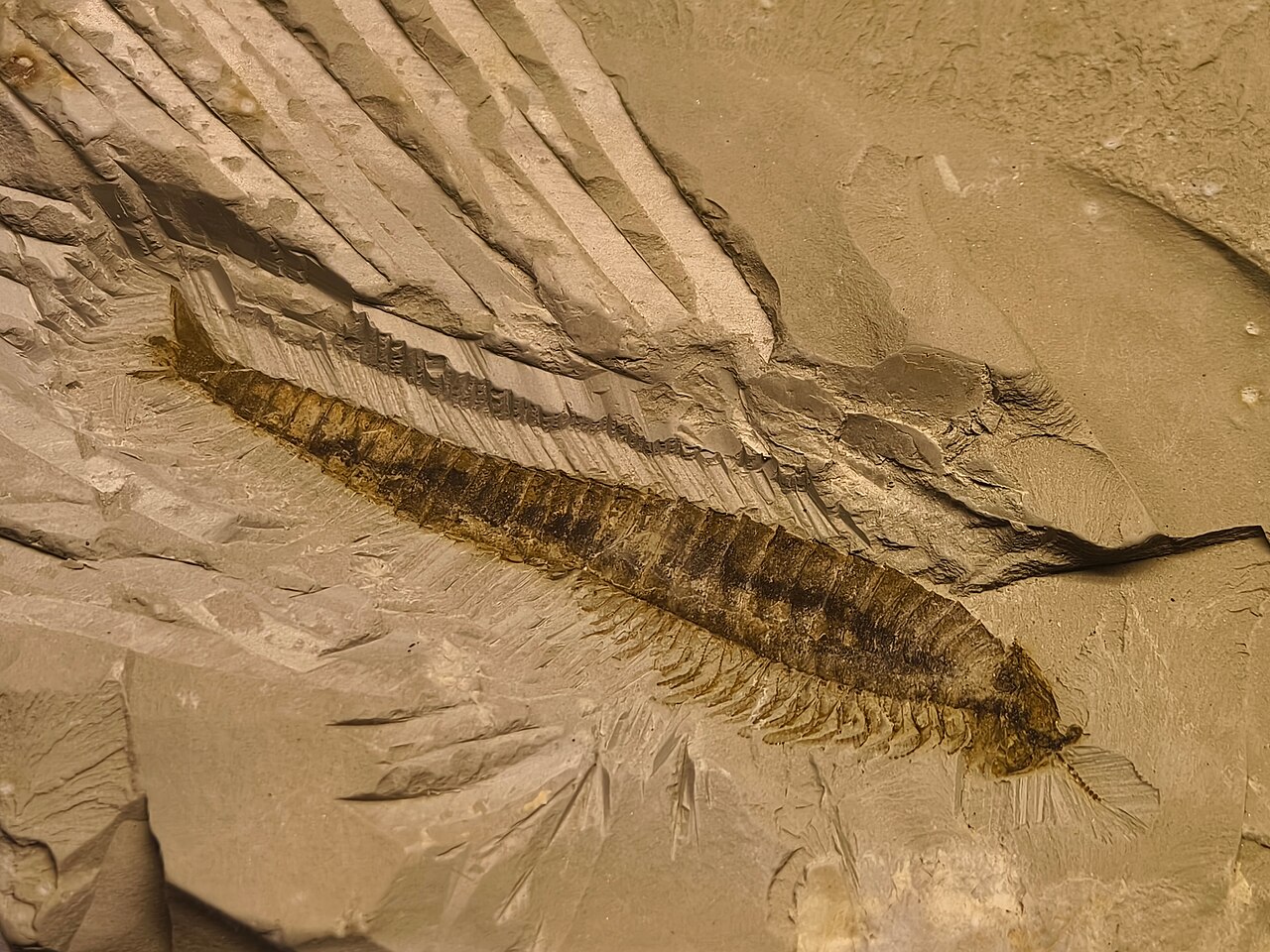
The cover image shows a photographed Fuxianhuia protensa fossil from the Chengjiang biota, exhibited at the Chengjiang Fossil Site Natural History Museum. The Commons description identifies it as a roughly 5-centimeter fossil in lateral view.[5] It is a useful lead image precisely because it does not pretend to show a glowing brain. To a nonspecialist eye, the fossil is mostly an elongated compression on a pale slab. That visual restraint is part of the lesson.
Most of the scientific force is not visible as a poster image. It emerges through lighting, microscopy, elemental mapping, specimen comparison, and anatomical argument. A photograph can show the object; it cannot by itself certify that a trace is a protocerebrum or a dorsal vessel. That gap is not a failure. It is the space where paleontology happens.
The right way to read Fuxianhuia is therefore neither naive nor cynical. Naive reading says, "The Cambrian fossil has a brain; case closed." Cynical reading says, "Brains cannot fossilize; every claim must be overreach." The evidence points to a better middle position. Some labile tissues can leave durable traces under rare conditions, but the claim has to survive tests of position, recurrence, chemistry, and comparative anatomy.[1][2][3]
Why Fuxianhuia still matters
The animal's importance is not that it gives a perfect ancestor for any one living arthropod group. It does not. Its value is that it lowers the fog around early euarthropod organization. A tripartite brain claim pushes neural complexity deep into the Cambrian record.[1] A vascular-system interpretation suggests internal anatomy was already regionally elaborate.[2] Preservation-pathway work shows that such claims can be tested across multiple specimens rather than treated as one-off marvels.[3] Limb studies give the body plan a feeding and locomotory context.[4]
That combination makes Fuxianhuia a good antidote to both fossil spectacle and fossil minimalism. The spectacle version sees only the oldest brain. The minimalist version sees only uncertain stains. The stronger reading sees a repeatable anatomical problem inside a real Chengjiang animal: how a segmented, appendage-bearing, visually equipped arthropod-grade body coordinated itself before the familiar crown-group forms had taken over the seas.
In that sense, Fuxianhuia is less a single discovery than a stress test for Cambrian evidence. It asks how much anatomy can be extracted from a flattened fossil without outrunning the specimen. The answer is not unlimited, but it is more than old assumptions allowed. Brains, vessels, limbs, and carbon films do not make the animal modern. They make it legible enough to argue with.
Sources
- Xiaoya Ma, Xianguang Hou, Gregory D. Edgecombe, and Nicholas J. Strausfeld, "Complex brain and optic lobes in an early Cambrian arthropod," Nature 490 (2012).
- Xiaoya Ma et al., "An exceptionally preserved arthropod cardiovascular system from the early Cambrian," Nature Communications 5 (2014).
- University of Arizona research record for Xiaoya Ma et al., "Preservational Pathways of Corresponding Brains of a Cambrian Euarthropod," Current Biology 25 (2015), with DOI and abstract.
- Jie Yang, Javier Ortega-Hernandez, David A. Legg, Tian Lan, Jin-bo Hou, and Xi-guang Zhang, "Early Cambrian fuxianhuiids from China reveal origin of the gnathobasic protopodite in euarthropods," Nature Communications 9 (2018).
- Wikimedia Commons, "File:Fuxianhuia protensa, Chengjiang biota.jpg" - source page for the real fossil photograph from the Chengjiang Fossil Site Natural History Museum used as the article image.