Broad bands of bone trail behind the skull of Dissorophus multicinctus, beginning with an outsized neck shield. Edward Drinker Cope, who named it in 1895, compared it to an armadillo.[1] The resemblance draws the eye; the attachments beneath those bands reward a closer look.
This was an Early Permian temnospondyl, a member of the great extinct assemblage commonly called amphibians. Its familiar Texas specimens belong to a world long before dinosaurs.[2][4] What makes Dissorophus distinctive is how closely the bones of its armor interacted with the bones underneath. A covering that looks defensive from the outside could also have controlled movement from within.
Two layers, different attachments
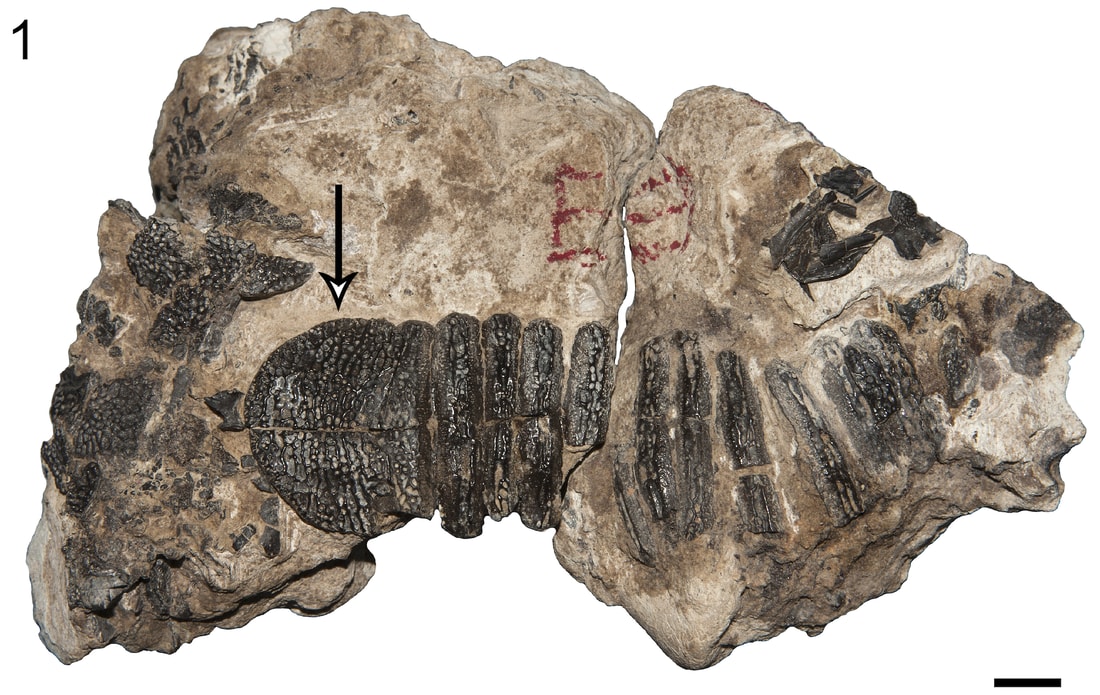
Its armor consists of skin bones, or osteoderms, arranged in inner and outer series. These are successive layers above the backbone. The broad plates and enlarged front shield distinguish its silhouette.[1]
The inner plates remained unfused to the vertebral spines, with flanges projecting downward. The outer plates lacked those projections and connected mainly through soft tissues; fossils can consequently separate along the boundary between layers.[1]
Armor, then, was an assembly of interacting parts. Calling it a shell conceals the joints and contacts that made it work.
A back with different degrees of freedom
David Dilkes's 2009 comparison of Dissorophus and its armored relative Cacops examined those contacts in detail. Immediately behind the enlarged first plate, four inner osteoderms carry flanges that fit into deep notches around the corresponding vertebral spines. Dilkes interpreted this fit as largely immobilizing that region.[2]
Farther back, the arrangement changes. The downward flanges fit between neighboring vertebral spines and lean forward. Their spacing suggests close contact, or only a small gap, with the next inner plate ahead. Dilkes proposed that ligaments binding the plates would have further restricted sideways bending.[2]
The notches and flanges are preserved; the ligaments and their effects are inferred. This supports regional differences in flexibility, without establishing complete rigidity or a particular gait.[2]
A museum catalogue records how this research could be revisited. Harvard's specimen MCZ VPRA-4187, from Baylor County, Texas, was cited in Robert DeMar's 1968 study and figured again by Dilkes in 2009. The same physical object remained available for another anatomical argument decades later.[5] Scientific portraits of extinct animals become sharper through such returns to the material.
Recognizable even in pieces
In 2019, Gee, Joseph Bevitt and Robert Reisz reported Dissorophus from the early Permian caves at Richards Spur, Oklahoma. This upland assemblage broadened its record beyond the familiar Texas lowlands.[3]
The finds were incomplete. Specimen ROMVP 80072 preserves part of the back of the skull with armor extending across thirteen vertebral positions. Its enlarged front shield is about four times as long, front to back, as subsequent plates. Another small block, ROMVP 80076, revealed forked downward flanges through neutron tomography. The investigators compared these features with the Texas material.[3]
They used the cautious identification Dissorophus cf. multicinctus: material comparable to D. multicinctus, with the species assignment qualified. The remains showed no apparent differences from that species, but their incompleteness warranted caution.[3]
What the shield cannot settle
A confident portrait need not supply a confident family tree. Gee's 2021 reassessment found substantial problems in datasets used to reconstruct dissorophid relationships. Correcting anatomical scores produced less resolved trees; relationships among Dissorophus and several close relatives remained poorly supported.[4] Similar armor therefore should not be turned into a tidy sequence in which one known genus inevitably became another.
Gee also cautions that the broad armor’s extra protection against predators remains unknown.[1] Cope’s armadillo comparison captured the first impression. More than a century later, the question has moved beneath the surface: how did those conspicuous plates fit the animal carrying them?
Sources
- Bryan M. Gee, “The Dog Days of Dissorophids, Week 2: Dissorophus” (6 August 2019) — a researcher's account of the taxon's history, broad armor, plate attachments and limits of the protective interpretation.
- David W. Dilkes, “Comparison and biomechanical interpretations of the vertebrae and osteoderms of Cacops aspidephorus and Dissorophus multicinctus,” Journal of Vertebrate Paleontology 29 (2009), 1013–1021 — original abstract and publication metadata via OpenAlex; DOI 10.1671/039.029.0410.
- Bryan M. Gee, Joseph J. Bevitt and Robert R. Reisz, “Dissorophid diversity at the early Permian cave system near Richards Spur, Oklahoma, USA,” Palaeontologia Electronica 22.2.46A (2019) — specimens ROMVP 80072–80077, tomography and qualified identification.
- Bryan M. Gee, “Returning to the roots: resolution, reproducibility, and robusticity in the phylogenetic inference of Dissorophidae (Amphibia: Temnospondyli),” PeerJ 9 (2021), e12423 — anatomical data quality and unresolved relationships.
- Harvard Museum of Comparative Zoology, specimen MCZ VPRA-4187 — identification, Texas locality and citations in DeMar (1968) and Dilkes (2009).