The long plesiosaur neck has attracted the wrong kind of confidence for nearly two centuries. Once the skeleton is reduced to silhouette, the temptation is to imagine a reptilian swan: a head held high above the surface, a neck curling freely in S-shapes, or a sudden sideways lash at prey. The modern literature is less theatrical and more useful. A long-necked plesiosaur still looks extraordinary, but the bones point toward a narrower set of options.[1][2][4]
That narrower reading is the one worth keeping in 2026. The neck was genuinely enormous in some forms; Elasmosaurus platyurus still stands among the longest-necked vertebrates known, with 72 cervical vertebrae in the revised count.[2][4] Yet length alone did not make the neck a whip. Osteological work argues that plesiosaur necks favored ventral bending over dorsal, lateral, or rotational freedom, and that the classic swan-like reconstructions asked the vertebrae to do more than the anatomy would permit.[1] Hydrodynamic work adds a second filter: a long neck could impose a real swimming cost, especially once it exceeded twice trunk length, but that cost was partly offset in very large-bodied elasmosaurs by the evolution of bigger trunks.[3]
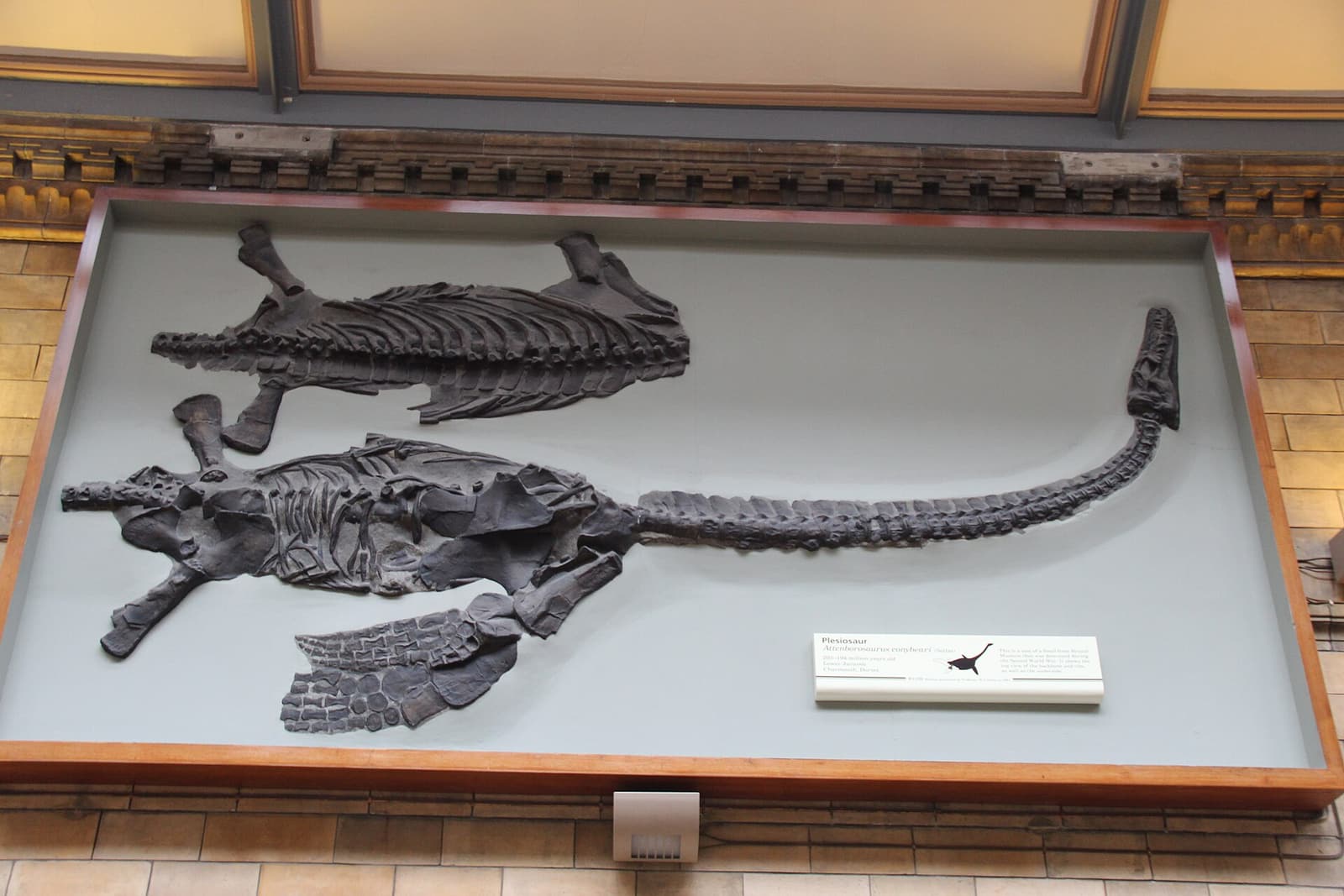
Image context: the cover uses a real photograph of a mounted plesiosaur skeleton in the Natural History Museum, London, sourced via Wikimedia Commons. It belongs here because this article turns on whole-body geometry. The neck reads differently once it is seen attached to a compact, drag-paying trunk and four large flippers rather than floating as an isolated curiosity.[5]
1) The neck got long through vertebral architecture, not through unlimited flexibility
The first correction is structural. Long-necked plesiosaurs did not simply acquire a cartoonishly bendy tube in front of the shoulders. They acquired a very large number of cervical vertebrae, and in some elasmosaurids that count became extreme.[2][4] Sachs, Kear, and Everhart's revision of Elasmosaurus platyurus reaffirmed 72 cervicals, keeping it among the longest-necked vertebrates ever recognized.[2] The Natural History Museum summarizes the public-facing version cleanly: Elasmosaurus had a neck more than seven metres long.[4]
That matters because count and flexibility are not the same variable. Adding vertebrae can create reach without granting every joint sweeping freedom.[1][2] The long-necked plesiosaur problem is therefore not "how did an animal support a snake on its shoulders?" It is "what kind of movement could this many joints, with these articular faces, neural spines, and cervical ribs, actually allow?"[1]
Once the question is phrased that way, the old visual habit starts to fail. A very long neck can still be mechanically constrained, and in plesiosaurs that is exactly what the osteology suggests.[1] Length made the head remote from the main body. It did not automatically make the neck free.
2) The bones point downward more readily than upward
Noe, Taylor, and Gomez-Perez provide the clearest methodological reset.[1] Reading the articular faces, zygapophyses, neural spines, and cervical ribs together, they argue that plesiosaur neck function was based primarily on ventral flexion, with other kinds of movement increasingly restricted, especially toward the rear of the neck.[1] Their conclusion is important precisely because it is less cinematic than the old art. The osteological evidence does not support the classic swan-like S-curves, elaborate side-to-side coils, or violent strike poses that once dominated reconstructions.[1]
This does not mean the neck was frozen. It means the freedom was directional and limited.[1] The head-neck joint probably remained relatively mobile, but the neck as a whole was not a serpent mounted on a barrel-shaped torso.[1] The most defensible posture was a gentle, controlled feeding envelope with a strong ventral component, not a high-arching display organ and not a sideways lash machine.[1]
That directional bias changes the ecological reading. If ventral bending was the main available motion, then the neck makes best sense as a way to place a small head below and ahead of the body, into the water column near the seafloor, or toward prey without having to drive the whole trunk directly over the target.[1] This is exactly where the famous neck stops being decorative. It starts behaving like a reach device with rules.
3) Hydrodynamics makes the tradeoff sharper, not weaker
The long neck still had to be paid for in water. Gutarra and colleagues tested the drag implications of extreme body proportions in plesiosaurs and found an important two-part result.[3] First, necks longer than twice the trunk length can substantially increase the cost of forward swimming.[3] Second, that effect was partly cancelled out in very large-bodied forms by the evolution of bigger trunks.[3] In other words, the neck was not hydrodynamically free, but neither was it an automatic design failure.
That is a useful correction because older popular summaries often slip into one of two bad extremes. One extreme treats the neck as obviously maladaptive, as if length alone refuted the animal. The other treats the neck as mechanically effortless, as if dramatic silhouette guaranteed evolutionary success. The CFD work supports neither simplification. Extreme necks carried a cost. Very large plesiosaurs could absorb more of that cost than smaller ones.[3]
The Natural History Museum's public summary lands in a compatible place when it notes that plesiosaur necks were more rigid than the old swan model allowed and highlights one plausible benefit of the long form: moving the skull and flippers farther apart so the animal could sense its surroundings more clearly and perhaps sneak up on prey.[4] That phrasing should not be taken as a final ecological verdict. It is better read as a sensible functional sketch. A small head displaced from the noisier, broader, flipper-driven body is exactly the kind of advantage a constrained long neck could buy.[1][3][4]
4) The strongest current reading is a feeding envelope, not a surface myth
Put together, the anatomy and hydrodynamics push toward a more exact conclusion. A plesiosaur neck was not a free-swiveling swan neck translated into reptile form.[1][4] It was a long, segmented, directionally constrained structure that likely enlarged the zone in which the head could forage while the heavy trunk and large flippers remained farther back.[1][3][4]
That is why the phrase "feeding envelope" is useful here. It keeps three truths in one sentence. The neck increased reach. The reach was bounded by osteology. And the whole solution still had to survive in a medium where drag mattered.[1][3] A long-necked plesiosaur could therefore be strange and functional at the same time. There is no need to rescue it with fantasy postures.
The boundary is just as important as the claim. Noe and colleagues explicitly warn against treating the neck as capable of the large, rapid bends that older reconstructions preferred.[1] Gutarra and colleagues show that even successful long-necked designs still faced hydrodynamic costs.[3] The safest summary is therefore disciplined rather than grand. The long neck let plesiosaurs move a small head into prey space under conditions their body plan could still support. That is already a remarkable piece of engineering, and it is much more interesting than the swan myth it replaces.[1][3][4]
Sources
- Leslie F. Noe, Michael A. Taylor, and Marcela Gomez-Perez, "An integrated approach to understanding the role of the long neck in plesiosaurs," Acta Palaeontologica Polonica 62(1) (2017) - anatomical synthesis arguing for predominantly ventral bending and against classic swan-like reconstructions.
- Sven Sachs, Benjamin P. Kear, and Michael J. Everhart, "Revised Vertebral Count in the 'Longest-Necked Vertebrate' Elasmosaurus platyurus Cope 1868, and Clarification of the Cervical-Dorsal Transition in Plesiosauria," PLOS ONE 8(8) (2013) - vertebral-count revision supporting 72 cervical vertebrae in Elasmosaurus.
- Susana Gutarra and colleagues, "Large size in aquatic tetrapods compensates for high drag caused by extreme body proportions," Communications Biology 5 (2022) - CFD analysis showing that very long plesiosaur necks carried drag costs that large trunks could partly offset.
- Natural History Museum, "What is a plesiosaur? The prehistoric sea creatures that inspired the Loch Ness Monster" - museum overview summarizing elasmosaur neck length, the limits of swan-like flexibility, and plausible stealth/spacing benefits of long necks.
- Wikimedia Commons file page for the photographed plesiosaur skeleton in the Natural History Museum, London, used as the lead image.