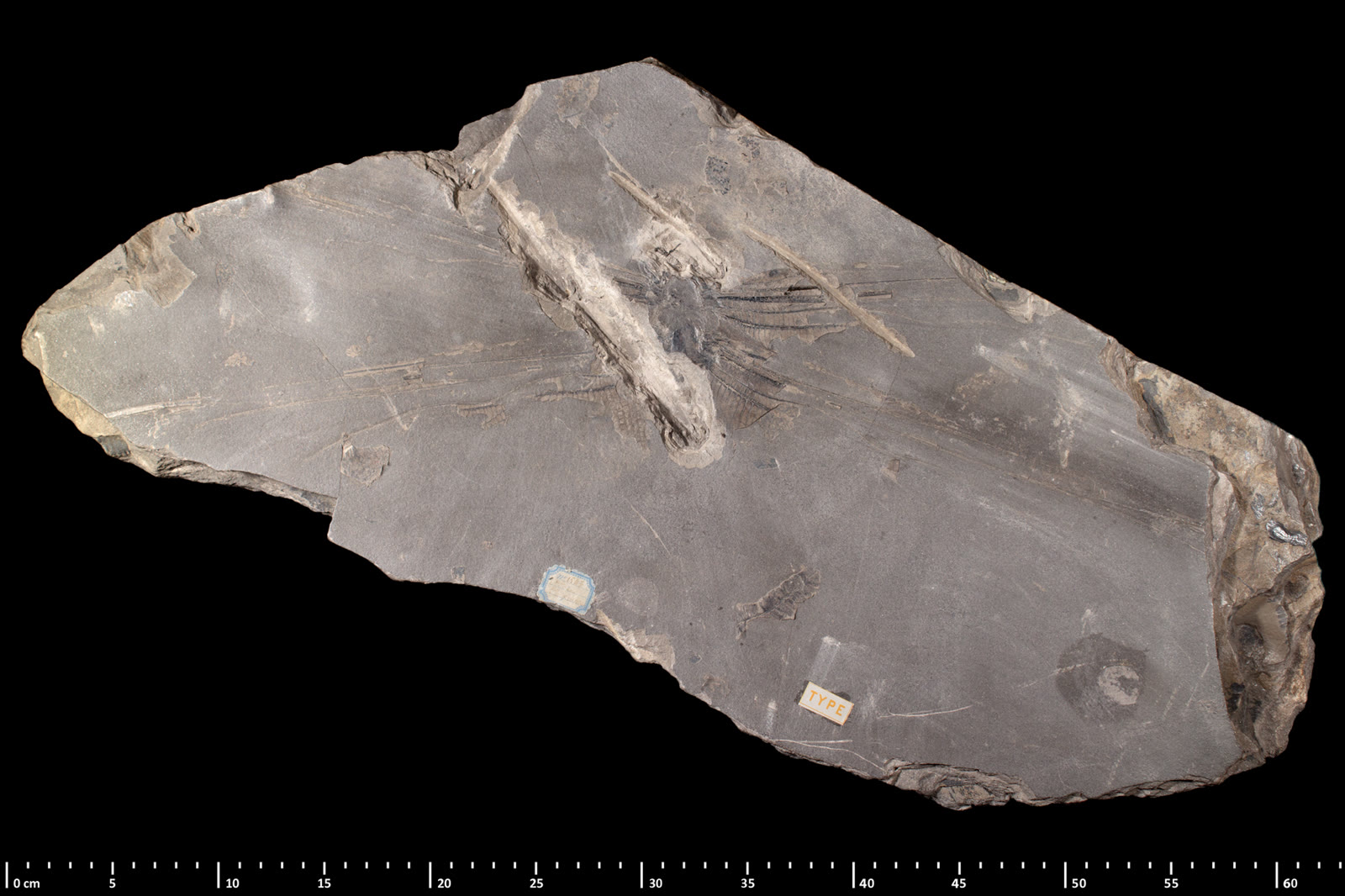
Meganeura monyi usually enters popular memory in the least helpful possible way: as the giant dragonfly from the Carboniferous, proof that ancient oxygen made insects enormous.[1][4] That shorthand survives because the animal really was huge. The Muséum national d'Histoire naturelle in Paris gives the wingspan at 70 cm, places the fossil in the Upper Carboniferous, and ties it to the coal basin of Commentry in France, where spectacular fossil insects began turning up in quantity in the late nineteenth century.[1] But the shorthand also flattens the species into one metric and one explanation. A stronger profile keeps three different things apart: what sort of insect Meganeura actually was, what its family-level anatomy suggests about how it hunted, and what oxygen can and cannot explain about its size.[1][2][3][4]
That separation matters because the fossil itself is narrower than the legend built around it. The Paris collection page emphasizes that the Commentry insects are unusually rich but still consist largely of complete individuals or isolated wings, and it notes that the material has been repeatedly revised as scientists rethought the affinities of these ancient insects.[2] Meganeura is famous, but it does not arrive as a perfectly preserved modern dragonfly scaled up to absurd proportions. It arrives as part of a historically important Carboniferous insect archive whose best evidence is concentrated in wings, venation, and comparative anatomy.[1][2]
Image context: the lead image uses a real photograph of the Meganeura monyi lectotype on Wikimedia Commons. It belongs here because this article argues against treating the animal as a free-floating icon of gigantism. The slab keeps the profile anchored to what the fossil actually preserves: a very large Commentry griffinfly known through an impression, not a complete cinematic body.[5]
The first correction is taxonomic: this was not a true dragonfly
The easiest upgrade in how to read Meganeura is to stop calling it a normal dragonfly with extra size.[1][3] Even museum pages still use "giant dragonfly" as public shorthand, because the resemblance is immediate.[1][2] The closer scientific reading is narrower. Meganeura belongs to the giant Paleozoic lineage traditionally called meganeurids, an extinct branch outside true Odonata even though it shared a broadly dragonfly-like predatory build.[3] That difference is not pedantic housekeeping. It changes what counts as a safe analogy.
The 2018 Scientific Reports paper on giant Paleozoic "dragonflies" makes this clear in functional terms. Petrulevicius and Nel argue that meganeurid flight was more similar to that of living dragonflies than to that of several other ancient flying insect groups, yet they also stress structural differences, including the absence of the nodal flexion system characteristic of true dragonflies.[3] In practice, that means Meganeura can be compared with modern dragonflies behaviorally and mechanically up to a point, but it should not be collapsed into them taxonomically. "Griffinfly" is the safer everyday word because it preserves both resemblance and distance.
The profile sharpens when size is attached to a hunting style
Size alone made Meganeura famous; predatory anatomy makes it scientifically legible. The best direct behavioral reconstruction in the current source set comes not from Meganeura monyi itself, which remains incompletely preserved, but from related meganeurids studied in detail by Petrulevicius and Nel.[3] Their paper describes forward-placed legs, strong tibial and tarsal spines, and large dorsally expanded eyes in Meganeurites, then argues that these giant insects functioned as open-space "hawkers" rather than dense-forest perchers.[3] The same paper explicitly treats still larger meganeurids such as Meganeura monyi from Commentry as the kind of predators that fit this aerial world.[3]
That family-level inference is stronger than the old monster image and weaker than a direct movie of Meganeura in flight, which is exactly where a good species profile should land. We can say that a 70 cm griffinfly from Commentry was not merely large in the abstract.[1][3] It belonged to a lineage whose preserved thorax, legs, and eyes point toward active interception of prey in open air, likely above lakes, rivers, ecotones, or open forest margins.[3] We should be more careful when the claim shifts from "predatory open-air flyer" to a detailed script about exact prey choice, daily activity rhythm, or precise maneuverability. The fossils support ecology in outline, not a documentary storyboard.
The Commentry collection helps here because it restores environmental scale. MNHN describes it as the world's largest series of fossil insects from that locality and notes that the old coal-mine deposits yielded hundreds of Carboniferous specimens across several lineages.[2] Meganeura is therefore best read not as a freak one-off but as part of a real insect fauna from a coal-swamp world rich enough to support very large aerial predators.[1][2]
Oxygen matters, but the fossil is stronger when oxygen is not asked to do everything
MNHN's specimen page gives the classic formulation with useful restraint: Meganeura's gigantism "could" be explained by higher Carboniferous oxygen content together with the absence of other flying predators.[1] That phrasing is worth keeping. It treats oxygen as a plausible cause without pretending one knob on the atmosphere explains the whole profile.
Clapham and Karr's 2012 analysis of more than 10,500 fossil insect wings is the right scale check.[4] Their result does not erase the oxygen story. It shows something more precise. Maximum insect size tracked atmospheric oxygen during the earlier part of insect evolution, but that relationship later weakened and then broke as biological factors, especially predation and competition from flying vertebrates, became more important.[4] In other words, hyperoxia remains a serious enabling framework for late Paleozoic giant insects, yet even in the broadest dataset it is not a timeless one-cause law.[4]
That is exactly the boundary a Meganeura profile needs. Oxygen likely helped make a griffinfly of this scale possible.[1][4] Oxygen alone does not tell you why the animal had this predatory build, why giant meganeurids occupied particular aerial habitats, or why "large dragonfly" became such a misleading label in the first place.[1][3][4] Once the profile is rebuilt around fossil identity, hunting ecology, and atmospheric context together, the species becomes more interesting and less mythic.
What the species profile can safely hold
The secure claims are already strong. Meganeura monyi was a very large Upper Carboniferous insect from Commentry, represented in the Paris collections by a famous lectotype and associated with one of the richest fossil insect archives in the world.[1][2] It was not a true dragonfly in the strict modern sense, but a giant griffinfly within Meganeuridae, close enough to dragonflies to support careful ecological comparison and distant enough to require taxonomic discipline.[3] The best family-level anatomical evidence points toward an open-air predatory mode built around visual hunting and prey capture in flight.[3] Atmospheric oxygen likely formed part of the size story, but broad comparative work shows that oxygen should be treated as an enabling condition interacting with ecological pressures, not as a total explanation.[1][4]
That is why Meganeura still holds its place. It was huge, yes. But the better reason to keep returning to it is that the fossil makes paleontology separate a famous silhouette into cleaner questions. What was the animal? What did its lineage likely do in the air? Which part of the size story belongs to physiology, and which part belongs to ecology? Once those questions are kept on separate rails, Meganeura monyi stops being just the Carboniferous giant insect and becomes a much sharper kind of species profile: a Commentry griffinfly whose scientific value is larger than its wingspan alone.
Sources
- Muséum national d'Histoire naturelle, "Meganeura monyi, libellule géante."
- Muséum national d'Histoire naturelle, "Fossil insect collection."
- Julian F. Petrulevicius and André Nel, "Palaeozoic giant dragonflies were hawker predators," Scientific Reports 8 (2018).
- Matthew E. Clapham and Jered A. Karr, "Environmental and biotic controls on the evolutionary history of insect body size," PNAS 109, no. 27 (2012), author-hosted PDF.
- Wikimedia Commons file page for the photographed Meganeura monyi lectotype used as the lead image.