Plateosaurus is often introduced as a "prosauropod," a label that does two different jobs at once. It places the animal near the base of the sauropodomorph story, and it quietly encourages the reader to imagine a half-finished sauropod waiting to drop onto all fours. The literature supports a better picture. Plateosaurus matters because several traits intensified together inside one Late Triassic herbivore: a long neck that enlarged feeding height, a hindlimb-dominant body that worked best in bipedal posture, a hand unsuited to weight support, and a growth pattern far more variable than a simple dinosaur ladder would suggest.[1][2][3][4]
That order matters because the taxonomic history is messy. Older functional papers often use Plateosaurus engelhardti; newer skull-focused work on the Frick, Trossingen, and Halberstadt material is framed as Plateosaurus trossingensis.[1][2][3][4] The name history should be noted, but it does not blur the main biological point. The best-known Central European Plateosaurus material keeps converging on the same body-plan signal: this was a large, common Late Triassic browser with its own locomotor and developmental logic, not a draft copy of later giant sauropods.[1][2][3][4][5]
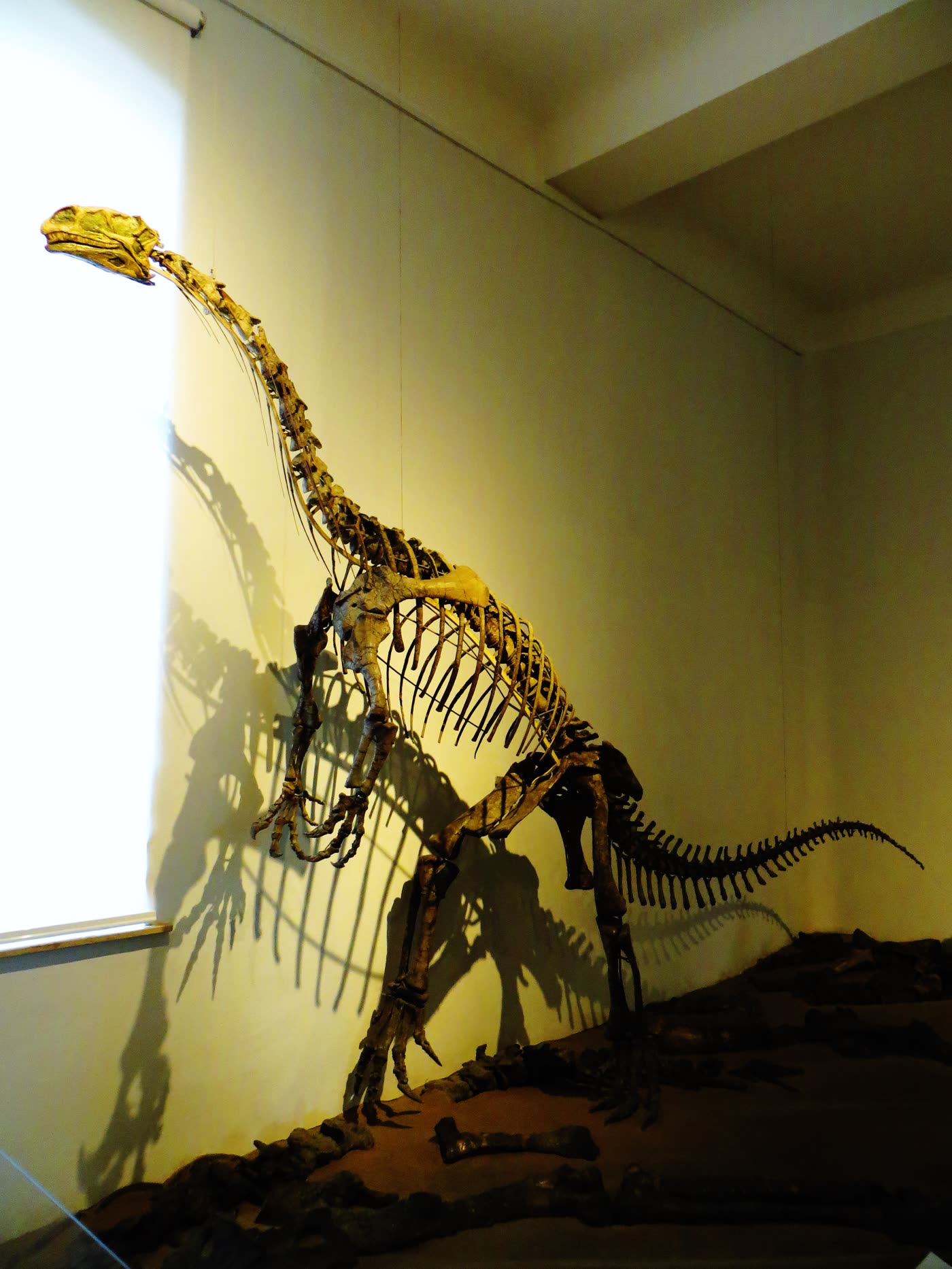
Image context: the cover uses a real Wikimedia Commons photograph of a mounted Plateosaurus skeleton in Tuebingen.[6] It fits this article because the pose makes the core claim visible before any interpretation starts. The torso is already deep, but the animal still carries itself over the hindlimbs, the hand hangs as a grasping structure rather than a hoof-like prop, and the long neck enlarges browsing reach without forcing a quadrupedal stance.
1) The first useful correction is bodily, not just taxonomic
Hofmann and Sander's 2014 PeerJ paper opens with a blunt reminder: Plateosaurus is the most abundant dinosaur in the Late Triassic of Europe and one of the best known basal sauropodomorphs, with remains from more than forty localities in Central Europe and Greenland.[3] That abundance matters because it keeps the profile from being built on one freak specimen. Plateosaurus is not interesting as a rare side branch with a weird silhouette. It is interesting because a widely distributed, repeatedly collected herbivore was already experimenting with body size and feeding height early in dinosaur history.[3]
The Frick museum context makes that concrete. Sauriermuseum Frick describes itself as the only museum in Switzerland showing a complete Plateosaurus skeleton recovered from the Frick clay pit.[5] That local concentration of bonebeds and associated skeletons is one reason the animal remains so informative. The profile is not being inferred from isolated teeth and a guess about posture. It comes from a fossil record rich enough to keep testing the same basic animal.
The 2021 Acta Palaeontologica Polonica skull paper sharpens the point in a different way.[4] New skull material from Frick more than doubled the known sample of Plateosaurus skulls, including the first known juvenile skulls, and the authors found no clean skull-based grouping that would split the Frick, Trossingen, and Halberstadt material into separate obvious species clusters.[4] This matters because it keeps variation inside the profile instead of letting every difference dissolve the animal into a taxonomic haze. A species with a broad sample can remain one species and still be highly variable.
2) The strongest Plateosaurus is a tall browser, not a slow proto-sauropod on all fours
Mallison's 2010 digital reconstruction is still the cleanest functional reset.[1] Using a complete mounted skeleton and CAD/CAE modeling, the paper argues that Plateosaurus was an obligate biped. The key contrast is not simply "two legs versus four." Mallison shows that quadrupedal models run into locomotor restrictions because of uneven limb lengths and limited forelimb motion, while also producing a smaller feeding envelope.[1] In other words, forcing Plateosaurus down onto all fours makes the animal worse at both movement and browsing.
That is the point that changes the whole silhouette. Once the body is read as hindlimb-led, the neck stops looking decorative and starts acting like a reach amplifier. Plateosaurus could enlarge feeding height without paying the full anatomical price later sauropods paid when quadrupedal mass and extreme neck length were locked together.[1] The species profile becomes clearer: this was an early large herbivore that solved browsing height with stance and proportion, not with a forelimb already remodeled into a column.
The tail matters here too, even if it gets less popular attention than the neck. A stable bipedal pose with a subhorizontal back depends on balance across the whole body.[1] The mounted skeleton makes that plain. The animal is not teetering upright like a movie tripod. It reads as a long-bodied, counterbalanced browser whose center of mass stayed compatible with habitual bipedality.
3) The hand finishes the argument by refusing to become a weight-bearing foot
Reiss and Mallison's 2014 manus study closes one of the oldest escape routes in the literature.[2] If Plateosaurus had really been comfortable as a quadruped, the hand should have looked and moved like a structure prepared to receive locomotor loads. The study found the opposite. The manus was not able to support the animal during quadrupedal locomotion and is better interpreted as a specialized grasping organ.[2]
That result is more important than it first sounds. It means the hand was not merely underbuilt for quadrupedality by accident. It had its own functional direction. A grasping forelimb paired with a long neck makes much more sense in an animal that feeds selectively at height, pulls vegetation inward, or stabilizes food during browsing than in one marching around as a small sauropod rehearsal.[1][2]
This is exactly where the profile becomes stronger than the old "prosauropod" stereotype. The stereotype implies indecision, as if Plateosaurus had not yet chosen a locomotor plan. The hand suggests the opposite. Once the forelimb is read as non-locomotor, the animal looks committed. Hindlimbs do the carrying. The neck expands the feeding zone. The hand remains available for grasping rather than collapsing into a front foot.[1][2]
4) Growth variability is part of the biology, not just a nuisance in the sample
The second major reason Plateosaurus still matters is developmental plasticity. Hofmann and Sander's juvenile material from Frick supports the idea that ontogenetic stage and body size did not track each other in a neat one-line way.[3] Juvenile neural arches with unfused neurocentral sutures could already belong to individuals whose estimated body lengths exceeded those of many adults.[3] That is a striking result because it means size alone was a poor guide to maturity.
This has a real payoff for the species profile. Early large herbivory in dinosaurs was not being assembled through one rigid growth schedule.[3] A Plateosaurus population could contain animals of broadly different sizes at similar developmental stages, which makes the taxon feel less like a standardized factory model and more like a lineage with flexible life-history pacing. The 2021 skull study helps because it shows that high variation does not automatically require multiple species.[4] Some of what older readers might have treated as taxonomic fragmentation can stay inside one biologically variable animal.
That boundary matters. The evidence does not license every dramatic claim ever made about Plateosaurus. It does not prove exact social structure, precise browsing plant lists, or a single universal growth curve for every bonebed. What it does support is narrower and better: Plateosaurus combined height, bipedality, a grasping non-locomotor hand, and developmental variability in a way that makes early sauropodomorph herbivory look more experimental and more self-sufficient than the old transitional cliché allows.[1][2][3][4]
5) Why the animal still reads as an early solution, not a preliminary draft
Put the evidence back into one frame and the profile sharpens. Plateosaurus was a common Late Triassic Central European sauropodomorph whose best-supported reconstruction is a habitual biped with a large feeding envelope, a non-pronating non-weight-bearing hand, and a growth pattern marked by unusual plasticity.[1][2][3] The expanding skull sample from Frick, Trossingen, and Halberstadt shows that this variability can be studied inside a broad, coherent taxonomic sample rather than discarded as noise.[4]
That is why the species should be read on its own terms. Plateosaurus is not important because it foreshadows sauropods in a vague way. It is important because it shows one earlier solution to the large-herbivore problem: stay tall, keep the forelimb free, browse with reach, and tolerate a developmental schedule looser than later textbook diagrams tend to imply. Read that way, the animal stops looking unfinished. It starts looking inventive.
Sources
- Heinrich Mallison, "The Digital Plateosaurus I: Body mass, mass distribution and posture assessed using CAD and CAE on a digitally mounted complete skeleton" (2010), Palaeontologia Electronica.
- Stefan Reiss and Heinrich Mallison, "Motion range of the manus of Plateosaurus engelhardti von Meyer, 1837" (2014), Palaeontologia Electronica.
- Rebecca Hofmann and P. Martin Sander, "The first juvenile specimens of Plateosaurus engelhardti from Frick, Switzerland: isolated neural arches and their implications for developmental plasticity in a basal sauropodomorph" (2014), PeerJ.
- Jens N. Lallensack, Elzbieta M. Teschner, Ben Pabst, and P. Martin Sander, "New skulls of the basal sauropodomorph Plateosaurus trossingensis from Frick, Switzerland: Is there more than one species?" (2021), Acta Palaeontologica Polonica.
- Sauriermuseum Frick, "Plateosaurus" exhibition page - museum context for the Frick clay-pit finds and the complete skeleton on display.
- Wikimedia Commons file page for the mounted Tuebingen Plateosaurus photograph used as the article image, "File:Plateosaurus engelhardti Tubingen.JPG".