Allosaurus fragilis is one of those dinosaurs that public memory smooths too quickly. It arrives as the default Jurassic carnivore: big head, big teeth, fast legs, and a permanent starring role in any ecosystem that predates Tyrannosaurus. That outline is recognizable, but it is too blunt for the fossil evidence. Allosaurus matters because several lines of evidence pull in the same direction at once. The skull was comparatively light and open yet mechanically strong, the neck contributed directly to feeding, the teeth were replaced on a rapid schedule, and the Cleveland-Lloyd material lets paleontologists study the species as a population rather than as one famous skeleton.[1][2][3][4][5]
That combination is why the animal still feels scientifically alive. In the Late Jurassic of North America, roughly 155 to 145 million years ago, Allosaurus was not just another large theropod moving through the Morrison Formation.[5] It was common enough, and preserved well enough, that the taxon became a testing ground for how paleontologists connect anatomy to behavior without drifting into cinematic certainty. The best profile does not ask whether Allosaurus looked frightening. It asks what kind of predator the bones can actually defend.
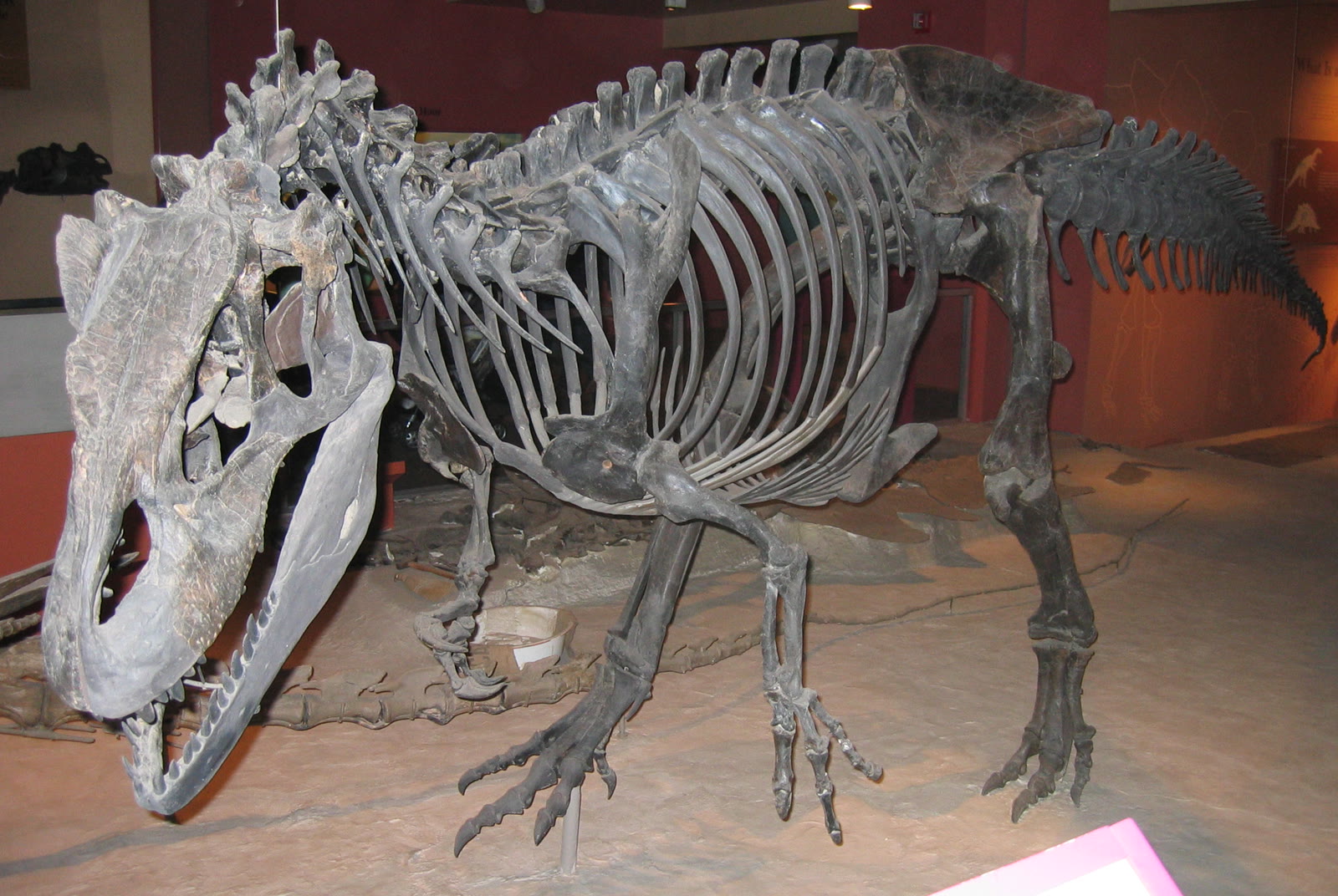
Image context: the cover uses a real photograph of the Smithsonian's mounted Allosaurus fragilis specimen USNM 4734 from Wikimedia Commons. It fits this article because the argument depends on the body staying integrated. The head is long rather than blocky, the forelimbs are short but usable, the torso is deep, and the tail counterbalances the whole front end. You can see immediately that this was not a bone-crushing tyrannosaur built in advance. It was another predatory solution.[6]
1) The skull was not built for brute force alone
Rayfield and colleagues' 2001 Nature paper remains the cleanest starting point for the head.[2] Their finite-element model did not turn Allosaurus into a weak predator. It did something more useful. It showed a combination that would have been hard to guess from the silhouette alone: a relatively weak muscle-driven bite, a very light and open skull architecture, and unusually high cranial strength.[2] That is not the profile of an animal whose entire feeding logic depended on one overwhelming clamp.
Once that mechanical combination is in view, the skull starts making more sense. A predator with a lighter skull can move the head quickly; a predator with a strong skull can still survive high loads; a predator with recurved, serrated teeth does not need to pulverize bone the way a later tyrannosaur might.[1][2] The head of Allosaurus reads better as a cutting and impact structure than as a living vise.
That interpretation tightened again in Snively and colleagues' 2013 multibody dynamics work.[3] Their model argued that a feeding style involving avian-raptor-like head retraction during defleshing was more plausible than crocodile-style side-to-side shake feeding.[3] In that reading, the neck matters as much as the jaws. Allosaurus did not merely close on prey and wait for bite force to finish the job. It could drive the head downward and backward, using the skull and neck together as a cutting system.[2][3]
This is the first reason the species profile has to stay disciplined. The famous face is real evidence, but it only becomes informative when it is read together with the rest of the feeding apparatus. The wrong reading turns Allosaurus into a generic big theropod. The stronger reading turns it into a predator whose head and neck shared the work.
2) The teeth were consumable tools, not permanent weapons
Madsen's 1976 revised osteology made Allosaurus anatomically legible at a scale that later biomechanical work could actually use.[1] The jaws are full of recurved, serrated teeth, but the animal's dental system becomes more interesting once replacement enters the story. Teeth in theropods were not irreplaceable blades; they were structures expected to wear, break, and return.
D'Emic and colleagues' 2019 PLOS ONE study sharpened that point by estimating theropod tooth replacement rates from a large CT and histological dataset.[4] For Allosaurus, the replacement interval comes out at about 100 days.[4] That figure matters because it matches the rest of the feeding picture. A predator using repeated strike-and-pull feeding with serrated teeth would impose real wear on the dentition. Rapid turnover makes that strategy sustainable.
This does not mean every tooth was disposable in a casual sense, or that paleontologists can reconstruct a one-size-fits-all feeding sequence for every carcass or prey item. It does mean that the mouth of Allosaurus was a renewable working edge.[1][4] The animal was not carrying a single set of perfect knives that had to survive unchanged for years. It had a production schedule.
That is easy to underrate because popular reconstructions tend to freeze dinosaur mouths into one dramatic instant. The fossil evidence supports a more dynamic system. Skull design, tooth form, and tooth replacement all belong to the same predatory economy.[1][2][4]
3) Cleveland-Lloyd matters because it gives us a species, not just a star skeleton
The Cleveland-Lloyd Dinosaur Quarry is one of the reasons Allosaurus became more than an icon.[1][5] The Bureau of Land Management's quarry brochure summarizes the basic fact pattern clearly: more than 12,000 bones have been excavated there, Allosaurus makes up 67% of the collection, many of the individuals are juvenile or adolescent, and the deposit preserves disarticulated bones rather than neat articulated skeletons.[5]
Those details change how the species can be studied. A quarry dominated by one predator and filled with scattered material is not only a dramatic fossil site. It is a population-level resource. Madsen's osteology drew heavily on abundant Cleveland-Lloyd material while also using more articulated guidance to build a coherent reconstruction.[1] The result was not simply another dinosaur monograph. It was a platform for later work on cranial mechanics, feeding, growth, and variation.[1][2][3][4]
This is also where a useful boundary should stay in place. The quarry has inspired multiple explanations, including predator-trap scenarios, drought or other mortality events, and more complicated taphonomic histories.[5] The abundance of Allosaurus does not automatically prove pack hunting, coordinated social behavior, or one simple death story. The strongest claim is narrower. Cleveland-Lloyd gave paleontology an unusually dense sample of a major Jurassic predator and therefore made that predator far easier to test.
That is a better kind of fame than pop culture usually offers. Instead of one celebrity skeleton standing in for the whole species, paleontologists got repeated bones, repeated age classes, and repeated chances to check whether the same anatomical pattern holds up.
4) What the species profile can defend
Put the evidence together and Allosaurus fragilis becomes much more specific than its poster-life suggests. It was a Late Jurassic allosaurid predator whose skull combined lightness with strength, whose neck likely helped pull flesh free during feeding, and whose teeth were replaced quickly enough to support a high-wear predatory system.[2][3][4] The Cleveland-Lloyd material then widened that picture from isolated anatomy to something closer to a species sample.[1][5]
The boundary layer matters just as much. This article does not prove that Allosaurus always hunted large sauropods, does not prove pack behavior, and does not collapse every Morrison Formation theropod interaction into one feeding script. It makes a more defensible claim. Allosaurus works best when read as a mechanically integrated predator, not as a generic Jurassic placeholder.[1][2][3][4][5]
That is why the species still matters. The public remembers the head. The science keeps improving because the head never worked alone.
Sources
- James H. Madsen Jr., Allosaurus fragilis: A Revised Osteology (Utah Geological and Mineral Survey Bulletin 109, 1976).
- Emily J. Rayfield, David B. Norman, Celeste C. Horner, John R. Horner, Paula May Smith, Jeffrey J. Thomason, and Paul Upchurch, "Cranial design and function in a large theropod dinosaur" (2001), Nature.
- Eric Snively, John R. Cotton, Ryan Ridgely, and Lawrence M. Witmer, "Multibody dynamics model of head and neck function in Allosaurus (Dinosauria, Theropoda)" (2013), Palaeontologia Electronica.
- Michael D. D'Emic, Patrick M. O'Connor, Tyler R. Pascucci, Jacob Gavras, Erdenebileg Mardakhayava, and Elizabeth K. Lund, "Evolution of high tooth replacement rates in theropod dinosaurs" (2019), PLOS ONE.
- Bureau of Land Management, Cleveland-Lloyd Dinosaur Quarry brochure — quarry composition, bone count, and site summary.
- Wikimedia Commons file page for the Smithsonian Allosaurus fragilis USNM 4734 photograph used as the lead image.