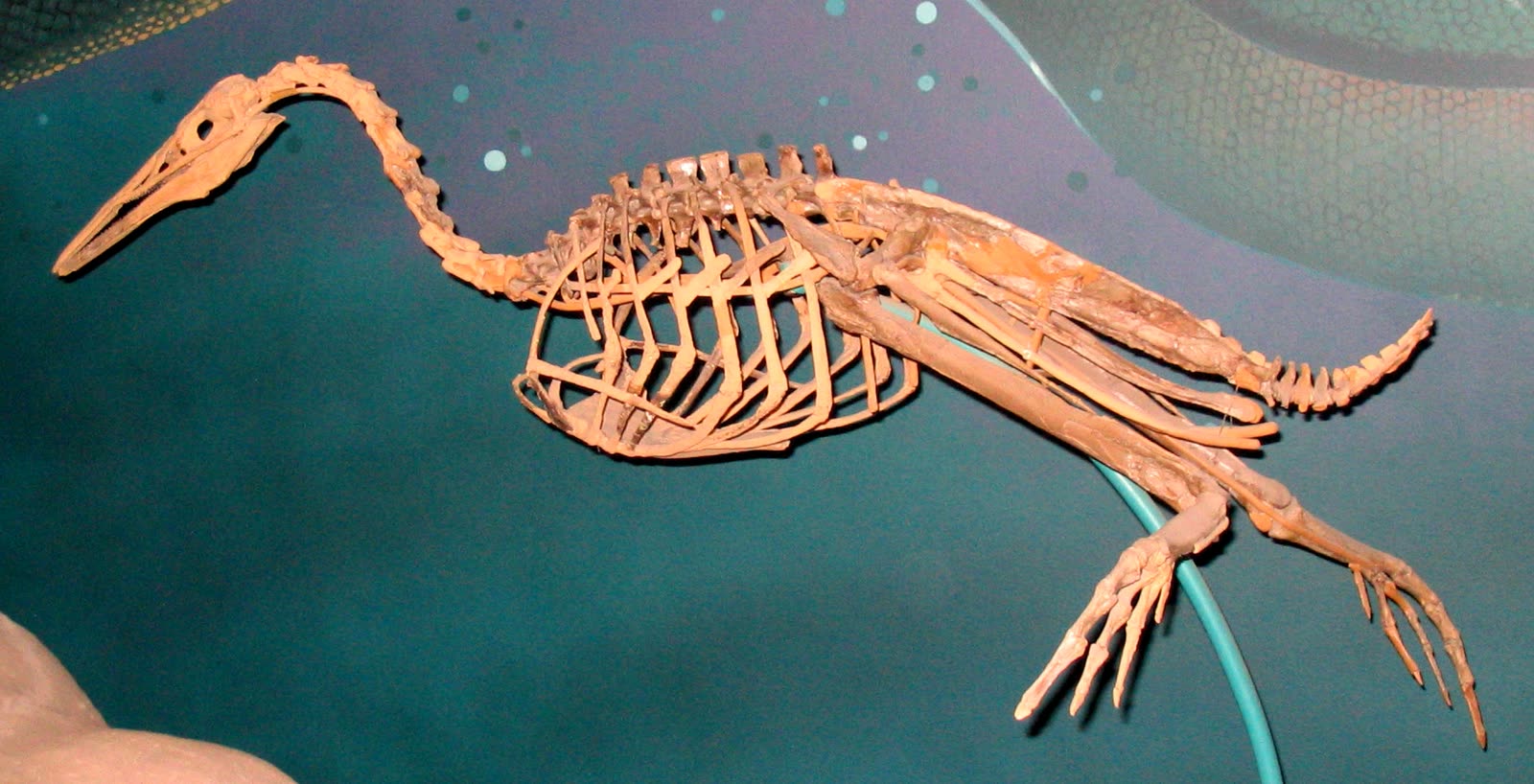
Hesperornis usually arrives with the wrong headline attached. People remember the teeth first because teeth in a bird sound like a Victorian provocation, a fossil built to irritate the border between birds and reptiles.[3][5] That historical reaction was real, and it mattered. But if the goal is to understand what kind of animal Hesperornis actually was, the better place to start is lower in the skeleton. The deep story sits in the pelvis, knee, ankle, and toes. Those are the structures that turned this Late Cretaceous bird into a serious foot-propelled diver.[1][2]
The order of discovery itself makes that point clearer. As Daniel Brinkman recounts in the Yale Peabody history of the 1872 skull find, Marsh had already named Hesperornis regalis from earlier Kansas material that lacked a skull, and he had already inferred a large, flightless, foot-propelled swimmer and diver from the postcranial remains.[5] The skull with teeth sharpened the evolutionary significance. It did not create the aquatic body plan. In that sense the nineteenth-century drama still offers the right reading method in 2026: the teeth explain why Hesperornis became famous, while the hindlimb explains how it lived.[5][6]
Image context: the cover uses a real photograph of the mounted Smithsonian skeleton, via Wikimedia Commons. That choice matters because this article is about whole-body mechanics rather than paleoart atmosphere. The reduced wings and heavy rear propulsion system are visible at a glance, which is exactly the evidence order the article is asking for.[7]
The real transformation happened behind the hips
The 2022 review of hesperornithiform birds is useful because it strips away the legend and lays out the bauplan.[1] Across the clade, and especially in derived forms such as Hesperornis, the pelvis is elongated, the preacetabular ilium expands forward, the femur becomes relatively short, and the tibiotarsus grows long.[1] Those are not decorative differences. They are the architecture of a bird that has shifted the burden of propulsion almost entirely onto the hindlimb.
That shift matters because Hesperornis did not solve water the way penguins did. Penguins turned the forelimb into an underwater wing. Hesperornis moved the heavy work backward.[1][2] Its wings shrank toward near-uselessness for flight, while the trunk and hindlimb became the main locomotive system.[1][5] Once that layout is in view, the famous teeth lose their monopoly over the story. Teeth can tell you something about ancestry and feeding. They do not tell you why the whole bird reads like a machine organized around rear-thrust swimming.
The North Dakota state fossil sheet gives the plain-language version: Hesperornis was a large, diving, fish-eating bird from the Western Interior Seaway, with powerful legs and reduced wings.[6] The scholarly review gives the mechanism behind that summary. By the middle to late Late Cretaceous, hesperornithiforms had already moved deep into a foot-propelled diving pathway, and Hesperornis sits near the specialized end of that experiment.[1] That is the real anatomical news.
The ankle and toes make the animal legible
Zinoviev's hindlimb study is where the skeleton starts to behave like a moving system rather than a museum silhouette.[2] The abstract alone is revealing. He reconstructs Hesperornis regalis as combining loon-like tarsometatarsal movements with grebe-like toe movements and argues that the intertarsal joint had a high degree of rotational freedom.[2] The payoff is not that Hesperornis was secretly a loon or a grebe. The payoff is that it arrived at its own underwater solution by mixing traits that in living birds are split across different diving lineages.[2]
That matters because public reconstructions often flatten extinct birds into nearest-living analogies. Hesperornis resists that shortcut. Zinoviev's conclusion that it became the most specialized avian foot-propelled diver known is strong precisely because it does not describe a crude half-finished modern bird.[2] It describes an independent Mesozoic solution. The rear of the body handled propulsion, the ankle tolerated rotational complexity, and the toes likely carried asymmetrical lobes that helped manage the stroke through water.[2]
Read that way, the skeleton becomes much easier to understand. The long trunk is not dead weight trailing behind a toothed head. It is part of a body balanced around rear propulsion. The reduced forelimbs are not just an evolutionary leftover. They are evidence that this bird had already committed to a different operating logic from the one that later made penguins so successful.[1][2]
The teeth still matter, but in a narrower way
The teeth are not trivial. They remain one of the reasons Hesperornis mattered so much in the history of evolutionary thought, and modern work keeps finding that they are anatomically stranger than the old shorthand suggested.[3][5] Dumont and colleagues used synchrotron imaging to show that Hesperornis teeth had fully thecodont-style root attachments, but that secondary loss of periodontal ligaments left the teeth implanted in a groove.[3] In other words, the familiar phrase "toothed bird" is correct, yet it still conceals a specifically hesperornithiform dental system rather than some generic reptilian carryover.[1][3]
The skull adds another layer of refinement. Bühler and Martin's 1988 paper argued that Hesperornis had prokinesis in the upper jaw and rejected older ideas that would have made hesperornithid skull mechanics more lizard-like.[4] That paper does not turn the animal into a modern seabird with extra teeth. It does something better. It shows that a bird can retain teeth and still carry cranial mechanics that belong inside avian evolution rather than outside it.[4]
That is why the teeth need to be kept in their place. They are historically dramatic, developmentally interesting, and taxonomically informative.[3][4][5] But they are not the structure that most clearly explains what Hesperornis was doing in the water. The locomotor system still carries that burden more heavily than the jaws do.[1][2]
What the strongest anatomy-first reading can say
The secure picture is already vivid. Hesperornis regalis was a large Late Cretaceous diving bird of the Western Interior Seaway with reduced wings, a highly specialized hindlimb, and teeth retained in a uniquely modified implantation system.[1][2][3][6] Its fame began with the shock value of toothed birds and the way those fossils helped nineteenth-century arguments about evolution.[5] Its long scientific afterlife, however, rests on something more specific: a body plan that pushed avian swimming hard in the direction of foot propulsion.
The limits are useful too. The literature does not license a lazy one-line equation with loons, grebes, or penguins.[1][2] Those comparisons help because they expose pieces of the mechanism. They stop helping when they erase how odd the full package was. Hesperornis belongs to a branch of bird evolution that took diving seriously enough to give up flight, rework the pelvis and lower limb, and let the head keep ancestral teeth without making those teeth the whole point.[1][2][3][4]
That is the version worth keeping. Hesperornis was not compelling because it put teeth in a bird. It was compelling because a bird with teeth became, through the harder evidence of pelvis and hindlimb, one of the clearest demonstrations that avian evolution had already begun to explore fully aquatic life on its own terms.[1][2][5]
Sources
- Martin, Bell, Case, and Kurochkin, "The Hesperornithiformes: A Review of the Diversity, Distribution, and Ecology of the Earliest Diving Birds," Diversity 14, no. 4 (2022).
- Andrei V. Zinoviev, "Notes on the hindlimb myology and syndesmology of the Mesozoic toothed bird Hesperornis regalis (Aves: Hesperornithiformes)," Journal of Systematic Palaeontology 9, no. 1 (2011).
- Marc Dumont et al., "Synchrotron imaging of dentition provides insights into the biology of Hesperornis and Ichthyornis, the 'last' toothed birds," BMC Ecology and Evolution (2016).
- Paul Bühler and Larry D. Martin, "Cranial Kinesis in the Late Cretaceous Birds Hesperornis and Parahesperornis," The Auk 105, no. 1 (1988).
- Daniel Brinkman, "Rare as hens' teeth" — Yale Peabody / Yale Alumni Magazine on the 1872 Hesperornis skull discovery and its evolutionary afterlife (2022).
- North Dakota State Fossil Collection, "Hesperornis regalis" species sheet PDF.
- Wikimedia Commons file page for the photographed Hesperornis regalis skeleton used as the lead image.