

Petrified Forest National Park is easy to misread. The popular image is a supernatural one: a whole forest paused in place and turned to stone by time alone. The three videos in this collection push toward a better paleontological reading. The park's logs matter because they sit inside a much larger evidence chain that begins with Late Triassic rivers, continues through burial and silica-rich mineralization, and only becomes science when specimens remain tied to their field context.[1][2][3][4][5][6][7][8]
That wider frame matters because the park is not just a scenic pile of mineralized trunks. The National Park Service describes Petrified Forest as one of the best exposed and most continuous records of Triassic rocks anywhere, deposited by enormous rivers between roughly 228 and 208 million years ago.[4][5] Those Chinle Formation deposits hold plant fossils, vertebrate fossils, and some of the world's most famous concentrations of petrified wood.[4][5] In other words, the logs are not isolated curiosities. They belong to a river-basin archive from the dawn of dinosaurs.[4][5]
Seen in sequence, these videos organize the site into three stages. The first makes the park legible as a fluvial landscape rather than a magic grove.[1][4][7] The second explains how wood survives by mineral replacement and infilling instead of by simple durability.[2][8] The third shows why a fossil still needs mapping, collection, and curation before it can answer serious questions about Late Triassic ecosystems.[3][4][5] That sequence is the real reason to curate them together. A petrified log becomes evidence only when geology, chemistry, and field practice stay linked.
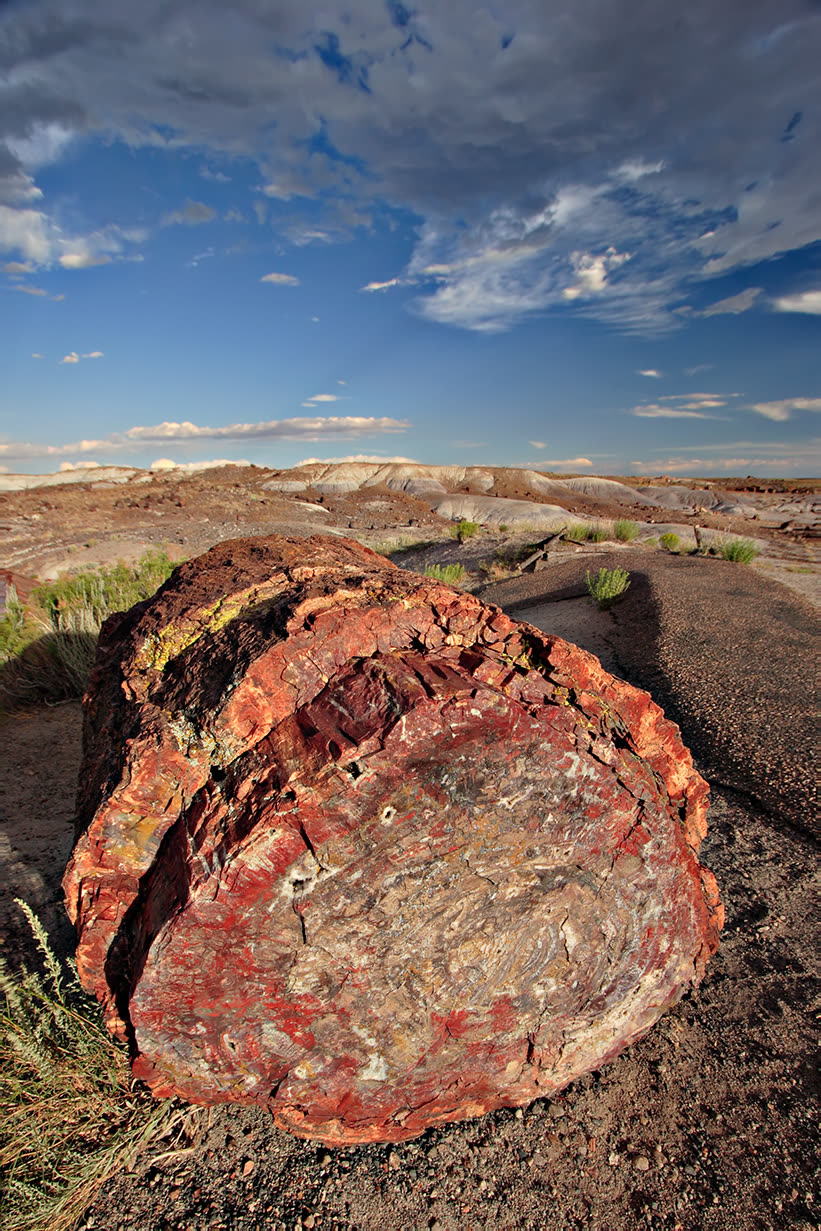
Image context: the cover uses a real Wikimedia Commons photograph of petrified logs from Petrified Forest National Park.[9] It is the right lead image because this article is not about an abstract mineral process. It is about colorful, broken, river-worked trunks that still carry their history on the surface.
Video 1: the park makes more sense as a river archive than as a frozen forest
The short NPS video Park Paleontology; Explained is the best opening because it widens the scale immediately.[1] Instead of treating petrified wood as a self-contained marvel, it places the viewer inside a Late Triassic research landscape where bone, leaf, wood, and sediment all have to be read together. That is the right first move. The park's fame begins with wood, but the science begins with the Chinle Formation as a whole.[1][4][5]
The written sources sharpen that setting. The NPS Geodiversity Atlas notes that Petrified Forest protects more than 700 paleontological sites and that the park's badlands, mesas, and buttes record fluvial deposition in an ancient river basin.[4] The park paleontology page adds the same deep-time anchor in plainer language: these rocks were laid down by enormous rivers and now preserve an unusually diverse Triassic fossil record.[5] Once those two facts are in place, the logs stop looking like detached objects. They start reading as survivors of a transport-and-burial system.
The Giant Logs page makes that point even harder. One of the park's signature concentrations of wood is described explicitly as an ancient log jam in a Late Triassic river, preserved in the Sonsela Member of the Chinle Formation.[7] That matters because it corrects a common visual mistake. Visitors often read the park as if it were a woodland preserved where it grew. Some plant fossils in the park do remain close to where they lived, especially in floodplain and marsh settings, but the biggest showpiece wood concentrations also record river sorting, accumulation, and burial.[6][7] The first video works because it keeps the park open as a landscape problem instead of reducing it to collectible chunks of rainbow stone.
Video 2: petrification is a mineral pathway, not a fairy-tale pause button
How Trees Get Petrified is the collection's chemistry lesson, but it matters because it also disciplines the language.[2] "Turned to stone" is acceptable shorthand only if the reader remembers how much physical history is hidden inside that phrase. Wood does not simply endure for 200 million years. It has to be buried, protected from oxygen-rich decay, and then transformed by mineral processes that preserve shape while replacing or filling original tissues.[2][8]
The Library of Congress explanation is useful here because it breaks petrification into two linked mechanisms: permineralization, in which minerals fill pores and spaces, and replacement, in which organic material dissolves and is substituted by inorganic minerals.[8] In wood, cellulose breaks down first while lignin holds the structure longer, giving mineral-rich water time to preserve the architecture of the trunk.[8] Quartz, built from silica, is the most common mineral in petrified wood, while trace minerals help create the park's famous reds, yellows, and purples.[8]
That is why the color and breakage of the logs belong inside the science, not outside it. The same Library of Congress page notes that the park's logs often snap into blocky chunks because the mineralized material is hard but brittle under geologic stress.[8] Read together with the river-log-jam context from Giant Logs, the wood stops looking ornamental.[7][8] These trunks are evidence of burial, chemistry, compaction, and later erosion. The second video earns its place by turning the park's prettiest surface effect into a fossilization argument.
Video 3: collection context keeps a fossil from collapsing into scenery or souvenir
The Burke Museum's Collecting Fossils at Petrified Forest National Park closes the set well because it returns the story to method.[3] By the time the third video appears, the reader already knows that the park is a river-basin archive and that petrification is a mineral process. The remaining question is how a spectacular object becomes a useful specimen. The answer is field context: exact locality, stratigraphic position, associated fossils, and the slow museum work that preserves those relationships instead of stripping them away.[3][4][5]
This is where the park's scientific strictness becomes visible. The NPS fossil and paleontology pages keep emphasizing that Petrified Forest is not just a display ground; it is an active research landscape in which fossils and surrounding rocks together tell the story of ancient ecosystems.[4][5] The taphonomy page pushes the same point from another angle. It distinguishes among transported log concentrations, floodplain plant fossils that remained closer to where they grew, and vertebrate remains whose burial histories can be compared with modern analogs.[6] Those distinctions only survive if collection preserves provenance.
That is also why the third video is more important than a casual viewer might expect. A loose piece of petrified wood may still be beautiful, but once it is separated from formation, member, and associated sediment, much of its explanatory power thins out. Museum and park practice reverses that loss. The object is mapped, stabilized, compared, and placed back into a Late Triassic system.[3][4][5] The collection therefore ends on the right note: paleontology is not admiration alone. It is the discipline that keeps spectacular material attached to context.
What the three videos reveal together
Watched in sequence, the collection turns Petrified Forest from a visual wonder into a three-part scientific argument. The first video shows that the park is a Chinle river archive with transported log concentrations, floodplain deposits, and one of the richest Triassic records in North America.[1][4][5][7] The second explains how wood becomes stone through burial, mineral infilling, and replacement rather than through a vague miracle of age.[2][8] The third shows why the final unit of meaning is not the colorful log by itself, but the specimen-plus-context package assembled through field and museum work.[3][4][5][6]
That is the reading discipline worth carrying away. Petrified Forest's logs are famous because they are beautiful, but their paleontological force comes from a tighter combination of transport, chemistry, and curation. Hold those three together and the park stops looking like a cabinet of mineral curiosities. It becomes what it actually is: a deep-time river system that still knows how to teach.
Sources
- PetrifiedForestNPS, "Park Paleontology; Explained," YouTube video.
- PetrifiedForestNPS, "How Trees Get Petrified," YouTube video.
- Burke Museum, "Collecting Fossils at Petrified Forest National Park," YouTube video.
- National Park Service, "NPS Geodiversity Atlas—Petrified Forest National Park, Arizona."
- National Park Service, "Paleontology - Petrified Forest National Park."
- National Park Service, "Taphonomy—Death & Decay."
- National Park Service, "Giant Logs."
- Library of Congress, "What is Petrified Wood?"
- Wikimedia Commons, "File:Petrified forest log 1 md.jpg" - source page for the lead image.