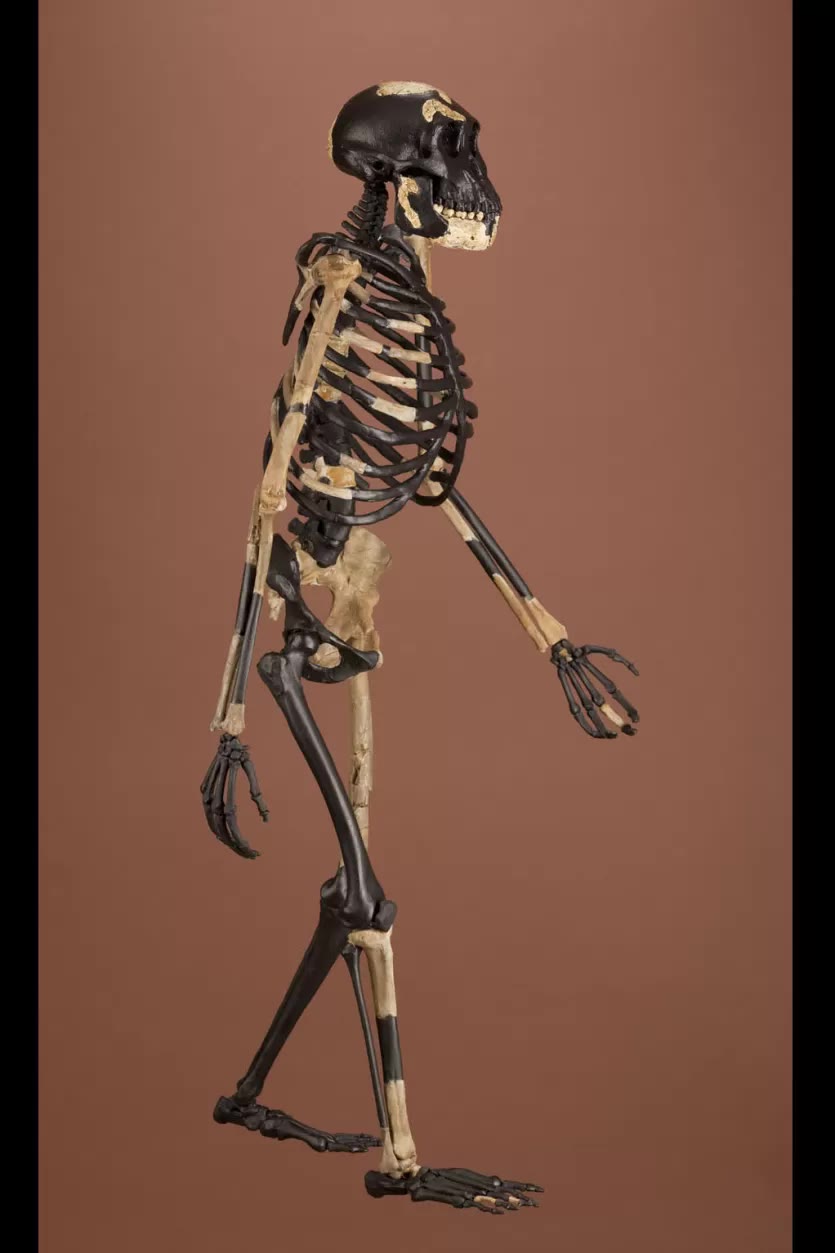
Lucy is too famous for her own good.[1][2][3] Once a fossil becomes an icon, readers start remembering the nickname instead of the anatomy. In Lucy's case that flattening is especially misleading. The real scientific force of AL 288-1 is not that she was "40 percent complete" in some abstract museum-label sense.[1][2][3] It is that one small adult skeleton from Hadar locked several locomotor signals into the same body: a short broad pelvis, an inward-angled femur and knee built for balancing over one leg at a time, spinal features tied to upright posture, and an ankle-foot complex moving away from ape-like grasping.[1][2][3][4] At the same time, the upper body did not quietly become human. The arms remained long, the thorax stayed more ape-like than ours, and later structural work on Lucy's limb bones kept substantial climbing ability in the picture.[1][3][5][7]
That mixed package is why the fossil still deserves a close reading in 2026. Lucy did not matter because she made the human story neat. She mattered because she made it harder to keep two old expectations alive at once. One was the idea that large brains had to come first. The other was the hope that once bipedality arrived, the upper body would immediately fall into a recognizably modern pattern.[1][4][5] Lucy broke both simplifications. She preserved a body that was already committed to habitual upright walking on the ground, yet still carried enough arboreal signal that the tree never fully leaves the scene.[1][2][3][7]
Image context: the lead image uses the Smithsonian's photographed reconstruction of Lucy in side view. That choice fits the article because the central claim depends on seeing multiple regions at once. A pelvis or knee in isolation would make the bipedality point, but only a whole-body view shows why Lucy remains a mosaic rather than a finished modern walker.[1]
The fossil is strongest as one individual, not as a bag of famous fragments
The first thing to remember is how unusually integrated the specimen is. Lucy was found at Hadar in Ethiopia in 1974, and after excavation the team recovered several hundred fragments, 47 of which formed part of a single hominin skeleton representing about 40 percent of the body.[2][3] The bones showed no duplication, which is the key taphonomic fact here: this was not a mixed sample later romanticized into an individual.[2][3] It was one young adult female, around 3.18 million years old, small-bodied even for her species, but anatomically dense in exactly the regions paleoanthropologists needed.[1][2][3]
That density matters because locomotion arguments usually fail when evidence is scattered across too many bodies. A pelvis from one individual, a knee from another, and a vertebra from a third can still be informative, but they always leave room for taxonomic doubt, size differences, sex differences, and simple over-assembly. Lucy narrowed that gap. Her lower jaw and skull fragments said one thing about head size and face. Her ribs and vertebrae said something about trunk form. Her pelvis, femur, and knee made the terrestrial argument. Her humerus and limb proportions refused to let the tree disappear.[1][2][3][5][7]
In that sense Lucy is best read as a conjunction fossil. The celebrity often attaches to completeness alone, but completeness is only valuable when the preserved parts answer the same question from different directions. Lucy does exactly that.
The lower body had already crossed the bipedality threshold
The cleanest evidence sits below the waist. The Institute of Human Origins summary is direct: Lucy's distal femur is angled relative to the knee joint surfaces in a way that lets a biped balance on one leg during stride, her patellar region helps stabilize the kneecap under that geometry, and her condyles are enlarged for the weight transfer that comes with habitual two-legged locomotion.[2] The pelvis tells the same story from another angle. It is not a modern human pelvis in every detail, but it is remodeled for upright stance and for balancing the trunk over a single supporting limb with each step.[2][3]
This is why Lucy still matters more than a generic slogan like "she walked upright." Bipedality is not one trait. It is a mechanical coalition. The knee has to bring the body over the foot. The pelvis has to reorganize trunk stabilization. The vertebral column has to manage permanent upright posture. The ankle-foot system has to stop behaving primarily like a grasping structure and start behaving like a weight-bearing propulsive one.[1][2][3][6] Lucy does not preserve every one of those parts perfectly, but she preserves enough of the coalition that the lower body cannot be honestly read as an ape body with a few suggestive hints attached.
The older literature already understood how disruptive this was. Johanson and White's 1979 assessment argued that the Hadar and Laetoli material demanded a distinct species, Australopithecus afarensis, precisely because the fossils combined apelike and humanlike features in a coherent early hominin package.[4] Jungers then used Lucy's limb proportions to show that ancestral hominid locomotion could not simply be modeled as a scaled-down version of either a modern ape or a modern human.[5] Lucy mattered because the lower body had moved decisively toward terrestrial bipedality without waiting for the rest of the skeleton to become familiar.
The upper body keeps the fossil from collapsing into a modern-human rehearsal
If the article stopped at the pelvis and knee, it would miss the hardest part of Lucy. Smithsonian's AL 288-1 page and the Natural History Museum overview both stress the upper-body remainder: long arms, a strong upper arm musculature signal, and a more ape-like trunk and ribcage than our own.[1][3] Those features are not decorative leftovers from a previous life. They are part of the locomotor interpretation.
That is where later structural work becomes useful. Ruff and colleagues used CT-based analysis of Lucy's humeri and femur to argue that although her lower limbs reflect regular bipedal loading, her upper limbs remained more robust than those of modern humans, consistent with substantial climbing activity.[7] This does not reverse the walking evidence. It sharpens it. Lucy was not a knuckle-walker on the way to humanity, but neither was she a stripped-down modern hiker accidentally trapped in Pliocene sediments.[5][7]
The boundary matters because popular retellings often demand a clean winner in the old "ground versus trees" argument. Lucy is stronger than that false choice. Her body suggests that habitual bipedality on the ground was already established, while arboreal competence remained behaviorally important enough to leave structural traces in the upper skeleton.[1][2][3][7] That is a more interesting evolutionary picture anyway. Major transitions do not usually erase old capacities in one stroke. They redistribute emphasis.
Lucy changed the argument because the body is mixed in a disciplined way
Later A. afarensis discoveries help show just how disciplined that mixture was. The complete fourth metatarsal from Hadar described by Ward and colleagues in 2011 supports permanent arches and a more human-like heel-off phase in the foot.[6] That specimen is not Lucy herself, and it should not be smuggled into AL 288-1 as if the missing bones had magically been recovered. But it does clarify the species-level context in which Lucy's pelvis and knee should be read. The foot story in A. afarensis was already moving toward stiffness and efficient terrestrial gait, even though arboreal traces had not vanished from the body plan.[3][6]
This is the right scale at which to understand Lucy's afterlife. She did not solve every question about ancestry, gait, sex dimorphism, or the exact proportion of time spent in trees.[3][5][7] What she did was narrower and more durable. She made it impossible to insist that a hominin had to become globally human-looking before it could walk habitually on two legs. The bipedal threshold had already been crossed, but it had been crossed by a skeleton that still looked evolutionarily busy.
That is why Lucy remains strongest when read as a fossil find rather than a mascot. The pelvis, knee, trunk, and arm do not point in identical directions, and that is precisely the point. They point to a body already reorganized around bipedalism, yet not finished with climbing. The scientific value of AL 288-1 lies in how tightly those signals are locked together inside one small skeleton from Hadar.[1][2][3][4][5][6][7]
Sources
- Smithsonian Institution Human Origins Program, "AL 288-1."
- Institute of Human Origins, Arizona State University, "About the Fossil Lucy."
- Natural History Museum, "Australopithecus afarensis, Lucy's species."
- Donald C. Johanson and Tim D. White, "A systematic assessment of early African hominids," Science 203, no. 4378 (1979).
- William L. Jungers, "Lucy's limbs: skeletal allometry and locomotion in Australopithecus afarensis," Nature 297 (1982).
- Carol V. Ward et al., "Complete fourth metatarsal and arches in the foot of Australopithecus afarensis," Science 331, no. 6018 (2011).
- Christopher B. Ruff et al., "Limb Bone Structural Proportions and Locomotor Behavior in A.L. 288-1 ('Lucy')," PLOS ONE 11, no. 11 (2016).