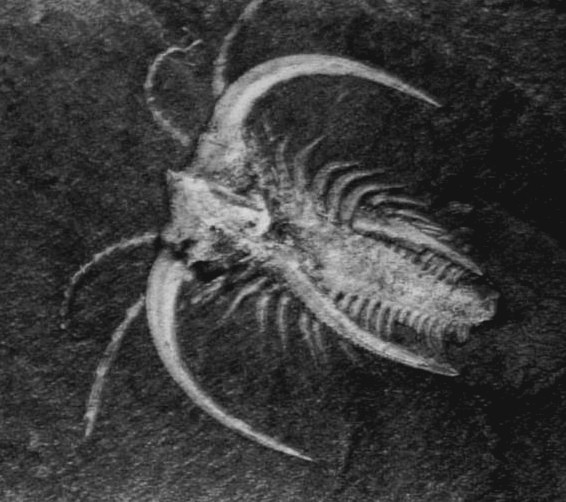
Marrella splendens is one of those fossils that arrives in the mind too quickly.[1][2][3] The long swept head spines make it memorable at a glance, and that glance can do real damage. It invites the wrong reading order: first the ornamental outline, then the label "weird Cambrian arthropod," and only afterward the harder question of why this animal mattered so much to paleontology. The better close reading reverses that sequence. Marrella became scientifically consequential not because it was picturesque, but because repeated specimens let paleontologists move past silhouette and into appendages, segments, preservation, and even behaviour.[1][2][4][5]
That is why this fossil still deserves attention in 2026. The Burgess Shale is full of animals that readers remember as icons of strangeness. Marrella helped force a more disciplined method. Its superficial trilobite-like look was not enough. Once the limbs, head appendages, body segmentation, and moulting evidence entered the picture, the fossil stopped being a decorative representative of the Cambrian Explosion and became something stricter: a warning that Burgess animals had to be classified and interpreted from preserved anatomy, not from resemblance at first sight.[1][2][3]
Image context: the lead image uses a real photographed Marrella fossil from Wikimedia Commons. It suits this article because the specimen keeps the main argument honest. The head shield is the first thing the eye catches, but the body beneath it is what changes the interpretation.[6]
1) The head shield made Marrella famous, but it also made early readings too easy
The first reason to read Marrella closely is historical. The Burgess Shale primer notes that early work at Walcott Quarry had already brought Marrella into view, and later quarry language preserved that prominence in the name of the "Great Marrella layer."[3] The animal was visually distinctive enough to become a marker inside the deposit. That prominence, however, did not automatically make it well understood. Distinctive outline and correct classification are not the same achievement.
The Royal Ontario Museum's Burgess Shale page is useful because it keeps both sides of that story visible.[2] Marrella is abundant, famous, and easy to recognize, but the page also places it inside Marrellomorpha rather than treating it as a trilobite cousin that can be settled by a casual glance.[2] That is the deeper lesson. The head shield with its long posterior and lateral spines made the animal legible to collectors and museum audiences. It did not, by itself, solve the anatomy. The fossil became important precisely because later work refused to let the silhouette stand in for the body.
That boundary still matters. Cambrian arthropods often get marketed through the one feature that fits on a poster: five eyes, a frontal claw, a shield, a nozzle, a crest. Marrella shows why that habit is weak. A memorable dorsal profile can launch scientific attention, but it cannot finish the job.
2) The limbs are what turned Marrella from an emblem into an argument
The sharpest reset came from specimen volume and anatomical patience. García-Bellido and Collins studied more than 1,000 specimens from a ROM collection of over 9,000 individuals and showed that Marrella preserved much more than an eccentric shell.[1] Their 2006 paper separates parts of the internal anatomy, expands the known size range to 2.4 to 24.5 mm, and documents an almost complete ontogenetic series from small individuals with 17 body segments to large ones with more than 26.[1] That matters because it turns Marrella into a growth problem as well as a shape problem. The animal is no longer a single famous body plan frozen at one scale.
Even more important, the paper reinterprets the second pair of so-called "antennae" as swimming appendages.[1] That is exactly the kind of evidentiary shift the Burgess Shale repeatedly demands. A structure that looks like a decorative forward extension in a flattening museum glance becomes, under closer anatomical reading, part of locomotor function. The five distal segments were interpreted as dorsoventrally compressed, fringed with setae, and supplied in a way that makes better sense for propulsion than for simple feeler-like display.[1]
This is the real reason Marrella matters. The fossil did not merely add one more strange arthropod to the Cambrian shelf. It made paleontologists earn every claim by reading underneath the shield. Once appendages and segment counts took priority over silhouette, the animal stopped being a curiosity and became a methodological correction.
3) The fossil is strongest when abundance stays attached to field context
One temptation with famous Burgess animals is to treat abundance as a synonym for ecological dominance or scientific simplicity. The evidence is narrower and better than that. The ROM primer repeatedly ties Marrella to the Great Marrella layer and to specific bed and quarry contexts inside the Burgess Shale succession.[3] The name itself is a reminder that abundance is stratigraphic before it is mythic. Some horizons are visibly rich in Marrella; that does not mean the whole formation was a single undifferentiated Marrella world.
The 2006 paper sharpens that point by extending the geographic distribution of the taxon 13 km to the southeast and its stratigraphic range through the lowest five members of the Burgess Shale Formation.[1] That is a stronger claim than simple local commonness. It shows recurrence across space and section, which is why Marrella became so useful for anatomy and growth. At the same time, the primer's field emphasis prevents overreach: a named layer, a quarry face, and a particular style of mudstone still matter to what sort of Marrella evidence survives.[3]
So the right reading is not "there were a lot of these things." The right reading is that repeated occurrence, tied to specific field horizons, created the sample size that let paleontologists stop arguing from one charismatic slab. In paleontology, abundance only becomes knowledge when locality and bed remain attached.
4) The moult is what made Marrella behavioural evidence
The rarest and most clarifying piece of the stack is the moult. In 2004, García-Bellido and Collins described a Marrella specimen preserved in the act of moulting, which Nature presented as the oldest known fossil of an arthropod caught in exuviation.[4] That does not simply add drama to an already famous fossil. It changes the type of claim the animal can support. Marrella is no longer only a body plan preserved on shale. It becomes direct evidence that a very early euarthropod lineage was shedding its exoskeleton in a recognizable arthropod way.[4]
The importance of that specimen becomes even sharper when set against later work on marrellomorph moulting. A 2023 Frontiers paper on a marrellid from the Fezouata Shale called the Moroccan material only the second ever reconstruction of marrellid moulting behaviour and explicitly treated the Burgess Marrella as the earlier benchmark.[5] In other words, this is not one charming anecdote in an overstuffed literature. The behavioural evidence is genuinely rare.
That rarity is why the article's thesis has to keep all three elements together. The head shield explains fame. The limbs explain classification and function. The moult explains why Marrella became more than anatomy. Read together, they produce the strongest close reading available in 2026: a Burgess fossil that taught paleontologists to distrust poster silhouettes, trust preserved appendages, and recognize that even behaviour can enter the record when preservation is improbably exact.[1][2][4][5]
Sources
- Diego C. García-Bellido and Desmond H. Collins, "A new study of Marrella splendens (Arthropoda, Marrellomorpha) from the Middle Cambrian Burgess Shale, British Columbia, Canada," Canadian Journal of Earth Sciences 43, no. 6 (2006).
- Royal Ontario Museum, "Marrella splendens" on The Burgess Shale site.
- Jean-Bernard Caron and Dave Rudkin, eds., A Burgess Shale Primer: History, Geology, and Research Highlights (ICCE 2009 field-trip companion volume).
- Diego C. García-Bellido and Desmond H. Collins, "Moulting arthropod caught in the act," Nature 429 (2004).
- Luke A. Parry et al., "Novel marrellomorph moulting behaviour preserved in the Lower Ordovician Fezouata Shale, Morocco," Frontiers in Ecology and Evolution 11 (2023).
- Wikimedia Commons file page for the photographed Marrella fossil used as the lead image.